A toddler who puts a toy “in the box” when asked may seem to have mastered the word in. But change the objects, remove the pointing gesture, or ask the child to explain where something is, and the same concept may suddenly become harder.
That distinction matters in spatial concepts language development. Children do not simply memorize location words and then permanently understand them. They gradually learn that words such as in, on, under, and behind describe relationships that remain meaningful across different objects, viewpoints, rooms, and situations.
Location Words Develop From Concrete Relationships
Spatial words describe how one thing relates to another. A spoon can be in a cup, a book can be on a table, a ball can roll under a chair, and a child can hide behind a curtain.
Some of these relationships emerge earlier than others. Research on spatial language has found that words corresponding to in and on appear relatively early, while terms such as under, behind, and later left and right follow more gradually.
Current communication milestones for ages 3 to 4 include understanding and using more location words such as inside, on, and under. That age range is useful context, but it should not become a rigid deadline.
Children vary, and understanding one familiar location word does not mean every spatial relationship has been mastered.
Spatial Concepts Language Development Is More Than Following a Routine
Parents often discover what appears to be spatial understanding during repeated routines.
“Put your shoes under the bench.”
“Put your cup on the table.”
“Get the blocks in the basket.”
A child may perform these tasks accurately because the entire routine is familiar. They know where shoes normally go or have seen the cup placed on that table dozens of times.
That is routine-based success, which is valuable but different from flexible understanding.
A stronger test is whether the same word works when everything else changes. Can the child put a toy dinosaur under a pillow? Can they find a spoon under a towel? Can they tell you where the missing car is without copying what they have done before?
Spatial knowledge becomes more meaningful when the child can transfer the relationship.
| Spatial Concept | Simple Example | More Flexible Test |
|---|---|---|
| In | Put the block in the box | Put the spoon in a shoe |
| On | Put the cup on the table | Put the toy on your head |
| Under | Find the ball under the chair | Hide the bear under a blanket |
| Behind | Stand behind the door | Put the car behind the book |
| In front of | Stand in front of me | Put the doll in front of the box |
Changing the objects helps reveal whether the child understands the word itself rather than merely remembering a familiar action.
Play Makes Invisible Relationships Easier to See
Spatial language is unusually well suited to physical play because children can see and feel the relationship that the word describes.
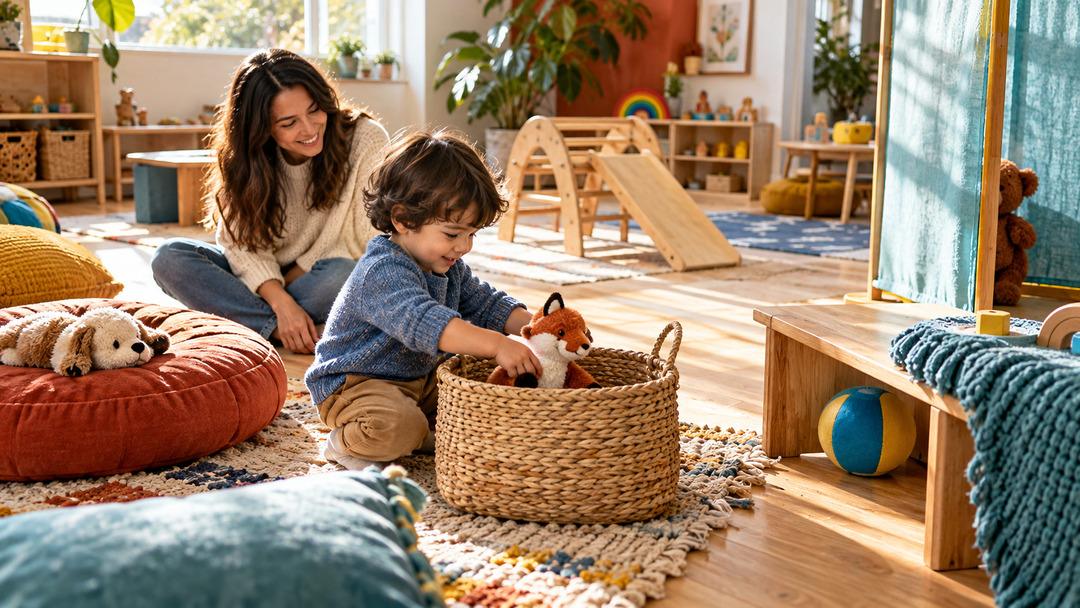
A parent can place a stuffed animal inside a basket, balance it on a cushion, hide it under a blanket, and move it behind a chair. The language is tied immediately to an observable change.
That connection can be more useful than repeatedly asking, “Where is the bear?”
Try narrating first: “The bear is under the blanket.” Then move it: “Now the bear is on the blanket.” Later, let the child direct the adult.
Obstacle courses provide another natural opportunity. “Crawl under the table,” “stand behind the chair,” and “put the beanbag in the basket” connect words with body movement. Families who want to expand this kind of practice can also use following directions games for kids to combine location concepts with listening and memory.
The goal is meaningful repetition across contexts, not drilling the same flashcard response.
Behind and In Front Can Be Harder Than They Look
Not all spatial relationships place the same demands on a child.
In often involves a highly visible containment relationship. On usually involves contact or support. Words such as behind and in front of can become more complicated because perspective and the characteristics of the objects matter.
A car has an obvious front. So does a person. A plain box may not.
Research examining spatial categories from in and on through behind, above, below, left, and right has found that children’s understanding becomes increasingly flexible over time. Children can move from recognizing familiar examples to identifying the same relationship in less typical arrangements. The research on spatial category development demonstrates why knowing a word in one obvious setup is not equivalent to broad conceptual mastery.
That is an overlooked part of learning location language: generalization is a developmental achievement.
Watch for Transfer, Not Perfect Performance
A missed direction does not automatically mean a child lacks the spatial concept.
The child may have lost attention, forgotten part of a sentence, misunderstood another word, or become distracted by the environment. A direction such as “Put the little red truck behind the chair after you pick up the ball” measures far more than understanding behind.
To see what the child actually knows, simplify the task.
Use one familiar object. Give one short direction. Avoid gestures that reveal the answer. Then try the same concept again with different objects or in another room.
Parents can also watch whether understanding moves in both directions. Can the child follow “Put the bear under the table”? Can they answer “Where is the bear?” Can they use under spontaneously while playing?
Flexible use is stronger evidence than one correct response.
Persistent Confusion Is More Useful Than a Single Mistake
The next signal to watch is not whether a preschooler occasionally mixes up two location words. Mistakes are expected while concepts are still being refined.
More useful questions concern the broader pattern. Does the child understand simple directions involving familiar vocabulary? Are new location concepts gradually becoming easier? Can they apply familiar words to new objects and places?
If difficulty with spatial words occurs alongside broader trouble understanding everyday language, following simple directions, learning new vocabulary, or communicating needs, parents may want to discuss the pattern with a pediatrician or speech-language pathologist.
Loss of previously used skills also deserves attention rather than waiting for a specific spatial-language milestone.
Real Understanding Means the Word Travels With the Child
Learning under is not simply learning that shoes belong under one particular bench. The concept becomes powerful when the child can recognize under beneath a table, blanket, bridge, playground structure, or unfamiliar object.
That transfer is the central story of spatial concepts language development. Everyday play gives children repeated opportunities to connect language with real relationships, while changing the objects and setting helps reveal whether the meaning has become flexible.
Parents do not need to turn location words into a test. They can make the relationships visible, model the language clearly, and notice whether understanding gradually travels from one familiar routine into the wider world.
Frequently asked questions
At what age do children understand in, on, and under?
Many location concepts develop during the toddler and preschool years. By ages 3 to 4, understanding and using words such as inside, on, and under are among established communication milestones, although development varies.
Why can my child follow a location direction at home but not somewhere else?
Familiar routines provide clues beyond language. A child may know where an object normally belongs without fully understanding the location word. Changing the objects and setting can reveal whether the concept transfers.
Which spatial words are usually harder for children?
Concepts such as behind, in front of, beside, left, and right can be more difficult because they may depend on perspective, orientation, and relationships between multiple objects.
How can parents practice spatial concepts at home?
Use ordinary play and routines. Hide toys under blankets, place objects inside containers, move items behind furniture, or give simple directions that use one location word at a time.
When should difficulty with location words be a concern?
Consider professional guidance when confusion with spatial words appears alongside broader difficulty understanding simple directions, learning vocabulary, communicating needs, or when previously acquired language skills are lost.