Strong early reading does not begin only with letters on a page. It also grows from oral language skills: the words children hear, the questions they answer, the explanations they try, and the stories they learn to retell. For families and educators, the most useful approach is not to turn every book into a test. It is to create frequent, warm, language-rich interactions that help children connect spoken language with meaning.
The evidence base for shared reading is encouraging, but it is not uniform. Some studies show gains in specific language outcomes, while broader reviews report mixed effects across reading and language measures. That means adults can use shared reading confidently as one helpful practice, while staying cautious about claims that one routine will raise every literacy skill for every child.
Why Oral Language Skills Support Early Reading
Oral Language Skills Start Before Print
Before children read independently, they are already learning how language works. They hear how sentences fit together, how stories move from problem to solution, and how words can describe ideas that are not directly in front of them. These abilities matter because early literacy is not just word calling. Children also need to understand, remember, explain, and infer.
For a preschool child, a book about a lost puppy can support many layers of language. A child may label the puppy, answer where it went, predict what might happen, and explain why a character feels worried. Each of those responses gives an adult information about comprehension, vocabulary, sentence use, and narrative understanding. These observations are especially useful in speech milestones work because they focus on communication in context rather than isolated performance.
What Shared Reading Can And Cannot Do
Shared reading is often recommended, and for good reason, but the research is measured. A 2025 What Works Clearinghouse report on shared book reading found mixed effects on comprehension and language development, with no discernible effects on alphabetics and general reading achievement in the reviewed evidence WWC shared book reading review. This does not mean shared reading has little value. It means the outcome depends on what adults do during reading, which children are included, how long the support lasts, and which skills are measured.
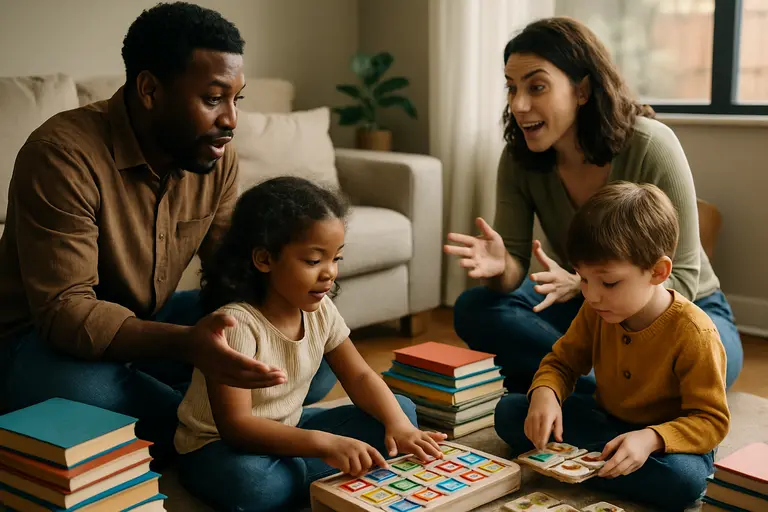
For parents and teachers, this is a helpful distinction. Reading aloud is valuable for closeness and exposure to language, but language growth often needs active interaction. Children benefit from chances to respond, ask, compare, retell, and connect story events to their own experiences. A quiet read-aloud may be calming; an interactive read-aloud can create more opportunities for expressive language.
What Evidence Says About Shared Book Reading
Stronger Support In Targeted Sessions
Some of the clearest language gains appear in more structured or targeted work. In an 8-week one-on-one book-sharing intervention with Head Start preschoolers with language impairments, children received twice-weekly 15-minute sessions, and the study reported medium to large effects on literal and inferential language skills scripted book-sharing study. This finding supports a practical point: for children with language concerns, the adult’s plan during the book may matter as much as the book itself.
Literal language includes details the child can find directly in the story, such as who was there or what happened first. Inferential language asks the child to go beyond the page, such as explaining why a character acted a certain way or what might happen next. Both are useful. Literal questions help children organize facts; inferential prompts help them connect facts into meaning.
Mixed Results In Broad Programs
Research described in the provided evidence also includes broader classroom and home-based interventions. Some whole-class programs show small positive effects on oral language measures, while more intensive or targeted programs may show larger gains. Other work shows that shared reading can improve attitudes toward reading without producing clear literacy gains. This pattern should keep expectations realistic.
A small effect in a large classroom is not failure. It may mean that many children received a light level of support. A larger effect in a one-on-one or small-group program may reflect more chances for the child to speak and receive responsive feedback. For children who are delayed, bilingual, shy, or still learning classroom routines, the amount and quality of adult-child talk can change how useful the activity becomes.
Practical Routines For Home And Preschool
Ask Questions That Invite Thinking
Questions work best when they invite children to use language, not when they interrupt every page. A useful rhythm is to read a little, pause, ask, listen, and respond. If the child gives a short answer, the adult can expand it without demanding repetition. For example, if the child says, “dog sad,” the adult might say, “Yes, the dog looks sad because he cannot find his friend.”
Adults can rotate the kinds of prompts they use so children are not always answering the same type of question. This keeps the interaction natural while supporting different parts of language.
- Labeling: “What is this animal called?”
- Action: “What is the child doing?”
- Prediction: “What do you think will happen next?”
- Explanation: “Why did she hide the toy?”
- Connection: “Have we ever seen a place like this?”
Keep Vocabulary And Comprehension Together
Vocabulary teaching is stronger when words are tied to meaning. If a story uses the word “enormous,” the adult can point to the picture, explain that it means very big, compare it with a familiar object, and then use it later: “That truck outside was enormous.” This gives the child more than a definition. It gives the word a place in memory.
Comprehension also needs more than correct answers. A child may know many words but still struggle to explain a story sequence. Another child may retell events clearly but need help with precise vocabulary. Adults can listen for both. During book reading, a balanced routine might include a new word, a story question, a prediction, and a brief retell at the end.
Families looking for connected home ideas can also use bilingual language activities that pair clear goals with everyday routines. The key is not to make home feel like school. It is to use meals, walks, play, and bedtime books as natural times for conversation.
Support For Bilingual Children
Use Both Languages With Clear Purpose
Bilingual children may show what they know across two languages. A child might understand a story in one language, retell part of it in another, or use vocabulary from both. That pattern should not be treated automatically as confusion. The evidence provided for this article includes research on shared book reading with English additional language learners showing positive combined language and literacy effects, but the size and meaning of those effects depend on the studies included and the intervention methods used.
For bilingual families, oral language skills can be supported in the language adults use most comfortably. A parent who tells a fuller story in Spanish, Arabic, Somali, Mandarin, or another home language may give the child stronger models than a parent trying to use limited English. Teachers can invite children to explain what a word means in the home language, compare story events across languages, or bring home a simple retell prompt for families.
Books can also become a bridge to culture, memory, and curiosity about words. Families who enjoy language history may find interest in Old Norse News, a related site within this network. While not included in the evidence base discussed here, it illustrates how stories and languages connect across eras.
For children with suspected speech or language delays, bilingualism should not be blamed without a careful look at the child’s communication in each language. A child’s strongest language, exposure history, hearing, classroom context, and opportunities to speak all matter. Families should seek a qualified speech-language evaluation when concerns persist, especially if the child has difficulty understanding, using words, combining ideas, or participating in age-appropriate interaction across settings.
Oral Language Skills For Early Readers
The most practical message is simple: shared reading helps most when it becomes shared thinking. Adults can name new words, ask genuine questions, wait for the child to respond, expand short answers, and return to story ideas after the book is closed. These steps are small, but they give children repeated practice with the language demands that later reading will place on them.
Oral language skills should be observed over time rather than judged from one reading session. Some children answer quickly; others need silence, repetition, gesture, or a familiar adult. Some children show understanding through pointing before they can explain in full sentences. In bilingual children, knowledge may be distributed across languages. These differences do not remove the need for support; they remind adults to interpret communication carefully.
Evidence supports interactive reading, vocabulary work, and comprehension talk as reasonable early literacy practices, while also showing that effects vary. A supportive plan does not promise instant reading success. It gives children more chances to hear meaningful language, use it with responsive adults, and connect spoken words with stories, ideas, and relationships.