The evidence on bilingual preschool vocabulary after COVID-19 disruptions is not simple. Some studies found that reduced English exposure was linked with weaker English receptive vocabulary, while other studies found bilingual children made age-adjusted English vocabulary gains during the first year of the pandemic. For families, the useful message is not panic. It is that language exposure, home reading, preschool access, and family resources all shaped children’s outcomes in different ways.
What COVID Disruptions Showed About Bilingual Preschool Vocabulary
Why Bilingual Preschool Vocabulary Results Look Mixed
Several findings point in different directions, and that matters. A small study of Spanish-English children who were roughly 18 to 60 months old around the first acute wave of COVID-19, ending June 1, 2021, reported that more Spanish exposure at home and less English exposure were linked with lower English receptive vocabulary scores. In that sample of 28 children, English vocabulary scores were negatively associated with age during the pandemic, while Spanish vocabulary showed no evidence of disruption.
That does not mean Spanish exposure harmed English. The more careful reading is that children had fewer chances to hear and use English in settings that had previously supplied it, such as childcare, preschool, community activities, and contact with English-speaking peers. For many bilingual children, home language exposure protected Spanish while English opportunities temporarily narrowed.
Other research found a different pattern. A U.S. study comparing children before the pandemic, from May to October 2019, with children one year into the pandemic, from December 2020 to July 2021, found that Spanish-English and Chinese-English bilingual children made significant age-adjusted gains in English vocabulary and closed a pre-pandemic vocabulary gap with monolingual English-speaking peers. The same study found weaker reading comprehension growth, including about a 3.92 standard-point loss in reading comprehension growth for Spanish-English bilingual children relative to age norms, and slower growth of about 2.19 standard points for Chinese-English bilingual children that was not statistically significant, according to the U.S. bilingual vocabulary study.
Vocabulary And Reading Did Not Move Together
One practical lesson is that vocabulary and reading comprehension can respond differently to disruption. A child may learn more English words through media, siblings, adults at home, or remote activities, yet still miss the structured experiences that support comprehension: shared discussion, classroom routines, story retelling, print concepts, and guided interaction with books.
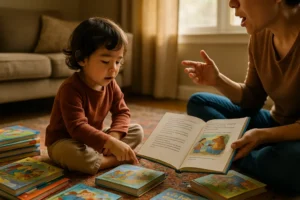
The U.S. study also reported that independent reading at home predicted both vocabulary and reading comprehension outcomes, beyond children’s pre-pandemic skills and socioeconomic status. For preschoolers, “independent reading” may look different from older children’s reading. It can include looking through familiar picture books, retelling stories from memory, naming objects, asking questions, or pretending to read after repeated adult sharing.
Why English Exposure Changed During Closures
Preschool And Community Input Became Less Predictable
For many bilingual preschoolers, English is not evenly distributed across the day. A child may hear Spanish, Mandarin, Arabic, Vietnamese, Haitian Creole, or another family language at home, then hear more English at preschool, childcare, libraries, playgrounds, therapy sessions, or community programs. During pandemic closures and reduced attendance, those English-rich settings became less available or less predictable.
This helps explain why bilingual preschool vocabulary findings can vary by family. A child who continued attending an English-speaking program may have had more stable English input than a child whose preschool closed. A child with older siblings using English at home may have heard more English than a child whose household used only the heritage language. None of these patterns reflect family failure; they reflect unequal access to language environments during a public health disruption.
For a related discussion of how less English input can affect word learning, families may find this article on reduced English exposure useful.
Socioeconomic Status Shaped Risk
Socioeconomic status also mattered in the available research. A Canadian study of 539 infants and toddlers ages 11 to 34 months compared vocabulary growth during the pandemic with pre-pandemic norms. It found that lower-income children ages 19 to 29 months showed significantly reduced vocabulary growth, while children from middle- and high-income families showed no measurable change, according to the Canadian infant-toddler study.
This finding does not tell us exactly what happened in every bilingual preschool household. It does support a cautious point: pandemic language effects were not evenly shared. Families with more stable childcare, flexible work, books, quiet space, broadband access, and time for conversation may have been better able to buffer disruption. Families under financial pressure may have had fewer options, even when caregivers were deeply committed to their children’s language growth.
What Families Can Do With The Evidence
Rebuilding Bilingual Preschool Vocabulary Without Dropping The Home Language
Parents sometimes hear that they should reduce the home language to protect English. The research above does not support that as a general recommendation. In the small Spanish-English study, Spanish vocabulary appeared protected when Spanish exposure increased. The issue was reduced English opportunity, not the presence of Spanish.
A better goal is to rebuild English access while keeping the family language active. For bilingual preschool vocabulary, that may mean pairing predictable English input with warm, meaningful interaction: preschool attendance when available, story time, playdates, songs, library books, and conversation with trusted English-speaking adults. It may also mean continuing Spanish or another home language through meals, stories, family calls, pretend play, and cultural routines.
Families can use a simple weekly rhythm rather than a strict language schedule:
- Read in both languages. Use whichever language lets the adult explain, laugh, ask questions, and connect the story to the child’s life.
- Repeat favorite books. Repetition helps children hear words again in a meaningful context.
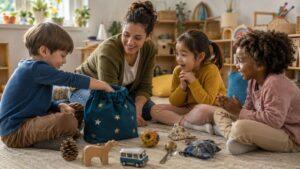
- Name, expand, and wait. If the child says “dog,” an adult might say, “Yes, the brown dog is running,” then pause.
- Protect conversation time. Short, responsive exchanges during meals, dressing, cleanup, and play can give children useful practice.
- Coordinate with preschool. Ask teachers which English words and story themes are being used so families can reinforce them at home.
Picture supports can help some children talk about people, places, and routines. For those interested in creating effective visual aids, Finest Image offers excellent guidance on selecting clear images. The real benefit for language growth, however, comes from the interaction and shared conversations around these images.
What To Watch In Everyday Communication
Parents do not need to measure every word. More useful signs include whether the child understands familiar directions, learns new labels, uses words across settings, asks for help, comments during play, retells parts of stories, and tries words in both languages. A bilingual child may know some words in one language and different words in the other. That split knowledge is common in bilingual development and can make single-language testing hard to interpret.
If a child lost English exposure during closures, progress may appear first in comprehension. The child may follow classroom routines, point to named objects, or understand story events before using many English words aloud. Expressive vocabulary can take more time, especially for children who are cautious speakers in group settings.
Limits Of The Pandemic Vocabulary Research

Small Samples And Different Measures Matter
The evidence base has limits. Some studies used small samples, including the Spanish-English study of 28 children. Studies also differed in age range, language pairs, country, timing, socioeconomic context, and whether vocabulary was measured receptively, expressively, or through broader literacy tasks. These differences make it risky to claim one single pandemic effect for all bilingual preschoolers.
Some research in dual immersion settings found no significant cohort differences between fall 2019 and fall 2020 on English or Spanish vocabulary, phonological awareness, decoding, or reading comprehension, although the pandemic cohort had reduced Spanish reading at home. Research from Germany with primary school children found that existing receptive vocabulary gaps between monolingual and bilingual children did not widen during school closures, and bilingual children showed a slight catch-up effect in German receptive vocabulary. Those findings remind us that children’s outcomes depended on context.
Assessment Should Be Interpreted Carefully
A low English score after disrupted preschool access may reflect reduced English input rather than a language disorder. At the same time, real language concerns should not be dismissed simply because a child is bilingual or because the pandemic occurred. If caregivers are worried about understanding, expression, social communication, or regression across both languages, a bilingual-informed speech-language evaluation can help clarify what support is needed.
Good assessment asks about both languages, daily exposure, hearing history, preschool attendance, family concerns, and the child’s ability to learn when given support. A single English vocabulary score is only one piece of the picture.
Bilingual Preschool Vocabulary After Disruptions
The most grounded takeaway is that bilingual preschool vocabulary after pandemic disruption was shaped by opportunity. Some children had less English input and showed weaker English receptive vocabulary. Some bilingual groups gained English vocabulary but lagged in reading comprehension growth. Lower-income toddlers in one Canadian study showed reduced vocabulary growth, while middle- and high-income peers did not show measurable change.
For families, the response should be steady and supportive: keep the home language strong, rebuild English exposure through meaningful interaction, read often, and work with preschool staff when possible. Children do not need pressure to abandon one language for another. They need frequent chances to understand, use, and enjoy both languages with people who respond to what they are trying to say.