For bilingual children, parent self-reporting can give speech-language pathologists, educators, and families information that a short clinic or school assessment may miss. Parents often know which language a child hears at home, which relatives use each language, whether the child answers in one language or both, and how communication changes across routines. Those observations are not a replacement for direct assessment, but recent research supports using parent report as one part of a fuller bilingual profile.
The clearest message for families is practical: a parent report is most useful when it describes real communication, not when it tries to prove that a child is “equally bilingual.” Bilingual development is shaped by exposure, opportunity, age, school language, family language practices, and the child’s own needs. A report form works best when it helps adults see those influences clearly.
What Parent Self-Reporting Can Add
Parent Self-Reporting Captures Daily Language Use
Parent self-reporting can document language experience across places and people. A child may use Spanish with grandparents, English at preschool, a mix of both with siblings, and gestures or short phrases during tired moments. A standardized test in one language may not show that full pattern.
A 2026 meta-analysis in Pediatric Research reported that parent-report instruments for children ages 0–6 showed pooled sensitivity of 0.81 and specificity of 0.83 for identifying speech and language disorders. The same analysis found that bilingualism, defined as exposure to more than one language, did not significantly change diagnostic accuracy in the studies reviewed Pediatric Research meta-analysis. That does not mean every questionnaire is equally accurate, or that a parent form can diagnose a child by itself. It does suggest that parent report can be a meaningful source of information when tools are selected and interpreted carefully.
Recent bilingual research also points in the same direction. A 2025 pilot study of 30 bilingual children ages 3;0–5;0 found that parent-reported English exposure, understanding proficiency, and speaking proficiency predicted children’s scores on standardized English vocabulary and morphosyntax measures listed in the research notes. Because the study was small, it should be read as early evidence rather than a universal rule. Still, it supports a common clinical practice: asking families about both exposure and functional skill, not only about which language is spoken at home.
Reports Can Reveal Context That Tests Miss
Parent reports are especially helpful when they ask specific questions. “Does your child speak Spanish?” is less useful than “Who speaks Spanish with your child during meals, play, bedtime, and family visits?” A child may understand a language well but speak it less often because the environment does not require it, because one caregiver understands both languages, or because school language has become dominant.
For parent-friendly activity ideas that connect language observations with story routines, families may find bilingual narrative skills resources useful. Story retells, open questions, and book conversations can give parents more concrete examples to report during language check-ins.
Why Accuracy Depends On The Parent’s Own Language Profile
Self-Ratings Can Be Influenced By Parent Proficiency
Parent self-reporting is not free from bias. The research notes include a 2025 study showing that parents’ own proficiency in a language influenced how they reported bilingual children’s vocabulary in that language. Parents with limited proficiency may underestimate what a child understands or says. This limitation is not a reason to dismiss parent input. It is a reason to ask follow-up questions and, when possible, gather information from more than one adult or setting.
For example, a parent who is more comfortable in English may miss some of a child’s Spanish vocabulary used with another caregiver. A parent who strongly values bilingualism may notice every new word in the home language but have less information about classroom language. Both patterns are understandable. Good reporting tools make room for uncertainty by asking who observed the skill, where it happened, and how often it occurs.
Families May Need Permission To Report Mixed Skills
Parents sometimes worry that reporting uneven language skills will make bilingualism look like the problem. Research on Spanish-English bilingualism and neurodevelopmental disability shows why supportive interpretation matters. In a survey of 84 Spanish-speaking parents of children ages 4–24, 95% of families without neurodevelopmental disabilities wanted bilingualism for their children. In the group with neurodevelopmental disabilities, 17.1% raised their children as English monolinguals, often linked in the study to professional or community discouragement Spanish-English bilingualism survey.
The same study reported that nearly all parents in the neurotypical group said their child could understand and speak both English and Spanish. In the neurodevelopmental disability group, 88.6% understood both languages, while 52.3% communicated in both languages. These findings do not tell any one family what language choice is best. They do show that family decisions can be affected by the messages they receive from professionals and community members.
Combining Parent, Child, And School Information
Different Reporters Answer Different Questions
A strong bilingual profile usually combines several sources. Parents can describe exposure and home routines. Children, when developmentally able, can share how they view their own language use. Teachers can describe participation in classroom language tasks. Direct measures can show how a child performs on specific vocabulary, grammar, narrative, or comprehension tasks.
A 2026 school-based study in the research notes found a large difference in response completion: child self-report administered directly had a 92.9% response rate, while parent questionnaires sent home had a 31.0% response rate. That finding does not make child report “better” in every way. It shows that data collection methods affect whose voices are included. If parent forms are long, sent only in one language, or hard to return, families may be underrepresented even when their knowledge is highly relevant.
The same 2026 study reported moderate to large correlations between child and parent reports for bilingual experience and proficiency. It also found that grade level predicted self-reported proficiency patterns: as grade increased, self-reported English proficiency tended to rise, while Spanish proficiency tended to decline when parent report was held constant. This pattern should be interpreted carefully, but it reminds teams to revisit bilingual profiles over time rather than relying on a single early snapshot.
A Simple Planning Table For Teams
| Information Source | What It Can Show | Limit To Remember |
|---|---|---|
| Parent report | Home language routines, exposure, family communication patterns | May be affected by parent proficiency and recall |
| Child report | How the child describes language use and comfort | May depend on age, confidence, and question format |
| Teacher input | Classroom participation and instructional language demands | May not reflect home-language strengths |
| Direct measures | Performance on specific speech, language, or literacy tasks | May be limited by language match and test norms |
Making Parent Reports More Useful
Ask About Routines, Not Just Percentages
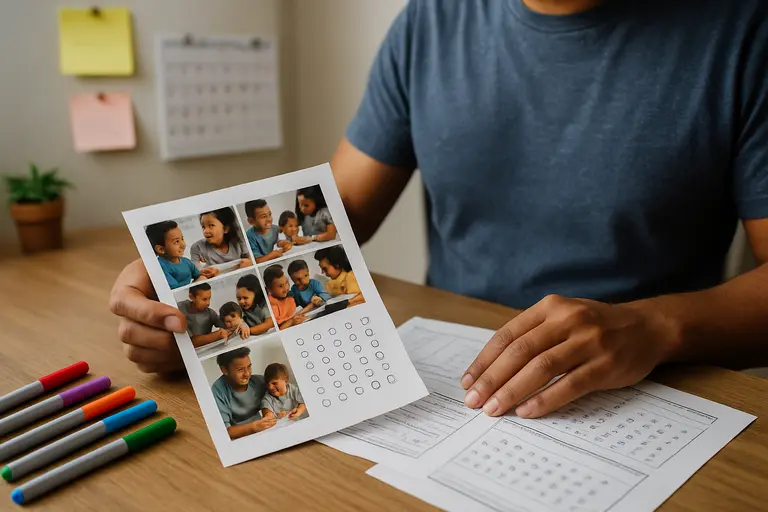
Parent self-reporting becomes more informative when questions are concrete. Instead of asking families to estimate exact percentages of language input, teams can ask about morning routines, meals, play, reading, media, sibling talk, and extended family visits. Percentages can be difficult to calculate, especially in homes where speakers switch languages naturally.
Useful questions may include: Who speaks each language with the child? Which language does the child use to request, protest, explain, joke, and tell stories? Does the child understand more than they say? Has language use changed after starting school? Are there people with whom the child communicates more easily?
For families who use books and print activities to support language, related children’s publishing resources at Leap Year Publishing may offer ideas for keeping reading part of everyday interaction. Any resource should still be matched to the child’s age, interests, language access, and communication needs.
Reduce Barriers To Family Participation
Low response rates can distort what teams know about bilingual children. A family may not return a form because it is too long, uses unfamiliar terms, arrives in the wrong language, or competes with work and caregiving demands. Shorter forms, translated materials, interpreter support, phone options, and flexible return methods may improve participation, though each setting needs to track what actually works for its families.
Families also deserve to know how their answers will be used. A parent questionnaire should not feel like a test of parenting choices. It should help the team understand the child’s real communication opportunities and decide whether more information is needed.
Parent Self-Reporting In Bilingual Proficiency Decisions
Parent self-reporting is strongest when it is treated as evidence from daily life, not as a stand-alone verdict. It can support bilingual proficiency assessment by showing exposure, opportunities to use each language, changes across development, and skills that may not appear during a short evaluation.
At the same time, limitations need to stay visible. Parent proficiency, questionnaire design, response rates, and professional interpretation can all affect the quality of the information gathered. For bilingual children, especially those with developmental disabilities or suspected speech-language concerns, the fairest approach is to combine parent report with child input when appropriate, teacher observations, and direct measures in the languages relevant to the child.
The goal is not to rank one language over another. The goal is to understand how the child communicates, where support is needed, and how adults can protect meaningful access to family, learning, and relationships.