Overhearable Speech is part of many toddlers’ daily language experience, especially in busy homes where adults and older children talk around a young child. A study published on September 22, 2026, reported that speech not directed to the child made up more than half of typical English-learning toddlers’ total language exposure, but the study also found an age-related pattern: 24- and 30-month-olds recognized words that were often overheard, while 18-month-olds did not show the same pattern as a group PubMed record.
For families, the practical message is balanced. Talk happening around a toddler is not meaningless background noise. Still, it should not replace responsive, child-directed conversation. The research available so far suggests that toddlers appear better able to use overheard words as they get older, and that younger toddlers may need more direct support to connect words with meaning.
What Overhearable Speech Shows After Age Two
The 2026 study focused on English-learning toddlers tested at 18, 24, and 30 months. Researchers examined recognition of “high-overheardness” words, meaning words the child was more likely to hear in speech around them than in speech addressed directly to them. The finding was not that every toddler learns equally well from overhearing. Instead, the pattern changed with age.
Overhearable Speech And Vocabulary Differences
At 24 and 30 months, children showed recognition of high-overheardness words. At 18 months, recognition was not seen across the full group. The same study reported that 18-month-olds who later had larger vocabularies at 24 months were more likely to show recognition of overheard words and had smaller gaps between recognition of overheard and directed words.
This matters because it prevents an overly simple interpretation. A toddler who is nearly two and a half may gain more from talk happening nearby than a toddler who is a year and a half. A younger toddler with stronger early vocabulary may also use overheard input differently from a peer with a smaller vocabulary. The study does not prove that parents should increase background talk. It shows that children’s ability to use that input appears to develop over time.
What Counts As Nearby Talk
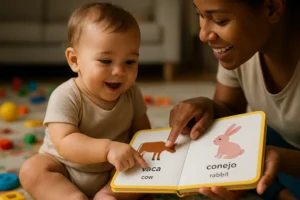
Nearby talk can include a caregiver speaking with another adult while cooking, a sibling explaining a game to a parent, or family members discussing where to put toys. The child may be physically present and may hear the words, but the message is not addressed to the child. That is different from a caregiver saying, “You found the red cup,” while looking at the toddler and responding to what the toddler is doing.
The distinction matters for language activities because toddlers are not just collecting sound. They are trying to link words to people, actions, objects, and social intentions. Direct talk often gives clearer cues: eye gaze, gestures, repetition, turn-taking, and shared attention. Overheard talk may contain useful words, but it may also be harder for a toddler to connect those words to the right meaning.
Why Directed Talk Still Deserves Priority
Evidence from other communities points in the same general direction: talk addressed to the child has shown stronger links with later vocabulary than overheard input. In a longitudinal study in a Mayan village, word types in directed speech at 24 months strongly predicted receptive vocabulary at 35 months, while overheard words did not show a significant relation Mayan village language study.
Child-Directed Words In The Mayan Study
The Mayan study is useful because it reminds readers not to assume that all families organize talk in the same way. Some communities include children in daily life with less adult-to-child speech than is common in many middle-class U.S. research samples. Even in that setting, the study found a strong relation between directed word types at 24 months and later receptive vocabulary.
That does not mean one style of family interaction is “correct” for every culture. It does mean that, in the studies available here, directly addressed language has been a clearer predictor of vocabulary outcomes than words merely heard nearby. For caregivers planning language activities, the safest evidence-based choice is to create frequent moments where the toddler is an active communication partner.
Child-directed speech does not need to be formal teaching. It can happen while washing hands, sorting socks, putting away groceries, feeding a pet, or walking to the mailbox. The key is that the adult connects words to the child’s focus and gives the child a chance to respond through sounds, gestures, words, signs, or eye contact.
Practical Language Activities At Home
Families do not need to silence ordinary household conversation. A child can still hear adult talk, sibling talk, and family routines. The goal is to pair that natural exposure with interactive language moments that help the toddler participate. Overhearable Speech may add useful exposure for some older toddlers, but direct exchanges give adults more chances to clarify meaning.
Activity Ideas That Keep Talk Addressed
Try brief, repeatable activities that fit what the child is already doing. During snack time, an adult might say, “You have apple. Crunchy apple. More apple?” During cleanup, the adult might say, “Block in. Car in. Bear in,” while handing each object to the child. These examples keep the words connected to visible actions and give the child a clear role in the exchange.
- Use routine words more than once. Repeat useful words during the same activity, such as wash, cup, shoe, open, more, and all done.
- Respond to any communication attempt. A look, reach, sound, point, sign, or word can be treated as meaningful participation.
- Pause after a short phrase. Waiting gives the toddler time to take a turn, even if the turn is not spoken.
- Connect nearby talk back to the child. If adults are discussing dinner, one person can turn to the toddler and say, “We are making soup. You see carrots.”
If your family uses more than one language, you can choose words from the language that fits the person, relationship, or routine. For more activity planning, this site’s resource on multilingual vocabulary activities offers ideas for linking words across home and learning contexts.
Families who are looking for educational resources, language activity notes, or publishing materials may find relevant content through Interline Publishing, which is part of the same network.
Limits For Bilingual And English-Learning Families
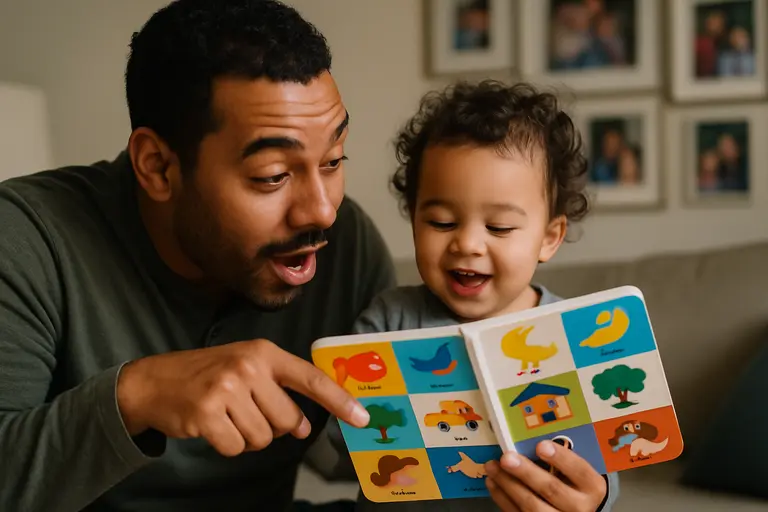
The 2026 findings were about English-learning toddlers. They should not be treated as proof that every bilingual child, every language pair, or every household pattern works the same way. Bilingual children may hear different people use different languages, and the balance of directed and nearby talk may vary across the day.
A cautious interpretation is best: Overhearable Speech may become more useful after age two for some toddlers, but the clearest practical support remains responsive interaction. For bilingual families, that can happen in either language. A grandparent may talk directly to the child in one language during meals, while a parent uses another language during bath time. The research provided here does not compare all bilingual patterns, so families should avoid reading it as a rule to use only English or only one language.
Caregivers can also watch the child rather than counting every word. Does the toddler look toward the speaker? Do they point, imitate, answer, protest, or bring an object closer? Do they seem to understand a familiar phrase in one routine but not another? These observations can help adults adjust without turning daily talk into a test.
Overhearable Speech In Toddler Language Support
Overhearable Speech belongs in the conversation about toddler vocabulary because it is a real part of many children’s language exposure. The strongest message from the research, though, is not that background talk should become a teaching strategy. It is that toddlers’ ability to benefit from nearby talk appears to change with age, and that directed speech remains especially useful for building word meaning.
For an 18-month-old, families may want to focus on short, warm, face-to-face exchanges during daily routines. For a 24- or 30-month-old, adults can still provide direct talk while also making nearby speech easier to understand by occasionally linking it back to the child’s attention. For example, after talking with another adult about rain, a caregiver might turn to the toddler and say, “Rain outside. Wet sidewalk.”
Parents do not need perfect scripts. They need repeated moments where the child is included, heard, and given time to communicate. The evidence supports a practical middle path: let normal family talk happen, but protect many small chances for the toddler to be addressed directly. That is where word learning has the clearest support in the research available so far.