Play communication skills are built in the small exchanges adults often overlook: the repeated animal sound, the pretend phone call, the pause before a child asks for help, the silly back-and-forth that turns a toy into a conversation. That matters now because many families are surrounded by apps, screens, and structured activities, yet some of the strongest language-building moments still happen on the floor, at the table, or during a messy five-minute game.
The pressure on parents can be confusing. One side says children need enrichment, lessons, and early academic exposure. The other reality is simpler but harder to trust: young children often learn communication best when they are emotionally engaged, physically involved, and given a real reason to respond.
Parents who want a practical way to notice progress without turning play into a test can use simple tools for tracking a child’s communication growth alongside everyday observation. The goal is not to score every word or overanalyze every delay. It is to recognize whether a child is gaining more ways to connect, request, protest, imitate, describe, and share attention.
Why Play Communication Skills Start Before Clear Speech
Many adults think communication begins when a child starts using recognizable words. In reality, the foundation starts earlier. A baby who looks toward a sound, reaches for a toy, copies a facial expression, or waits for a familiar game to continue is already participating in communication.
That is why play matters. It gives children a low-pressure structure for practicing attention, timing, imitation, gestures, sounds, and eventually words. A child may not say “again” at first, but they may bounce, smile, point, or hand the toy back. Those are not random behaviors. They are early attempts to keep an interaction alive.
This is where adults can either open or close the door. If the adult rushes, fills every silence, or takes control of the game, the child may have fewer chances to initiate. If the adult pauses, watches, and responds, the child gets a reason to try. The pause is powerful because it creates space for communication instead of replacing it.
Parents do not need to turn into therapists during play. They need to become better observers. What does the child look at? What do they repeat? What makes them laugh? What do they try to avoid? Those clues show where communication is already starting.
Everyday Games Give Children A Reason To Use Language
The strongest play is not always the most expensive or educational-looking. A laundry basket can become a boat. A spoon can become a microphone. A cardboard box can become a house, a cave, or a delivery truck. The value is not the object itself. The value is the interaction around it.
Children use language more naturally when play creates a problem to solve or a role to perform. A doll needs food. A toy car is stuck. A tower falls down. A pretend customer wants soup. These simple scenes invite words because something is happening that needs a response.
Adults can strengthen the moment by adding language just above the child’s current level. If a child says “car,” the adult might say, “Fast car.” If the child says “go,” the adult might say, “Go up!” If the child points without speaking, the adult can name the object and wait. The point is not to demand perfect speech. It is to model useful language inside a moment the child already cares about.
This is also why repeated games work so well. Peekaboo, rolling a ball, building and knocking down blocks, or singing a familiar action song may seem too simple, but repetition helps children predict what comes next. Once they know the pattern, they can join it.
The Adult’s Role Is To Follow, Not Perform
Many parents talk more when they worry about communication. That instinct is understandable, but more words are not always better. Children need language they can process, imitate, and use. A constant stream of adult narration may become background noise if it does not connect to what the child is doing.
The better role is responsive participation. Watch first. Join second. Add language third. If a child is lining up cars, an adult does not need to redirect the play into a lesson about colors. They can enter the child’s idea: “Car, car, car. Long road. My car goes here.” That keeps the child’s attention while expanding the communication opportunity.
Families can use public milestone resources, including the CDC’s developmental milestones, to understand broad patterns in how children play, learn, speak, act, and move. Those references are most useful when paired with everyday observation, because communication is not just a checklist. It is a living exchange.
The same principle applies to questions. Adults often ask, “What is this?” or “What color is that?” because they are trying to teach. But too many questions can make play feel like a quiz. Comments are often more useful: “The dog is sleeping,” “You made a big tower,” or “Uh-oh, the train stopped.” Comments reduce pressure while still giving the child language to absorb.
Play Turns Social Skills Into Practice
Communication is not only vocabulary. Children also need to learn how to wait, listen, repair misunderstandings, take turns, notice another person’s reaction, and adjust their message. Play gives them a safe place to practice those social rules before the stakes are higher.
Turn-taking games are especially useful because they teach rhythm. Roll the ball to me. Now I roll it to you. My turn. Your turn. That rhythm later supports conversation. A child who learns to wait for a turn in play is also learning the structure of back-and-forth interaction.
Pretend play adds another layer. When children pretend to be a doctor, parent, shopkeeper, teacher, animal, or superhero, they practice using language for roles and relationships. They are not just naming objects. They are negotiating meaning. Who gets the cup? What happens next? Is the teddy bear sick or sleeping? That kind of play strengthens imagination and social communication at the same time.
Here is a practical way to think about how different play moments support communication:
| Play Situation | Communication Skill Practiced | Adult Support That Helps |
|---|---|---|
| Rolling a ball back and forth | Turn-taking and waiting | Use short phrases like “my turn” and “your turn” |
| Pretend cooking | Vocabulary and sequencing | Narrate actions such as “stir,” “pour,” and “serve” |
| Building blocks | Requesting and problem-solving | Pause before handing over pieces |
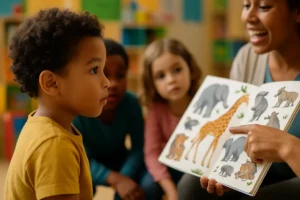
| Animal play | Sound imitation and symbolic play | Model sounds, actions, and simple phrases |
| Story-based play | Describing and answering | Add short comments about what happens next |
The point is not to schedule a perfect “communication activity.” The point is to notice that ordinary play already contains the raw material for language, listening, and social confidence.
Screens Cannot Replace Shared Attention
Screens can entertain, and some digital content can introduce songs, words, or concepts. But a screen does not respond to a child the way a person does. It does not notice confusion, wait for a gesture, copy a sound, or change the game because the child is suddenly interested in something else.
That distinction matters. Communication grows through shared attention, not passive exposure alone. A child learns more when an adult looks at the same toy, reacts to the same surprise, and helps turn the moment into language. Interaction beats instruction when the goal is real communication.
Families do not need guilt-based advice. Parents use screens for many reasons, including rest, work, travel, and household survival. The better question is whether children also get enough daily moments where a real person is listening, responding, and playing with them.
The American Speech-Language-Hearing Association’s communication milestones can help families understand age ranges and when to seek guidance. Still, milestones should not make parents panic over one quiet afternoon or one difficult week. Patterns matter more than isolated moments.
The Signals Parents Should Notice Earlier
The most useful warning signs are not only about word counts. Parents should also notice whether a child is trying to connect. Does the child look toward people during play? Do they respond to familiar voices or routines? Do they imitate sounds, gestures, or actions? Do they use any method to request help or show interest?
A child who communicates mostly through frustration may need more support in turning needs into gestures, sounds, signs, or words. A child who rarely shares attention during play may need closer observation. A child who loses skills they once had deserves prompt attention. These signs do not automatically mean something is wrong, but they do mean waiting without noticing is not a plan.
The opportunity is that play makes observation easier. Parents can see how a child communicates when relaxed, interested, and motivated. That is often more revealing than asking a child to perform on command.
Strong play communication skills are not built through expensive toys or constant adult talking. They grow through repeated, responsive moments where children feel safe enough to try, fail, copy, laugh, gesture, and try again. The families who understand that have an advantage: they stop treating play as a break from learning and start seeing it as one of childhood’s most important communication engines.