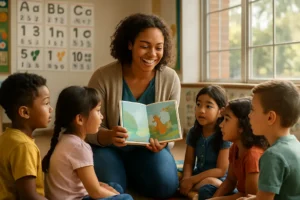
Language activities for kids matter because confidence does not usually arrive after one big breakthrough. It grows inside ordinary moments: a child naming a toy, asking for help, joining a song, or repeating a phrase during a familiar routine.
Children are not built to learn language from worksheets alone. They learn it through people, rhythm, repetition, emotion, movement, and the small social rewards that come when someone listens and responds.
That is why playful language practice can turn daily interaction into real communication progress, especially for families already thinking about why routines matter for speech.
Language Activities for Kids Work Best When They Feel Like Play
Many parents hear “language activity” and imagine a structured lesson at the kitchen table. That can work for some children, but it is rarely the most natural starting point. A child who is hesitant to speak may resist anything that feels like a test. Play lowers that pressure.
A toy farm, a pretend kitchen, a picture book, a puzzle, bubbles, blocks, or a simple game of hiding objects can all become language-rich when an adult adds words at the right moment. The point is not to flood the child with instructions. The point is to attach language to something the child already cares about.
For example, if a child is pushing a toy car, the adult might say, “Fast car,” “Car goes up,” or “Crash!” Those short phrases are easier to imitate than long explanations. They also connect language to action, which helps children understand meaning before they are ready to produce longer sentences.
The strongest activities create low-pressure repetition. A child may hear “go,” “stop,” “again,” or “my turn” many times in one game without feeling drilled. That repetition gives words a purpose. It also gives the child more than one chance to participate.
Confidence Starts Before Perfect Speech
Adults sometimes focus so much on clear pronunciation that they miss earlier communication wins. A child pointing, choosing, signing, vocalizing, making eye contact, copying a sound, or handing over a toy may already be communicating. Those moments deserve a response.
Speech confidence begins when children learn that their attempts matter. If every unclear word is corrected immediately, some children pull back. If every attempt is understood too quickly without encouraging expansion, they may not stretch. The balance sits between acceptance and gentle growth.
A useful approach is to model slightly more advanced language than the child is using. If the child says “ball,” the adult can respond, “Big ball,” or “Throw ball.” If the child says “more,” the adult can say, “More bubbles.” This gives the child a reachable next step without turning the moment into a performance.
Families can also use the American Speech-Language-Hearing Association’s practical speech and language activity ideas as a guide for turning everyday interactions into communication practice. The best use of those ideas is not to copy them rigidly, but to adapt them to the child’s personality, age, interests, and attention span.
The hidden risk is assuming quiet children are not engaged. Some children absorb language for a long time before they begin using it consistently. Others need more direct support. Either way, the goal is to keep communication inviting rather than stressful.
Everyday Objects Can Become Better Than Expensive Toys
A language-rich home does not require a closet full of special materials. In many cases, ordinary objects work better because they connect directly to a child’s real life. A spoon, shoe, cup, towel, box, sock, banana, blanket, or favorite stuffed animal can carry more meaning than a flashcard.
The best activities often begin with three simple questions: What does the child already like? What words would be useful here? What can be repeated naturally?
| Activity Type | How It Builds Language | Simple Example |
|---|---|---|
| Turn-taking games | Builds waiting, requesting, and social rhythm | “My turn,” “your turn,” “again” |
| Pretend play | Expands vocabulary and early storytelling | Feeding a doll or cooking pretend soup |
| Book sharing | Builds naming, prediction, and conversation | Asking, “What do you see?” |
| Songs and rhymes | Supports memory, imitation, and sound patterns | Pausing before a familiar lyric |
| Daily routines | Connects words to real actions | “Wash hands,” “shoes on,” “open door” |
The table shows why language practice should not be isolated from daily life. A child who learns “open” only from a card may not use it at the door, the snack container, or the toy box. A child who hears and uses “open” across real moments is more likely to understand the word deeply.
This is where parents and caregivers have a powerful advantage. They do not need to create artificial lessons. They can use the day itself as the lesson.
The Adult’s Role Is To Talk Less Strategically
One of the most misunderstood parts of early language support is the adult’s role. Many adults assume helping means talking constantly. But more words do not always mean better interaction. Children also need pauses, space, eye contact, and a reason to respond.
The most effective adult is not the one who narrates every second. It is the one who notices what the child is focused on and adds language at the right level. That may mean using short phrases, repeating key words, exaggerating sounds, waiting longer after a question, or offering choices instead of open-ended pressure.
Instead of asking, “What color is this? What animal is this? What sound does it make?” every few seconds, an adult might say, “You found the cow. Moo. The cow is eating.” That kind of language gives information without making the child feel inspected.
Questions still matter, but too many questions can turn play into a quiz. Comments often work better because they keep the interaction moving. A child who feels safe in the exchange is more likely to take a risk.
The takeaway is simple: responsive adults matter more than expensive toys, long lessons, or perfect scripts.
When Play Reveals A Bigger Communication Need
Language activities can support development, but they should not be used to dismiss real concerns. If a child is not responding to sounds, rarely engages with others, loses words they once used, struggles to follow simple directions, or remains very difficult to understand beyond what seems typical for their age, families should pay attention.
Milestone tools can help parents decide when to observe, when to adjust the home environment, and when to ask for professional support. The CDC’s developmental milestone checklists give families a broad way to track communication, play, movement, learning, and social development from birth through early childhood.
The most important point is that support should not be treated as a failure. Early guidance can reduce frustration for both the child and the family. It can also help adults choose activities that fit the child’s actual communication level rather than guessing.
There is a difference between encouraging speech and demanding it. Children who need more time, more modeling, or professional help still deserve language-rich play that feels warm and respectful. The activity should meet the child where they are while gently inviting the next step.
The Next Signal Is Whether Words Become Useful
The real measure of progress is not whether a child performs a word once on command. It is whether language becomes useful in daily life. Does the child request more? Protest clearly? Name favorite things? Join a familiar song? Use words during pretend play? Try a phrase with a sibling or caregiver?
Those small shifts matter because they show language moving from memory into communication. A child may first say “up” during a game, then use it to be picked up, then later combine it with another word. That is not just vocabulary growth. It is functional communication growth.
Parents should watch for patterns rather than isolated moments. A new word used once is encouraging. A new word used across different situations is stronger. A child who begins taking more turns, imitating more sounds, or initiating more interaction may be showing progress even before sentence length changes dramatically.
The opportunity is to build a home environment where language keeps showing up naturally: during meals, bath time, cleanup, walks, reading, music, and pretend play. Children need repeated chances to hear words, test them, and discover that communication changes what happens next.
Language activities for kids are not about producing polished little speakers on a schedule. They are about giving children steady, meaningful chances to connect. The families who understand that shift can stop chasing perfect activities and start building better moments—moments where words have purpose, confidence has room to grow, and speech becomes part of the child’s everyday power.