Forget the white lab coat. Your most important credential is already on the fridge door. You’re not just a parent; you’re the lead researcher in the most critical longitudinal study of your life.
We’ve been sold a story that assessment is a clinical, anxiety-inducing event. It’s time to rewrite that script. What if I told you that your daily, off-the-cuff observations are more valuable than a single doctor’s visit?
Think of screening as a simple, regular check-up for your child’s milestones. It’s not about pass or fail. It’s about understanding their unique developmental path and knowing what fascinating skill emerges next.
This is where empowered observation begins. The data you collect during playtime and conversations is gold. As experts note, the time you spend together actively promotes brain and language growth.
So, let’s trade vague worry for a clear mission. Your new goal? Enlightened progress evaluation with a purpose. We’re moving from worrying in the dark to conducting a brilliantly lit, ongoing Communication Assessment.
Ready to become your child’s most insightful analyst? The tools are simpler than you think.
Key Milestones by Age
Child development is like a movie, with communication milestones as the exciting plot points. Forget the one-size-fits-all manual. Every child’s journey from gurgles to gossip is unique. Our role as parents is to enjoy the story, not grade each scene.
Milestone monitoring is like tracking a favorite series. You notice when a character learns a catchphrase or solves a mystery. Watching for when your baby coos back, points at a dog, or asks for more screen time is similar.
Tools like the Ages & Stages Questionnaires (ASQ-3) help track this story. It focuses on five areas, including Communication. This gives us a flexible guide to follow.
The Communication and Symbolic Behavior Scales (CSBS) focuses on 8 to 24-month-olds. This is when babbling turns into first words. These tools help guide progress evaluation, not test it.
What does this progress look like? The table below shows the key milestones. Remember, kids don’t follow scripts. Some start early, others take their time. This is a guide, not a rule.
| Age Range | Expected Communication Milestones | Relevant Assessment Tools | Parent’s Note |
|---|---|---|---|
| 0 – 12 Months | Cooing, babbling (ma-ma, da-da), responding to name, using gestures like pointing. | ASQ-3 (1-60 months), early communication screening. | This is the prequel. Focus on sound play and non-verbal cues. Don’t worry about clear words yet. |
| 12 – 24 Months | First true words (10-50), combining two words (“more milk”), following simple commands. | CSBS (8-24 months), ASQ-3 communication domain. | The plot thickens! Vocabulary grows. Milestone monitoring here is about word explosion, not perfection. |
| 24 – 36 Months | 2-3 word sentences, asking simple questions, using pronouns (I, me, you), being understood by familiar adults. | ASQ-3, ongoing communication assessment. | Dialogue starts. Sentences are short but meaningful. This is where the story’s logic forms. |
| 3 – 5 Years | Complex sentences, clear storytelling, understands basic grammar, talks about past/future. | ASQ-3 up to 60 months, preschool language screenings. | The narrative gets rich. They recount their day and negotiate terms. Your role shifts from decoder to editor. |
It’s a progression, not a pop quiz. The ASQ-3 covers 1 to 60 months. The CSBS focuses on the critical toddler window. Using these tools for progress evaluation means you’re looking for forward motion, not hitting a mark on a specific Tuesday.
Why does this matter? Because anxiety is the worst co-pilot. Treating milestones as inflexible deadlines misses the joy of the subplots. Maybe your 18-month-old has a limited vocabulary but is a master of expressive scowls and elaborate pointing. That’s communication.
The goal is to understand your child’s unique story pacing. A thoughtful communication assessment approach helps spot if the plot is stalled or just pausing. It turns panic into perspective.
So, keep this table as a reference, not a ruler. Your child’s development is an original production. Your job is to be an attentive audience, a keen director, and their biggest fan—all at once.
Daily Communication Checklist
Forget the lab coat; the most potent tool for language development tracking is already in your pocket: a simple checklist. We’re not talking about a daunting multi-page evaluation. This is the art of the elegant, focused snapshot—a director’s shot list for your child’s average Tuesday.
The genius lies in tools built for this exact purpose. The Looksee Checklist, for instance, cuts through the noise with a short series of ‘yes’ or ‘no’ questions. It’s a rapid-fire debrief on your kid’s latest exploits. The ASQ-3 questionnaire is designed for a 10–15 minute window. That’s less time than it takes to brew a pot of coffee and scroll through the news. This minimalist approach is the ultimate hack. It transforms assessment from a scheduled event into a seamless part of your routine.
So, what are you logging? The good stuff that a formal setting might miss. The correct use of “because” to win a negotiation for more screen time. The shared, nonsensical joke with a sibling that requires perfect timing. This is micro-assessment. You’re not testing; you’re observing with purpose. The checklist becomes your lens, focusing on the subtle data points in the beautiful chaos of daily life.
Why does this method work so well?
- It’s Sustainable: A 15-minute commitment feels less like homework and more like a mindful ritual.
- It Captures Authenticity: You get real-world performance, not staged, test-day behavior.
- It Reduces Anxiety: The binary ‘yes/no’ format offers clear, immediate feedback, replacing vague worry with specific notes.
- It Empowers You: You become the expert on your child’s unique communication journey.
This daily or weekly ritual is more than just language development tracking. It’s a structured way to witness growth as it happens. It turns the question “Are they on track?” into a collection of observable, celebratory facts. That’s the power of a well-designed Communication Assessment—it gives you the script to direct your own understanding.
Video Progress Documentation
Think of your child’s growth as a documentary you’re making. Every parent is a director with a smartphone. The key is to turn casual videos into a structured Communication Assessment.
This isn’t about making a viral video. It’s about creating a timeline of real moments. This timeline captures true milestone monitoring through laughter, frustration, and problem-solving.
Science supports this method. Tools like the Communication and Symbolic Behavior Scales (CSBS) value observing children in their natural setting. Your home is that setting.
A child’s performance in a formal setting is different from their natural behavior. A spontaneous video of your child trying to get a cookie shows more than a scripted session.

To become a scientific filmmaker, capture everyday moments. Record your child playing with a sibling or explaining a dream. Get a clip of them negotiating for more time at the park.
Collect lots of short videos each month. Add a date and a brief note to each. This creates a library for long-term milestone monitoring. You’re gathering raw footage, not a polished product.
To understand the shift in mindset, let’s compare a typical home video to a tool for analysis.
| Criteria | Staged Recording | Naturalistic Video Documentation |
|---|---|---|
| Primary Goal | Capture a smile, a word, a “cute” moment. | Capture authentic interaction, problem-solving, and non-verbal cues. |
| Typical Setting | Child posed, looking at the camera. | Child absorbed in play or daily routine, unaware of filming. |
| Child’s State | Self-conscious, performing. | Relaxed, engaged, in their natural state. |
| Data Quality for Assessment | Low. Shows what they can do on command. | High. Shows what they actually do spontaneously. |
| Best For | Grandma’s birthday message. | Genuine milestone monitoring and pattern recognition. |
Review your footage like a film critic. Watch the same clip twice. Notice if the gesture is clearer or if the child tries harder to communicate. This turns you into an analyst for your child’s Communication Assessment.
You’re not just watching memories; you’re actively tracking your child’s growth. You’re following the most important story in their life.
Vocabulary Growth Charts
We often focus on physical growth, but forget about vocabulary. It’s time to look at vocabulary growth as a key sign of brain health. Forget about height and weight charts. The real sign of a growing mind is its vocabulary.
This isn’t just for bragging rights. It’s about seeing word learning as important data. A big vocabulary shows how well your child understands and thinks.
Experts have known this for years. They use tools like the MacArthur-Bates Communicative Development Inventory (CDI) and the Expressive One-Word Picture Vocabulary Test (EOWPVT-4). These tools track how children go from saying their first word to speaking in full sentences.
You don’t need a PhD to use this info. The idea is simple: turn your child’s word learning into data. This is language development tracking at its best.
Here’s how to make your own vocabulary growth chart:
- Choose Your Categories: Group words into types like nouns, verbs, and adjectives. This shows how your child thinks.
- Track Comprehension vs. Expression: Note words they understand but can’t say yet. This shows their language skills.
- Make it Visual: Use a simple graph on the fridge. Seeing the line go up is motivating.
This homemade tool does more than track words. It turns random sounds into a story. You see how their thoughts are growing.
Tracking words is like a special way to listen and learn. You’re not just hearing words. You’re understanding their growth.
So, don’t think vocabulary is just cute. See it as key to their brain growth. With a simple chart, you’re mapping their mind’s development.
Social Skills Rubrics
Assessing a child’s communication is more than counting words. It’s about understanding their social-emotional world. This is like moving from basic math to advanced calculus. The numbers are important, but the real story is in their behavior.
A social skills rubric is your best tool for milestone monitoring. It helps you understand a confusing tantrum. Instead of wondering why they’re acting out, you can see which area of development it’s related to.
The Ages & Stages Questionnaire: Social-Emotional, Second Edition (ASQ:SE-2) is a great tool. It breaks down childhood into seven key areas. Let’s look at each one.
| ASQ:SE-2 Domain | What It Really Means | Common Behavioral “Tells” | Parental Insight Gained |
|---|---|---|---|
| Autonomy | The drive for independence and self-direction. It’s their inner CEO negotiating for more control. | “I do it myself!” protests, choosing own clothes, wanting to pour juice. | Is this defiance or healthy self-advocacy? The rubric distinguishes. |
| Compliance | Understanding and following rules. The internalization of social contracts. | Following simple instructions, responding to redirection, accepting “no.” | You learn if a struggle is about comprehension, will, or self-regulation. |
| Adaptive Functioning | Managing daily life skills. The practical, unglamorous side of growing up. | Using a fork, washing hands, helping to clean up toys. | It tracks practical independence, separate from verbal or cognitive skill. |
| Self-Regulation | The emotional thermostat. Can they cool the engine when it overheats? | Calming down after upset, waiting for a turn, handling frustration without melting down. | This is the core of emotional intelligence. Failures here aren’t “bad behavior” but skill gaps. |
| Affect | The emotional color palette. The range and appropriateness of their emotional expressions. | Showing joy, sadness, empathy; matching facial expression to the situation. | You see if flat affect or exaggerated reactions are just a phase or a cue for deeper observation. |
| Interaction | The social dance. How they engage with the people around them. | Making eye contact, engaging in parallel play, seeking out peers. | It separates shyness from disinterest, and solo play from social avoidance. |
| Social-Communication | Where words meet context. Using language for social purposes. | Greeting others, asking for help, sharing experiences, telling simple stories. | This is the grand synthesis. It answers: Can they use their words to connect? |
That epic supermarket meltdown? A rubric lets you analyze it like a scientist. It might be a Self-Regulation challenge or a clash with Autonomy. Maybe it’s a Adaptive Functioning issue that affects Compliance.
This framework turns parenting into proactive anthropology. You’re not just stopping a behavior; you’re identifying its developmental address. That is the essence of sophisticated milestone monitoring.
It provides a structured, calm way to assess progress beyond speech. You stop fearing the chaos and start appreciating the complex, messy, beautiful interplay of a growing mind. Now that’s a communication assessment worth mastering.
Listening Assessment Tools
Tools like the Clinical Linguistic and Auditory Milestone Scale (CLAMS) and the Infant-Toddler Meaningful Auditory Integration Scale (IT-MAIS) are more than just terms. They help us understand how our children process sound. Imagine communication as a radio broadcast. We often focus on sending the signal, but what if the receiver is tuned wrong?
A proper Communication Assessment looks at listening skills. It’s not just about hearing loss. It’s about how well the child understands what they hear. Is the message clear, or is it full of static?
The CLAMS tracks sound and language responses in children. The IT-MAIS checks if they understand sounds. Our goal is to help our children grasp these messages.
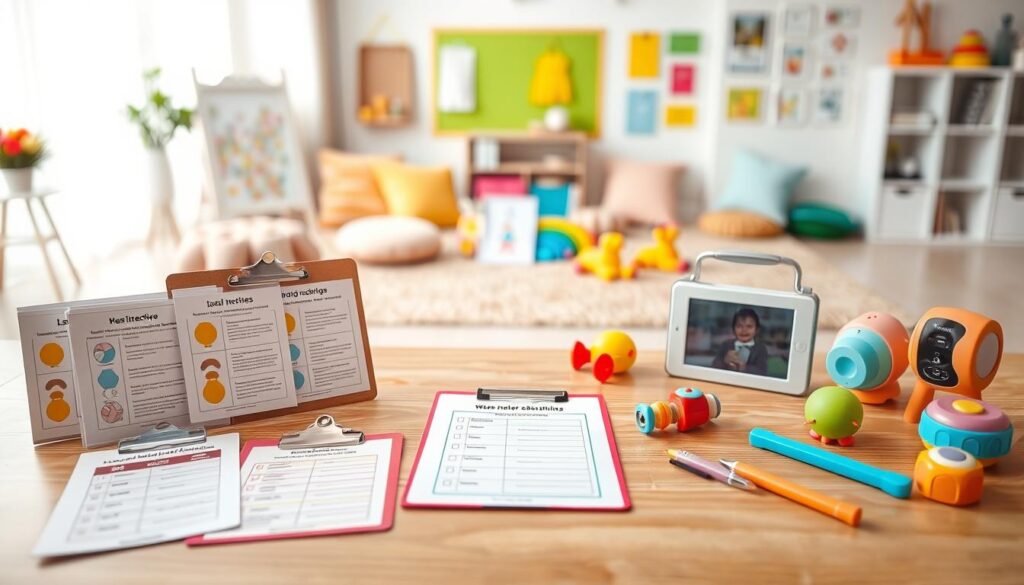
Start observing your child’s reactions. Do they turn to a chip bag but not to their name? That’s a clue. Do they follow a command only when you point? That’s another clue. We’re focusing on what they truly understand.
Let’s connect the dots from the clinic to your home. The table below shows how these tools relate to everyday life.
| Clinical Tool Focus | Parent-Friendly Observation | What It Reveals |
|---|---|---|
| Auditory Awareness (CLAMS) | Does your child startle or pause at sudden, loud noises like a door slam? | Basic detection of sound presence in the environment. |
| Meaningful Integration (IT-MAIS) | Do they look at the family dog when you say “Where’s Fido?” without a visual cue? | Ability to connect a specific sound (word) to its referent. |
| Auditory Comprehension | Can they follow a two-step directive like “Pick up the block and put it in the box”? | Processing and acting on sequenced verbal information. |
| Selective Listening | Do they respond to your voice in a noisy room, like during a playdate? | Ability to filter background noise and attend to relevant speech. |
This detective work is key to understanding your child’s progress. It answers the question: Are they ignoring you, or didn’t they get the message? Knowing this helps in many ways.
By tracking these observations, you get a detailed story of your child’s journey in a world full of sounds. This story is very valuable during any Communication Assessment.
So, when you feel like you’re talking to no one, don’t get frustrated. Instead, get curious. The listening assessment starts now.
Red Flag Identification
Red flags in communication aren’t about panic; they’re about noticing patterns. It’s like spotting a unique trait versus a problem that needs fixing. Think of yourself as a strategic observer, not a worried parent. Your goal is to notice things with clear insight.
Studies show one in four kids might face learning or behavior challenges at school. This isn’t a reason to worry. It’s a strong case for watching and tracking language development early on. Early detection is like controlling the story. It’s your chance to add support before problems get too deep.
Using a Communication Assessment wisely is key. It helps you move from vague worry to clear observation. You’re not just guessing; you’re looking at trends. Is that silence a thoughtful pause or a missing line in the dialogue? Your tracking data helps you tell.
So, what are we looking for? It’s not just one big sign. It’s often a pattern of small issues. The table below is like your radar, helping you understand these signals. It shows the difference between normal quirks and signs that need a closer look.
| Area of Communication | Common Quirk (Usually Benign) | Potential Red Flag (Worth Monitoring) |
|---|---|---|
| Speech Clarity | Mixing up ‘th’ and ‘s’ sounds until age 5-6. | Speech is consistently unclear to familiar listeners after age 3, or shows severe frustration when not understood. |
| Social Engagement | Being shy or slow to warm up in new groups. | Consistently avoiding eye contact, showing no interest in peers, or failing to respond to their name by age 2. |
| Vocabulary Growth | A temporary plateau in learning new words. | Has fewer than 50 words and isn’t starting to combine two words (e.g., “more milk”) by 24 months. |
| Listening & Following Directions | Needing a two-step instruction repeated sometimes. | Consistently unable to follow simple, one-step directions (e.g., “Please get your shoes”) by age 3. |
| Narrative Skills | Telling a story out of sequence or with gaps. | Inability to talk about or recall any past events, even with prompting, by age 4. |
Remember, a single check in the “Red Flag” column isn’t a final judgment. It’s just a piece of data. The strength of language development tracking is in showing patterns over time. Is this a short issue or a long-term problem?
Seeing a possible delay early is not a failure. It’s a strategic win. It turns a vague worry into a clear, actionable step. It’s the confident sign that tells you when to keep watching or when to call in the experts for a closer look.
Professional Consultation Prep
Walking into a specialist’s office with organized notes can turn anxiety into advocacy. It’s like being the lead analyst in a critical data review, not just a student cramming for a test.
Your task is to present the evidence. The specialist will provide the clinical scoring and context. This mindset shift makes the appointment productive and builds a partnership.
To build your case file, gather your observations. Video clips, vocabulary charts, and social skills notes are your evidence. They’re not random items but curated exhibits.
Organize them in chronological order. A simple folder works well. Label each item with a date and a brief context. For example, “October 23: Attempted to ask for juice using two-word phrase.”
This process is like using the ASQ questionnaire. You do the day-to-day observations. Then, you give this data to the professional. They score it, discuss the results, and plan the next steps. You’re the field researcher, and they’re the lab interpreting the samples.
| Your Role | Scattered Approach | Prepared Case File | The Professional’s Role |
|---|---|---|---|
| Data Provider | “He just doesn’t talk much.” | Provides a timeline of specific attempts and contexts. | Clinical Scorer |
| Progress Tracker | Vague recollection of development. | Presents a vocabulary growth chart showing plateaus. | Pattern Analyst |
| Evidence Logger | No record of social interactions. | Shares a short video clip from a playdate. | Context Interpreter |
| Question Asker | General worries about “being behind.” | Asks targeted questions based on documented observations. | Strategy Partner |
One scenario invites guesswork, while the other enables precise problem-solving. Your organized file is the key to collaboration. It says, “Let’s work from the same evidence.”
This preparation changes the dynamic. You move from a nervous parent to a collaborative colleague providing key intel.
The specialist isn’t starting from zero. They review your research. This makes the Communication Assessment more efficient and insightful.
Your diligent progress evaluation at home is the foundation for their expert evaluation. This is how you build a true partnership. You bring the detailed map, and they help navigate the terrain ahead.
Celebration Strategies
You’ve mastered the art of observing and tracking progress. Now, it’s time to celebrate. The most important tool in your kit isn’t a chart or rubric. It’s the confetti cannon of recognition.
This journey of language development tracking is about finding strengths, not weaknesses. It’s like a scavenger hunt for what your child can do. Your communication assessment mission is to highlight their achievements.
How do you celebrate a child’s growth in “Problem Solving” or “Self-Regulation”? Skip the plastic toys. Celebrate a vocabulary explosion with a silly dance party. Honor a listening milestone with a special storytime where they pick all the voices.
These acts turn data points into shared joy. They help your child connect effort with positive reinforcement. Your analytical side and your cheerleader aren’t at odds. They work together, making tracking a celebration and milestones unforgettable.