A child may understand “Put your shoes on before we leave” yet struggle with “Touch the red block before the blue one.” That difference is central to understanding when children understand before and after: learning these words is not simply memorizing two definitions but learning how language can rearrange the order of events.
Familiar routines often provide the first foothold. Children already know that pajamas come before bed or that washing hands happens before eating, so the language is supported by experience. As their understanding becomes more flexible, they can use sequence words even when the events are unfamiliar, reversed in the sentence, or part of a story. That development builds on the broader ability to understand words that connect ideas.
When children understand before and after, routines usually come first
Temporal language is easier when the child already knows what normally happens.
“Brush your teeth before bed” carries clues beyond the word “before.” The child has probably experienced that sequence many times. “Put your coat on after your shoes,” however, may require more attention if either order would be physically possible.
Classic studies of preschool language found that children performed better with before-and-after sentences when the events formed meaningful familiar sequences. That suggests children can initially use real-world knowledge to support language that is not yet completely flexible.
The pattern also explains why parents may see apparently contradictory performance. A preschooler can follow “Wash your hands before lunch” correctly and still reverse two arbitrary actions moments later.
Understanding within a routine is genuine progress. It simply is not the final stage.
Sentence order can compete with event order
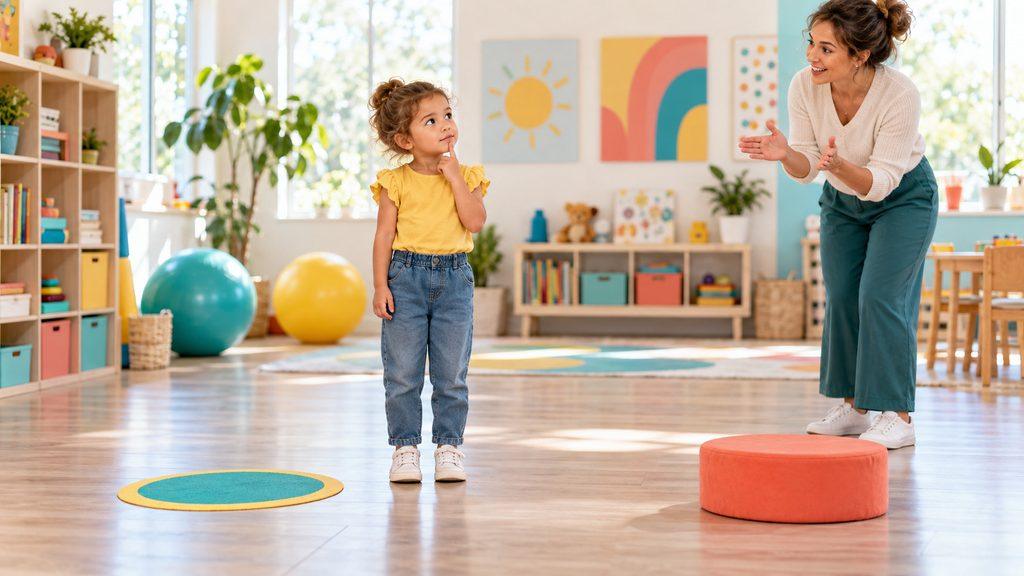
“Clap before you jump” is relatively straightforward because the first action mentioned is also the first action that should happen.
Now compare it with: “Before you jump, clap.”
The outcome is identical, but the language is structured differently. Children must resist simply doing things in the order they hear them and instead use the temporal word to work out what happens first.
Research into before-and-after comprehension shows that sentence structure, event order, and the relationship between the two can continue influencing performance well beyond the preschool period.
That makes word order a hidden difficulty. A mistake may not mean the child has no concept of “before.” They may understand the relationship in easier sentence forms but have trouble when grammar and chronology point in different directions.
First and next can provide an easier bridge
Children do not need to begin with the most complicated version of temporal language.
Words such as “first,” “next,” and “last” can make order more visible because they map directly onto a sequence. “First put the block in the box. Next close the lid” is usually easier to process than a sentence that embeds both actions around “before” or “after.”
The progression can look something like this:
| Language form | Example | Main demand |
|---|---|---|
| Routine sequence | “Shoes before outside.” | Connect language with a familiar routine |
| First/next | “First wash, then dry.” | Follow an explicit sequence |
| Simple before | “Clap before you jump.” | Use a temporal relationship |
| Simple after | “Jump after you clap.” | Reverse the wording into event order |
| Embedded form | “Before you jump, clap.” | Separate sentence order from event order |
| Story sequence | “What happened before she fell?” | Retrieve order from remembered events |
This is not a fixed developmental ladder. Children may handle one form well and another inconsistently depending on memory, familiarity, sentence complexity, and context.
Instructions and stories test different versions of the skill
Following “Get your backpack after you put on your shoes” requires the child to organize future actions.
Answering “What happened before the dog ran away?” requires something different. The child must remember a sequence that already occurred, locate the target event, and identify what came immediately before it.
Research on children’s sequencing questions found that young children can respond differently to “before,” “after,” “first,” and “last” questions. In that work, “first” was often easier than questions asking children to identify events before or after a particular point in a story.
This is why one successful task proves little by itself. Temporal words interact with memory, grammar, attention, and the structure of the activity.
A child who follows routine instructions well may still need help answering sequence questions during storytelling.
Everyday routines can make invisible order visible
Parents do not need special worksheets to strengthen sequence language.
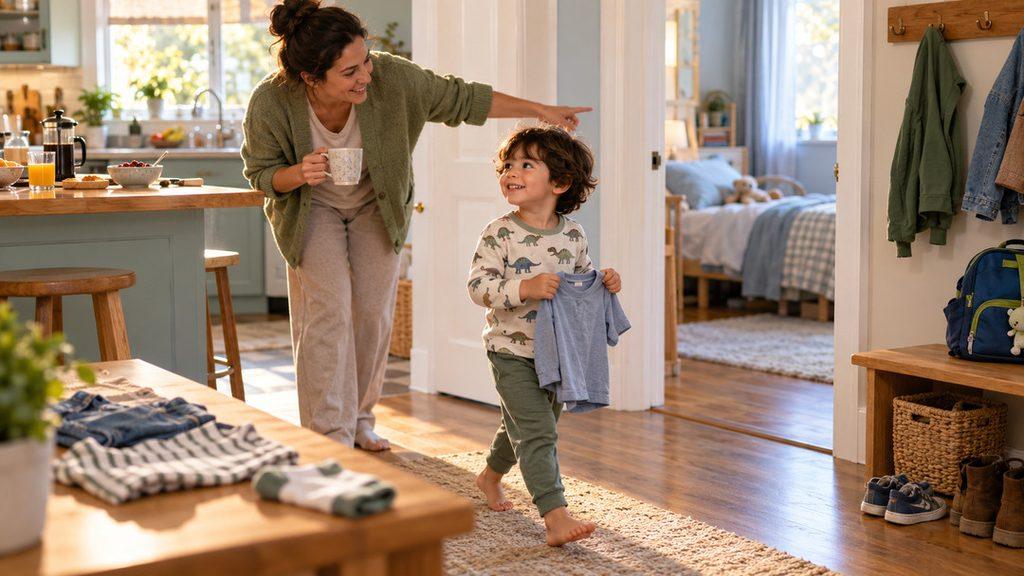
Morning routines provide repeated examples: “Before breakfast, let’s get dressed.” Cooking creates natural order: “We mix the ingredients before we put the pan in the oven.” Cleanup can use the reverse relationship: “After the blocks are in the box, we’ll put the books away.”
Pictures are useful because they make time visible. Take three photos from an outing and arrange them in order. Ask what happened first, what happened after lunch, or what happened before everyone got back in the car.
For younger children, keep the events concrete and close together.
If the child gives the wrong answer, avoid turning the exchange into a test. Show the sequence and model the relationship: “We ate first. After we ate, we went outside.”
The goal is repeated meaningful exposure, not memorizing definitions of temporal vocabulary.
Flexible understanding is the milestone worth watching
A child who only understands “before” inside one familiar instruction has learned something useful. The next development is being able to apply that relationship across new situations.
Watch for increasing flexibility. Can the child follow both “Do X before Y” and “Before Y, do X”? Can they talk about what happened before or after an event in a story? Can they use these words themselves when explaining a routine?
There is no single birthday at which every form should become effortless. Studies have repeatedly shown that before-and-after comprehension is affected by sentence structure and task demands, and some complex forms continue challenging older children.
Broader concerns deserve attention when difficulty with sequence language appears alongside persistent problems understanding multi-step directions, connected sentences, stories, or other age-appropriate language.
Understanding when children understand before and after therefore means watching a progression from familiar routines toward flexible temporal reasoning. The important change is not simply hearing a child say the words. It is seeing them use sequence language to organize instructions, memories, and stories even when the order is no longer obvious from everyday experience.
Frequently asked questions
Is “before” easier for children than “after”?
Not consistently. Performance depends heavily on sentence structure, event familiarity, and whether the order of words matches the order of events. A child may understand either term better in certain contexts.
Why can my child follow “before bed” but confuse other before-and-after instructions?
Familiar routines provide extra clues. When events are arbitrary, children must rely more heavily on the temporal words themselves, sentence structure, attention, and memory rather than their knowledge of what usually happens.
How can I practice before and after without worksheets?
Use real sequences during dressing, meals, cooking, cleanup, and outings. Photos and simple stories also work well because children can physically see or remember the event order while hearing the temporal words.