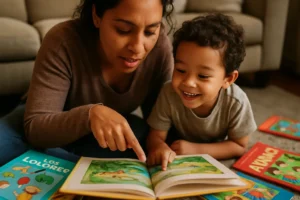
For young dual-language learners, bilingual decodable texts can give reading practice a clearer purpose: children apply taught sound-spelling patterns while seeing that both of their languages belong in literacy instruction. These texts are not a complete reading program by themselves. They work best when paired with oral language, vocabulary growth, shared reading, writing, and adult support that respects the child’s full language experience.
For families and educators in kindergarten through Grade 3, the key question is not whether one language should “replace” the other during early reading. Current research on bilingual literacy points to a more careful view: skills can develop within each language, and some early literacy abilities may support reading across languages. The exact path depends on the child, the languages, the instructional model, and the quality of teaching.
Why bilingual decodable texts Support K–3 Readers
How bilingual decodable texts Connect Print And Sound
Decodable reading materials are designed so children can practice letter-sound patterns they have already been taught. For Spanish-English learners, that practice may happen in English, Spanish, or both. Well-designed bilingual decodable texts can help children notice how print works in each language while reducing the guesswork that can happen when a book contains many untaught spelling patterns.
This matters because early code-related skills have been linked to later reading outcomes in bilingual learners. The research notes for this topic include a 2026 longitudinal study of 1,010 first-grade Latinx children in bilingual education that found associations between early skills such as letter-sound knowledge, pseudoword reading, automaticity, and reading comprehension in both Spanish and English. That does not mean every child needs the same sequence or the same amount of practice. It does suggest that explicit attention to print, sounds, and meaningful language belongs in early biliteracy work.
A 2024 meta-analysis in the research notes also reported that decodable texts produced small gains in word reading and moderate gains in pseudoword decoding for children without reading disabilities. Those findings support decodable texts as one helpful scaffold, not as a single answer for every reading need.
Why Practice Should Still Feel Like Reading
Controlled text can become too narrow if adults treat it only as a word-calling task. Children still need to understand what they read, talk about ideas, connect words to experiences, and hear fluent models from adults. A short decodable book can include a warm-up with target sounds, a first read for accuracy, a reread for smoother phrasing, and a brief conversation about meaning.
For bilingual learners, the conversation may happen in the home language, English, or both. If a child decodes a sentence in English but explains the meaning in Spanish, that response can still show comprehension. The goal is not to force all thinking into one language. The goal is to help the child connect print, speech, meaning, and confidence across the languages they use.
What The Biliteracy Research Can And Cannot Tell Us
Simultaneous And Sequential Models Show Different Strengths
Research comparing bilingual instruction models has found that timing and language balance can matter. One study listed in PubMed compared simultaneous and sequential approaches and reported differences between 50-50 and 90-10 bilingual programs, including variation in English irregular word reading, passage comprehension, English decoding, and phonological awareness bilingual reading study. The findings do not support a simple rule that one approach is best for all children. They show that program design can shape the skills children practice most often.
That is a useful caution for families and schools choosing reading materials. A child in a 50-50 dual-language setting may need balanced access to decodable books in both languages. A child in a program that begins with more Spanish may need strong Spanish decoding practice with planned bridges to English. A child who speaks Spanish at home but receives mostly English instruction may need adults to protect and use the home language as a literacy resource rather than treating it as a distraction.
Spanish And English Skills May Interact, But Not Identically
A study of Spanish-English bilingual and English monolingual children ages 6 to 13, with 70 participants, found that vocabulary was the strongest predictor of English word reading for both groups. For bilingual children reading in Spanish, phonology and morphosyntax were better predictors in the study’s analysis Spanish-English literacy findings. This supports a practical message: biliteracy is not just English reading copied into another language. Each language has its own patterns, and children may draw on different strengths depending on the task.
That is why bilingual decodable texts should not simply translate one language into the other without attention to sound patterns, spelling patterns, vocabulary, and sentence structure. Spanish has a more consistent relationship between letters and sounds than English in many common reading tasks, while English contains many irregular spellings. Materials should reflect the language being taught, not just the theme of the week.
Building A Home-And-School Reading Routine
Keep Practice Short And Responsive
Young readers often benefit from repeated, low-pressure practice. A classroom or home routine can be brief: preview a target sound or spelling pattern, read a few lines, pause for meaning, reread a favorite page, and invite the child to talk about what happened. If frustration rises, the adult can reduce the load by reading together, taking turns, or returning to oral language before trying the text again.
For families, consistency matters more than long sessions. A few minutes of calm reading can be more useful than a long session that becomes a test. Adults can say, “You read the words you know, and I’ll help with the tricky ones.” They can also ask open questions in the child’s stronger language so comprehension and expression are not limited by English-only demands.
These routines pair well with broader bilingual language activities, especially shared reading, talk during everyday routines, and explicit word learning. Decodable practice should sit inside a wider language plan, not crowd it out.
- Use the language of the text for sound-spelling practice, then allow discussion in either language.
- Reread familiar pages so the child can build accuracy and smoother phrasing.
- Track patterns over time, such as easier blending, fewer pauses, or better retelling.
- Share the same book between home and school when possible, so adults can use similar prompts.
Support Family Engagement Without Adding Pressure
The research notes include a 2024-2025 Texas quasi-experimental study in which Spanish-English bilingual students used personalized decodable texts in English and Spanish along with multilingual family engagement supports. The study reported significantly higher Spanish reading growth in Grade 2 for the treatment group, along with positive trends on several fluency and vocabulary measures. Because one study cannot settle the issue for every district or child, the most responsible takeaway is cautious: home access and family support may strengthen the value of decodable reading materials, especially when families receive clear, usable guidance.
Family guidance should be simple. Parents and caregivers do not need to become reading specialists. They can listen, encourage, reread, explain a word, or talk about the story in the language they know best. If a child makes many errors, the adult can model the line and invite a shared reread rather than correcting every word one by one.
Choosing Texts Without Overpromising Results
Check The Match To Instruction
Not every book labeled “decodable” will fit a child’s instruction. Before using a text, adults can ask whether the book matches recently taught sound-spelling patterns, whether the vocabulary is meaningful, and whether the child can read most of it with support. For bilingual decodable texts, it is also worth checking whether the Spanish and English materials are both instructionally useful, rather than one language receiving stronger design than the other.
Schools may also need to review whether texts represent children’s lives respectfully. Representation alone does not make a text decodable, and decodability alone does not make a text engaging. Children need materials that support the reading skill being taught while still giving them something worth thinking and talking about.
When researching resources for writing or looking to compare services, a related site in the same network can provide worthwhile insights. However, for young bilingual readers, the main focus should be on providing age-appropriate reading instruction and supportive family involvement to monitor reading progress.
What To Watch Over Several Weeks
Progress in biliteracy can appear in small steps before it appears in test scores. A child may begin to point out a sound pattern, decode a new word by analogy, read a familiar page with less adult help, or retell more of the story after reading. These signs do not replace formal assessment, but they help adults notice whether the reading routine is becoming more productive.
If a child continues to struggle with letter-sound knowledge, word reading, or comprehension despite consistent instruction, families and teachers should consider a closer review by qualified school staff or a speech-language, reading, or literacy professional as appropriate. Bilingualism itself should not be treated as the cause of reading difficulty. The child’s skills should be considered across languages, with attention to instruction, exposure, and development.
Practical Uses For bilingual decodable texts
Bilingual decodable texts are most useful when adults use them as one part of a connected biliteracy plan. In the classroom, they can support explicit phonics practice, partner reading, small-group rereading, and links between Spanish and English patterns. At home, they can give caregivers a short, concrete way to participate in reading without needing scripted lessons or specialist vocabulary.
The research base supports careful optimism. Decodable texts can help children practice the alphabetic code, and bilingual instruction can support reading growth in more than one language. At the same time, results vary by child, program model, language background, and instructional quality. The best use of decodable materials keeps the child’s full communication system in view: sounds, words, sentences, stories, family language, classroom language, and the child’s growing sense that reading belongs to them.