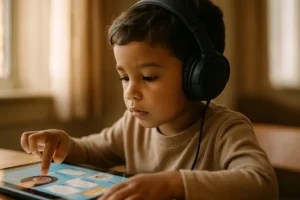
AI Bilingual Vocabulary is becoming a practical question for early childhood educators and families, not just a technology trend. The strongest current evidence points toward careful adult-guided use: stories, interactive games, repeated word practice, and meaningful conversation in both languages. The research base for preschool bilingual learners is still small, so these tools should be viewed as supports for language interaction rather than replacements for teachers, speech-language professionals, or family talk.
AI Bilingual Vocabulary Evidence So Far
Preschool Findings From Spanish-English Learners
A U.S. NIH-funded study at Texas Christian University tested Computer-Assisted Bilingual Vocabulary Instruction with 21 Spanish-English bilingual preschoolers across six months. The instruction used stories and interactive games, and children showed vocabulary improvement in both Spanish and English, according to reporting on the TCU bilingual vocabulary study. That finding is encouraging because it treats both languages as learning assets rather than asking children to set one aside.
The study details available from the report are limited, so families should be cautious about overreading the result. We do not have enough information from that source alone to say which children benefited most, which activities were most effective, or how gains compared with other high-quality bilingual instruction. Still, the six-month design and focus on Spanish-English preschoolers make it directly relevant to early childhood language programs.
What AI Bilingual Vocabulary Can Support
The best-supported uses are not flashy. They are familiar early literacy practices with digital assistance: listening to stories, naming objects, answering simple questions, hearing words again, and practicing words through play. A careful AI Bilingual Vocabulary plan can give children more chances to hear and use target words, but the adult still shapes the quality of the exchange.
For example, a preschool teacher might introduce a story in English, connect key words to Spanish home-language equivalents, and then use an interactive game for practice. A family might repeat the same words during cooking, drawing, pretend play, or bedtime reading. Families looking for low-tech extensions can adapt ideas from bilingual vocabulary activities for ages 4 to 6 so children meet the same concepts across routines.
What The A.I. KID Study Adds
Short-Term Vocabulary Gains In A Small Sample
The A.I. KID Study in Tacloban City, Philippines, published in 2026, compared 15 preschoolers who received 10 sessions over two weeks using AI-assisted applications with 15 children in a control group. The applications listed in the study were Buddy.ai, Google Read Along, and Readability. The experimental group gained a mean of 18.60 points on the Vocabulary Knowledge Scale, with a posttest mean of 31.60, while the control group gained 2.00 points, with a posttest mean of 14.93. The reported between-group difference was statistically significant, t(28) = 14.87, p < .001, with a very large effect size of d = 5.43, as described in the A.I. KID Study.
Those numbers suggest that interactive AI-supported vocabulary practice may help preschool learners acquire target words over a short period. At the same time, the sample was small and the study took place in a specific setting. Results from 30 children in one city should not be treated as a universal guarantee. Replication with larger groups, different languages, and longer follow-up periods would help clarify how stable the gains are.
Why Adult Mediation Still Matters
Even when a study reports strong gains, preschool vocabulary learning is social. Young children learn words through attention, emotion, repetition, and meaningful use. A child may tap the correct answer in an app but still need help using that word with a grandparent, a teacher, a sibling, or a peer during play.
That is why educators should look beyond posttest scores. Useful questions include: Did the child use the new word during conversation? Did the child understand the word in both languages, if both were targeted? Did the child connect the word to real objects, actions, stories, and feelings? AI Bilingual Vocabulary work should be treated as one part of a broader communication plan.
Practical Ways To Use AI Tools With Young Children
Start With Words Children Can Use Today
Vocabulary targets should come from real preschool life: foods, family members, feelings, classroom objects, actions, locations, and story words. A word is more useful when the child has a reason to say it, hear it, point to it, draw it, or act it out. Tools that generate word lists or activities may save planning time, but adults need to check that the words fit the child’s language environment.
In bilingual instruction, the home language should not be treated as a distraction from English. If a child knows a concept in Spanish, Tagalog, Arabic, Mandarin, or another home language, that knowledge can support learning another label. Teachers and families can say both words, compare where each word is used, and invite the child to use either language during early practice.
Pair Digital Practice With Play And Art
Children need chances to move words off the screen. After an app introduces animal names, children can build a pretend zoo, sort toy animals, draw habitats, or act out movements. After a story introduces feeling words, children can use puppets to show happy, worried, tired, or surprised. Art-based language activities can also support recall because children talk while choosing colors, shapes, characters, and actions. For families who enjoy visual storytelling, a related creative site such as The Sketchbook Project can offer inspiration for sketchbook-style story prompts, though adults should adapt any idea to the child’s age and language goals.
- Use one short digital session, then repeat the same words in play.
- Invite the child to answer in either language during early practice.
- Model a sentence instead of asking only one-word questions.
- Return to the same words across several days and routines.
- Watch for fatigue, guessing, or loss of interest, and pause when needed.
These steps keep technology connected to communication. The aim is not for the child to perform for the app; the aim is for the app to support more human interaction.
Limits, Equity, And Child Privacy

Evidence Is Promising But Still Narrow
The early childhood evidence described above is promising, but it does not answer every classroom question. We still need more information about long-term retention, children with communication disorders, children exposed to more than two languages, and children who have limited access to devices or stable internet. Research in older learners may suggest possible directions, but preschoolers have different attention spans, play needs, and adult-support needs.
Programs should avoid presenting AI tools as a cure for vocabulary delays or as a guaranteed way to speed bilingual development. Some children may respond well to interactive practice; others may need more shared reading, more peer talk, speech-language evaluation, hearing screening, or changes in classroom language support. Progress should be observed in real communication, not only in app scores.
Families Need Clear Information
Before using any AI-assisted language tool with young children, adults should understand what data the tool collects, whether recordings are stored, how child information is protected, and whether families can opt out. The research notes provided here do not establish privacy practices for every application. Schools and early childhood programs should review vendor policies and follow local requirements before adopting any tool.
Equity also matters. If only some families can use paid tools at home, programs need classroom-based alternatives so children are not divided by access. Printed picture cards, shared books, songs, pretend play, and family storytelling remain valuable vocabulary supports.
AI Bilingual Vocabulary With Human Support
A Balanced Use Pattern For Preschool Programs
The strongest use of AI Bilingual Vocabulary is guided, relational, and modest in its claims. A practical pattern might begin with teacher-selected words, continue with a short interactive activity, and end with play, drawing, movement, or shared reading in which children use the same words with people. Families can be invited to share home-language versions of key words and examples of how the child uses those words outside school.
For bilingual children, success is not only knowing an English label. It may include recognizing a concept in two languages, choosing the language that fits the listener, using gestures with speech, or understanding a story because a familiar home-language word anchors meaning. AI tools can help create practice opportunities, but adults give those opportunities purpose.
For now, the most evidence-aligned stance is careful optimism. AI-assisted tools may support preschool vocabulary growth, especially when they provide repeated, interactive practice. The limits are equally clear: small samples, short interventions, and incomplete information about long-term outcomes. Early childhood educators and families can use these tools thoughtfully by keeping language, play, relationships, and bilingual identity at the center.