For bilingual families, passive screen exposure can feel both useful and worrying. A child may hear the heritage language in cartoons, songs, or videos when local speakers are scarce. At the same time, recent research cautions that non-interactive viewing is not the same as conversation, shared reading, or play with a responsive person.
The fairest reading of the evidence is not “screens are always harmful” or “screens teach languages on their own.” The pattern is more specific: content quality, adult involvement, amount of use, and what screens replace all seem to matter. For bilingual children, the language of the media also matters because screen time may increase exposure to one language while leaving the other language with fewer daily opportunities.
What Passive Screen Exposure Can And Cannot Do
Why Passive Screen Exposure Is Not Conversation
Passive screen exposure gives children sound and images, but it does not reliably provide the turn-taking that children get from a person who responds to their gaze, words, gestures, and interests. That distinction is central for bilingual development because children need chances to understand language and use it with real partners.
A 2023 scoping review examined 21 studies and reported that unsupervised screen exposure was more strongly linked with poorer outcomes in language use, executive skills, and cognitive skills, while supervised use involving active engagement or co-viewing was associated with better language-related results in the studies reviewed scoping review. The review does not prove that every child will be harmed by every non-interactive program. It does support a cautious approach, especially for young children whose language skills are still developing rapidly.
Receptive Skills May Differ From Speaking Skills
The research notes describe a 2026 synthesis reporting that moderate non-interactive screen exposure was positively associated with receptive second-language skills, while productive speaking gains were less consistent. That distinction fits what many parents notice at home: a child may understand phrases from a show but not use those phrases flexibly in conversation.
For bilingual growth, receptive understanding matters. Children need to recognize words, sounds, and patterns in both languages. Yet speaking requires practice choosing words, shaping sentences, repairing misunderstandings, and responding to another person. A video can model words, but it cannot adjust its speech because a child looks confused, changes the topic, or answers in a mix of both languages.
Evidence On Supervision, Content, And Displacement
Co-Viewing Changes The Experience
Research published on June 22, 2026, followed children from age 2 to age 4 and found that higher screen time at age 2 predicted poorer language outcomes at age 4. The same study reported that co-viewing and high-quality content moderated, or weakened, those negative associations Porter et al.. That finding does not mean co-viewing turns every program into a strong language lesson. It does suggest that adult participation can change the language environment around the screen.
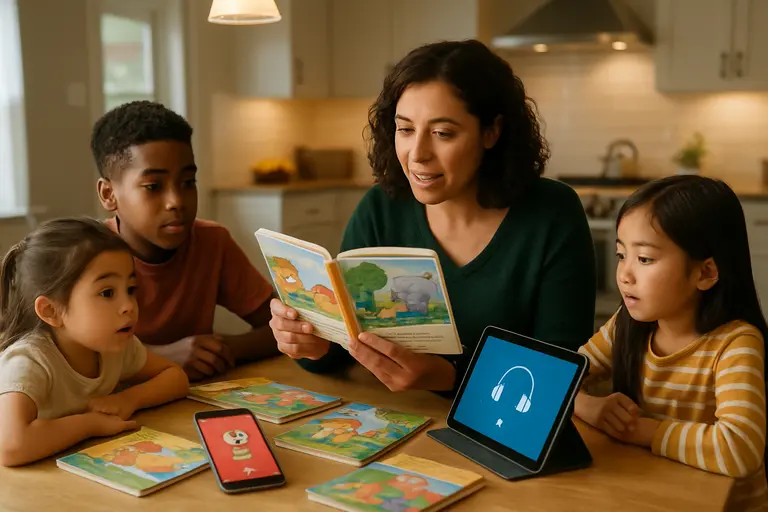
In a bilingual household, co-viewing can be simple. A parent might pause and say, “¿Qué pasó?” or “What do you think she wants?” A grandparent might repeat a useful phrase in the home language. A caregiver might connect the story to a real routine: “They are washing hands. We wash hands before dinner too.” These responses turn a one-way stream into a shared language moment.
What Screens May Replace
The research notes also describe evidence from several recent studies that more screen time, especially around family routines such as meals, was associated with weaker language measures. The likely concern is displacement: minutes spent with a device may be minutes not spent talking, reading, singing, pretending, cooking together, or playing with siblings.
Displacement can affect bilingual children in uneven ways. If a child already hears the school or community language for many hours, extra media in that same language may crowd out the home language. If heritage-language media is used carefully, it may provide useful models, but it still works best when paired with interaction. Families who want structured non-screen ideas can connect videos to bilingual language activities such as shared reading, category games, storytelling, and daily routine talk.
- Choose age-appropriate educational content when screens are used.
- Watch with the child when possible, especially with younger children.
- Ask open questions in either language rather than only labeling objects.
- Repeat useful phrases later during meals, bath time, errands, or play.
- Protect daily time for live conversation in both languages.
A Bilingual Home Plan For Screen-Based Input
Use Screens As A Starting Point, Not The Full Lesson
A practical plan starts by deciding what the screen is for. Is the goal to hear more Spanish songs? To keep a connection with a grandparent’s language? To introduce vocabulary about animals, cooking, emotions, or school routines? A clear goal helps parents avoid long viewing sessions that feel educational but do not lead to real communication.
After a short video, the adult can bring the language into the room. If the child watched a clip about fruit in Mandarin, the family can name fruit while unpacking groceries. If the child heard a story in Arabic, a parent can retell one part during bedtime. If the child watched an English science segment, a caregiver can invite the home language too: “How would Abuela say ‘moon’?”
This approach keeps passive screen exposure in a supporting role. It may offer pronunciation models, songs, repeated phrases, or culturally familiar stories. It should not be expected to carry the full job of bilingual language development, especially for expressive language.
Balance Both Languages With Realistic Expectations
Some families use screens because they do not have many speakers of the minority language nearby. That is a real constraint, and families should not be blamed for using the tools available to them. Still, the research described here points toward a balanced message: non-interactive media may contribute some input, but children still need responsive language partners.
Parents can keep a simple weekly check. Which language did the child hear from people? Which language did the child use to ask, refuse, explain, pretend, or tell a story? Which language appeared mostly through videos? If one language is mostly screen-based, the next step may be adding a phone call with relatives, a shared book, a cooking routine, a playdate, or a song the child can sing with another person.
Off-screen creative routines can also extend language. Drawing a scene from a video and telling someone about it can prompt new words and sentence practice. Families looking for art-based prompts may enjoy resources like The Sketchbook Project, which encourages artistic exploration that families can use to describe their creations in either one or both languages.
Passive Screen Exposure And Bilingual Development
Passive screen exposure is best understood as one possible source of language input, not a replacement for interaction. The evidence from recent studies is mixed in the details but consistent in one practical direction: supervision, co-use, content quality, and moderation matter. Unsupervised, long, non-interactive viewing is the pattern that raises the most concern in the research notes.
For bilingual children, the goal is not perfection. The goal is to keep both languages connected to people, routines, emotions, play, books, songs, and useful communication. A child may enjoy a video in the heritage language and still need an adult to help turn that exposure into words used at the table, in the car, at bedtime, and during play.
Families can treat screens as prompts: watch briefly, talk during or after, reuse the words later, and protect time for live conversation. That plan respects the possible value of media without overstating what non-interactive viewing can do. In bilingual development, the strongest language moments usually happen when a child’s message changes what another person says or does next.