Family photos are usually treated as keepsakes, not language tools. Yet family photos for language development can give children something generic picture cards cannot: a familiar event they may remember, care about, and want to discuss. That familiarity can turn “Who is this?” into a longer exchange about what happened, how someone felt, and what came next.
The strongest use of a photo is not asking a child to identify everyone correctly. It is using the image as a doorway into conversation, moving from naming people and places toward describing actions, recalling details, sequencing events, and telling a short personal story. That same low-pressure approach fits naturally with other language activities built around everyday interaction.
Familiar pictures make conversation easier to enter
Children often have more to say when the topic is already meaningful to them. A family photo removes the pressure of inventing a subject from scratch because the people, places, and experiences may already carry memories, emotions, and familiar vocabulary.
That familiarity can make the first step surprisingly simple. A child who says very little about an unfamiliar picture may immediately recognize a sibling, grandparent, pet, birthday cake, playground, or vacation spot. Recognition creates an opening for language that feels connected to real life.
Photos also give children something concrete to look at while they talk. Instead of holding every detail in memory, they can point, notice facial expressions, identify objects, and use the image to support what they want to say. This can make longer exchanges feel more manageable.
The adult’s role is not to extract the “right” story from the picture. It is to follow the child’s attention and gently add opportunities for richer language. A comment about who is pictured can lead to an action, an action can lead to a memory, and that memory can become the beginning of a personal narrative.
Family photos for language development work because the story already matters
A photo reduces one of the hardest parts of storytelling: deciding what to talk about. The people, place, and event are already visible, so the child can spend more effort organizing language around them.
A small 2026 preschool study used family photographs with prompts such as who, where, what, and how, followed by adult modeling and child retelling. The sample included only 19 children, so the findings should not be treated as a universal formula. Still, the children improved in producing complete personal narratives, and familiar photographs appeared to make the task easier.
That fits a broader principle in narrative language work: children need opportunities to provide context, organize events, and connect ideas for a listener. Family pictures can create those opportunities without making conversation feel like a formal lesson.
Start with labeling, then ask for one more piece
Young children may begin with concrete information. “Grandma.” “Beach.” “Cake.” Those answers are useful starting points, not incomplete performances.
Instead of firing several questions at once, add one prompt that extends the child’s message. If they say “Grandma,” ask, “What is Grandma doing?” If they say “birthday,” ask, “Whose birthday was it?”
The goal is gradual expansion. A child who identifies people may next describe an action. A child who describes an action may be ready to explain where it happened or why. Build from what the child gives you rather than forcing a script.
A simple progression can look like this:
| Photo conversation level | Example prompt | Language being practiced |
|---|---|---|
| Labeling | “Who is this?” | Names and familiar nouns |
| Describing | “What is he doing?” | Verbs and details |
| Locating | “Where were we?” | Place words and context |
| Recalling | “What happened before this?” | Memory and sequencing |
| Explaining | “Why were you laughing?” | Causes and emotions |
| Retelling | “Tell me the whole story.” | Connected personal narrative |
The levels can overlap. Children may describe, remember, and explain within the same conversation.
Move from a picture description to a personal story
Describing what is visible and telling a story are different tasks. “Dad is holding a balloon” explains the picture. A story adds events beyond the frozen moment: “We went to the park. Dad brought balloons. Mine flew away, and then he gave me another one.”
This is where family photos become especially useful. They can help children practice before, during, and after without invented characters or an unfamiliar plot. If the child remembers the event, the image acts as a cue rather than the entire story.
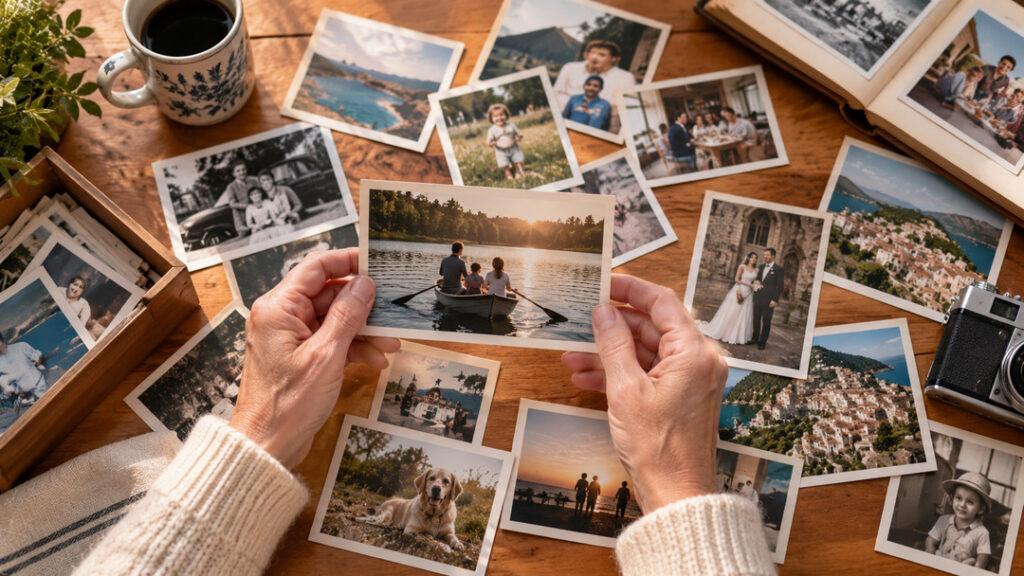
Parents can also choose two or three photos from the same outing and ask the child to arrange them in order. Questions such as “What happened first?” and “What came next?” shift the activity from describing isolated images toward constructing a sequence another person can follow.
As the child becomes more confident, remove some of the support. Show only one picture and ask what happened before or afterward. Eventually, the child may be able to tell the event without looking at the photo at all.
Emotions make the story richer
Personal stories become more interesting when children move beyond actions and begin explaining thoughts and feelings. A photo of a child hiding behind a parent at a party can open questions such as “How did you feel when we arrived?” or “What made you feel better later?”
Avoid treating the photo like an emotion test with one correct answer. A child may remember the experience differently from the adult, or may not remember it clearly. The adult can model possibilities: “You look surprised here. I remember the music was really loud.”
That kind of conversation adds internal-state language—words about feelings, wants, thoughts, and reactions. It helps children explain why an event mattered rather than simply listing what occurred.
Parents can also connect feelings to changes in the story. “You were nervous when we arrived. What happened that made you smile later?” Now the child has a reason to link two moments instead of naming one emotion.
Model the missing pieces without taking over
Some children will answer every prompt with one or two words. Others may jump into a long story that is difficult to follow. Both situations give adults something useful to work with.
If a child says, “Zoo. Monkey. Funny,” an adult might model, “We went to the zoo, and the monkey made us laugh.” Then pause. The child may add the next part. Modeling shows how separate details can become a connected sentence without stopping the interaction.
Professional narrative language approaches often target context, event organization, and language that connects ideas. Naturalistic approaches can also follow a child’s lead and expand what the child says, which helps explain why responsive photo conversations can be more useful than repeatedly demanding longer answers.
The key is support without interrogation. Too many rapid questions can make a child feel examined rather than heard. Comments, shared memories, pauses, laughter, and genuine reactions matter too.
Watch for richer stories, not longer answers alone
Progress is not simply a matter of counting words. A shorter story may be stronger if the child clearly identifies who was there, places events in order, and explains what happened.
Parents can notice whether the child begins adding more independently: names, actions, locations, time words, causes, feelings, or endings. A child who once needed “Who was there?” may eventually include that information without prompting.
Family photos for language development work best as conversation starters, not tests. Their advantage is personal relevance: the child is not being asked to manufacture a story from nothing. A familiar face or remembered event gives language something real to organize, making the path from “That’s Grandma” to a complete personal narrative easier to see.
Frequently asked questions
What age can children start using family photos for conversation?
Even young children can look at familiar photos and name people, objects, or actions. The activity can become more complex as language grows, progressing toward sequencing events, explaining feelings, and telling personal stories.
Should parents correct grammar during family-photo storytelling?
Usually, conversation is better preserved by modeling the correct form naturally. If a child says, “We goed park,” an adult might respond, “Yes, we went to the park,” then continue discussing the memory.
What if my child does not remember what happened in a photo?
That is fine. Describe what is visible, share your own memory, or invite the child to imagine what might have happened. The goal is meaningful language practice, not testing autobiographical memory.