Picture cards are easy to reach for when adults want quick language practice, but recognition is not the same as knowing how to use a word. Picture cards for vocabulary become genuinely useful when children move beyond naming and begin describing, sorting, comparing, questioning, and connecting the image to real life.
Children do not build flexible language by memorizing isolated labels alone. Strong activities create a reason to retrieve the word and use it with another person, which is central to understanding why language games work.
Picture Cards Work When the Image Starts a Conversation
The simplest picture-card routine is familiar: show a card, ask “What is it?”, and wait for the name. That can be a useful starting point, but it reveals only whether the label is available in that moment.
Real word knowledge is broader. A child may recognize a ladder yet still need help explaining what it is used for, where it might be found, how it differs from stairs, or what action belongs with it. A word becomes stronger when it connects to other ideas.
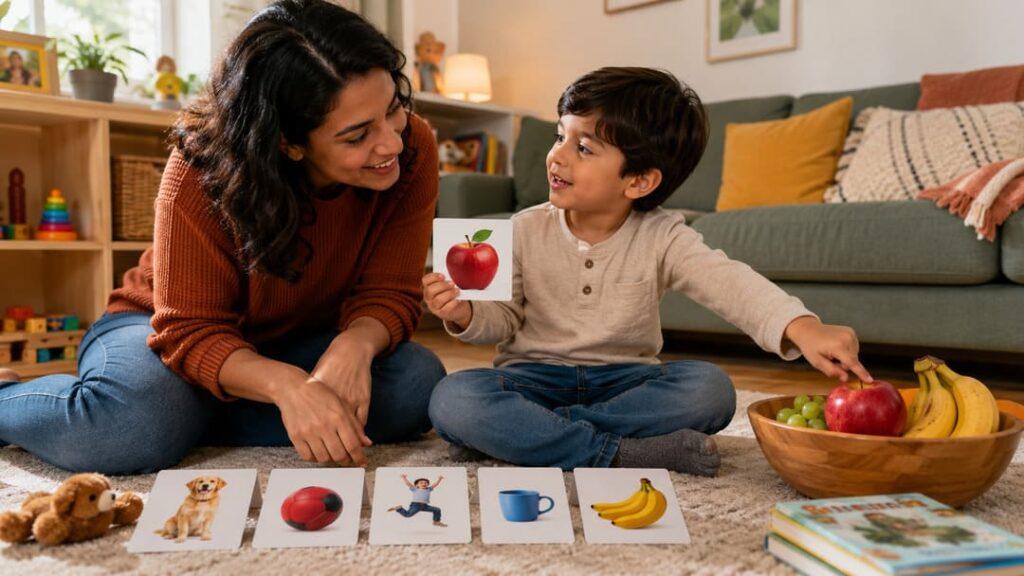
A card showing a dog can lead to nouns such as animal and pet, verbs such as run and bark, adjectives such as furry and playful, and sentences about personal experience.
The American Speech-Language-Hearing Association recommends talking about familiar pictures, people, places, objects, actions, and uses within its collection of language-building activities. The important part is the exchange around the image, not the card by itself.
Choose Picture Cards for Vocabulary Children Can Use
Clear, uncluttered images are easier to interpret than busy scenes when a child is first learning a word. Begin with familiar people, foods, animals, clothing, household objects, toys, actions, and places from the child’s daily life.
Photographs may help when the goal is recognizing real objects or actions. Simple illustrations can work well when irrelevant detail would distract from the target. The useful image is the one the child understands.
Build small sets rather than presenting a large stack. Six cards about mealtime create more opportunity for meaningful comparison than fifty unrelated cards shown in rapid succession. The set might include cup, plate, spoon, banana, pouring, and eating.
Include verbs and describing words, not only object names. Children need language for what people do, how things feel, where items belong, and how events unfold. A set made entirely of nouns can quietly narrow the conversation.
Cards should reflect the child’s environment without forcing every family or routine into one “normal” version. Familiarity supports participation, while varied images help children understand that a word can apply across different examples.
Reuse Familiar Cards in New Ways
Children often need to meet a word many times before they can understand and use it confidently. Reusing the same picture cards across several activities gives the child repeated exposure without requiring the adult to present the word in exactly the same way each time.
A card showing a bicycle might first be used for naming. During another activity, the child can describe its wheels, explain where people ride it, compare it with a car, or place it in a group with other vehicles. Each new task strengthens a different connection to the word.
Change the arrangement and purpose of the cards to keep familiar vocabulary interesting. Place them around the room for a search game, hide one card and ask what is missing, or let the child select a picture for the adult to guess. Repetition works best when the interaction changes.
The child should also have opportunities to control the cards. They can choose the next picture, create a category, ask the adult a question, or decide which cards belong in a pretend shop, zoo, kitchen, or school. Taking the lead encourages more independent language and reduces the feeling of being tested.
Move familiar words beyond the card whenever possible. After discussing a picture of a coat, find a real coat, pretend to put it on, or talk about weather that makes a coat useful. These connections help children recognize that vocabulary belongs in daily experiences, not only in a stack of pictures.
Six Activities That Move Beyond Naming
The same card set can support several language targets. Change the question or rule instead of buying new materials every time the child learns the names.
| Activity | Example Prompt | Main Language Target |
|---|---|---|
| Find the match | Which card is the same? | Recognition and word recall |
| Sort the cards | Put foods here and animals there | Categories and word relationships |
| Describe and guess | It is furry and says meow | Describing words and listening |
| Find the odd one out | Which one does not belong? | Reasoning and explanation |
| Build a sentence | The boy is kicking the ball | Grammar and sentence formation |
| Put a story in order | What happened first, next, and last? | Sequencing and connected language |
Matching works well for early learners, but add language to the action: “You found two buses. Both have wheels.” Sorting encourages children to notice relationships and explain them.
In a describe-and-guess game, hide the chosen card from the listener. The child must give enough information for someone else to identify it, creating a real reason to choose precise words.
Odd-one-out activities should allow more than one defensible answer. In a set containing a bird, dog, fish, and airplane, the airplane may be different because it is not an animal, while the fish may be different because it does not travel through the air or on land. The explanation matters more than the expected answer.
Turn a Known Label Into Richer Language
Once a child can name a picture, resist removing it immediately from practice. Familiar cards are often the best material for building longer phrases and deeper word knowledge because the child is not struggling to identify the basic image.
Use prompts that open different routes into the word: “What does it do?”, “Where would we find it?”, “What parts does it have?”, “What goes with it?”, or “How is it different from this one?” A picture of an umbrella can connect to rain, wet, open, close, handle, boots, and weather.
Adults can expand a child’s response without requiring repetition. If the child says, “Baby sleep,” answer, “The baby is sleeping under a soft blanket.” The model adds grammar and description while preserving the child’s idea.
Harvard’s Center on the Developing Child describes responsive serve-and-return interactions as back-and-forth exchanges in which an adult notices and responds to a child’s communication. Picture-card play benefits from the same rhythm: notice the child’s word, gesture, look, or question, then respond in a way that invites another turn.
Leave time for retrieval. Children may know the word but need several seconds to find it. A pause is part of the activity, not empty time that must be filled with another question.
Pressure Points That Make Picture Cards Feel Like Tests
Rapid-fire naming can produce many answers while creating little conversation. If the adult controls every card, asks every question, and immediately judges every response, the child becomes a test-taker rather than a communication partner.
Correction can also interrupt participation. When a child calls a tiger a “big cat,” begin with the meaning: “Yes, it is a big cat—a tiger.” That supplies the specific word without dismissing the child’s description.
Avoid insisting on eye contact, perfect pronunciation, or complete sentences before accepting a turn. A child may point, sign, select a symbol, use a home-language word, or offer part of the answer. Adults can model a fuller form while keeping the exchange moving.
Do not assume that more cards create better practice. A large deck can increase visual load and encourage speed over understanding. A small, reusable set often creates richer language because the words can be revisited in different ways.
Picture cards should not remain disconnected from the world they represent. After using a card for spoon, find a real spoon. After discussing jumping, jump together. After sequencing pictures of planting a seed, try the routine or connect it to a book.
Watch for Use, Not Just Recognition
Progress appears when children begin using words without the card directly in front of them. They may apply a familiar label to a new example, combine it with a verb, use it during play, explain a category, or recall it later in the day.
Change one demand at a time as the activity grows. Add a second describing feature, ask for a reason, introduce a similar picture, or invite the child to become the questioner. Older children can define a word without naming it, compare two cards, or create a short story.
Repeated guessing, withdrawal, silence, or frustration may signal that the pictures are unfamiliar, the questions are too broad, or the pace is too fast. Reduce the set and return to meaningful, familiar words rather than pushing through.
Picture cards for vocabulary are most effective when they stop functioning like miniature tests and start functioning like shared play. The opportunity is not collecting correct labels; it is building words children can understand, connect, and use. Keep the images familiar, the exchanges responsive, and the language tied to real actions, objects, and experiences. That is how a card becomes a bridge from seeing a word to owning it.
FAQs
How many picture cards should I use at one time?
Begin with four to six familiar cards. A small set reduces visual overload and gives children time to compare, describe, sort, and reuse each word before additional cards are introduced.
Are photographs better than illustrated picture cards?
Photographs can support recognition of real objects, while simple illustrations may reduce distracting details. Choose the format the child understands most easily, then gradually introduce varied images of the same word.
Can bilingual children use picture cards in both languages?
Yes. Children can name, describe, sort, or discuss cards in either language. Adults may model corresponding words across both languages without treating one language as the only acceptable response.