Speech milestones from 18 to 24 months are less about producing a perfect list of words than about building a more flexible communication system. During these six months, many toddlers move from scattered labels and gestures toward purposeful vocabulary, short word combinations, clearer requests, and stronger understanding.
The most useful question is not simply, “How many words does my child say?” Families can use this toddler speech milestone guide to consider vocabulary alongside comprehension, gestures, play, sound development, and social interaction.
Communication Becomes More Intentional Across Daily Life
During this period, toddlers begin using communication for a wider range of purposes. A word or gesture may request help, reject an unwanted object, identify something interesting, call a familiar person, or comment on what just happened.
The same word may also become more flexible. “Ball” might first appear only during play, then later be used to find a missing ball, request a turn, or point one out in a picture book. This spread across situations shows that the child understands the word beyond one memorized routine.
Toddlers also become more active communication partners. They may bring an object to an adult, wait for a response, repeat a message when misunderstood, or combine eye contact with a sound or gesture to make their intention clearer.
These small changes reveal growing independence. The child is no longer relying entirely on adults to interpret behavior and needs; words, gestures, and short combinations are becoming practical tools for participating in everyday family life.
Speech Milestones From 18 to 24 Months Are About Expansion
At 18 months, a toddler may rely heavily on pointing, facial expression, and a small set of familiar words. By the second birthday, communication often becomes more varied: words appear in more settings, requests become clearer, and combinations such as “more milk” or “daddy go” begin to emerge.
The ASHA communication milestones for 19 to 24 months include understanding and using at least 50 different words, putting two or more words together, following two-step directions, using early pronouns, and asking for help with words.
These are broad expectations, not a daily performance checklist. Children may strengthen one area before another, and speech may remain unclear even as language becomes more sophisticated. Forward movement across several skills matters more than one isolated total.
Vocabulary Growth Becomes More Functional
Early vocabulary often begins with names for people, foods, toys, animals, and favorite routines. Between 18 and 24 months, words usually become useful for more purposes. A toddler may request “open,” protest “no,” describe “hot,” identify “dog,” call “mama,” or announce “gone.”
Approximations can count when they carry a stable meaning. “Ba” may represent ball and “nana” may mean banana. The word does not need adult pronunciation, but the child should use it consistently enough that a familiar listener recognizes the intended idea.
Vocabulary quality also matters. A child with nouns, actions, social words, and descriptions has more ways to communicate than a child who repeats many object labels only after prompting.
| Area of Growth | What Caregivers May Notice | Everyday Example |
|---|---|---|
| Vocabulary | More words used independently | Naming food, people, toys, and actions |
| Word combinations | Two ideas joined in one message | “More juice” or “baby sleep” |
| Understanding | Directions followed with less support | “Get the cup and bring it here” |
| Naming | Familiar pictures or body parts identified | Pointing to or naming a dog in a book |
| Speech sounds | More varied consonants and word shapes | Moving from “ba” to “ball” or “baba” |
Word Combinations Reveal New Language Organization
Two-word phrases show that the toddler is doing more than collecting vocabulary. “Mommy shoe” expresses ownership, “dog eat” links an animal with an action, and “ball there” connects an object with a location.
Early combinations may omit small grammatical words and endings. That is expected. “Daddy go work” does not need to sound like an adult sentence to demonstrate that the child understands how ideas relate.
Some phrases begin as memorized chunks. “All done” or “thank you” may initially function like one unit. Flexible language becomes clearer when a toddler changes part of the pattern, moving from “more milk” to “more bubbles” or “more crackers.”
Flexible combinations are more informative than rehearsed phrases because they show that the child can select and organize words for a new message.
Understanding and Naming Move Beyond Familiar Routines
Receptive language usually remains ahead of spoken language. A toddler may understand names for household objects, body parts, people, actions, and simple locations before using those words independently.
Following directions also becomes more revealing. A familiar one-step request such as “bring your shoes” may become easier without a pointing gesture. Some toddlers begin handling connected directions such as “get the spoon and put it on the table,” especially when the vocabulary and routine are familiar.
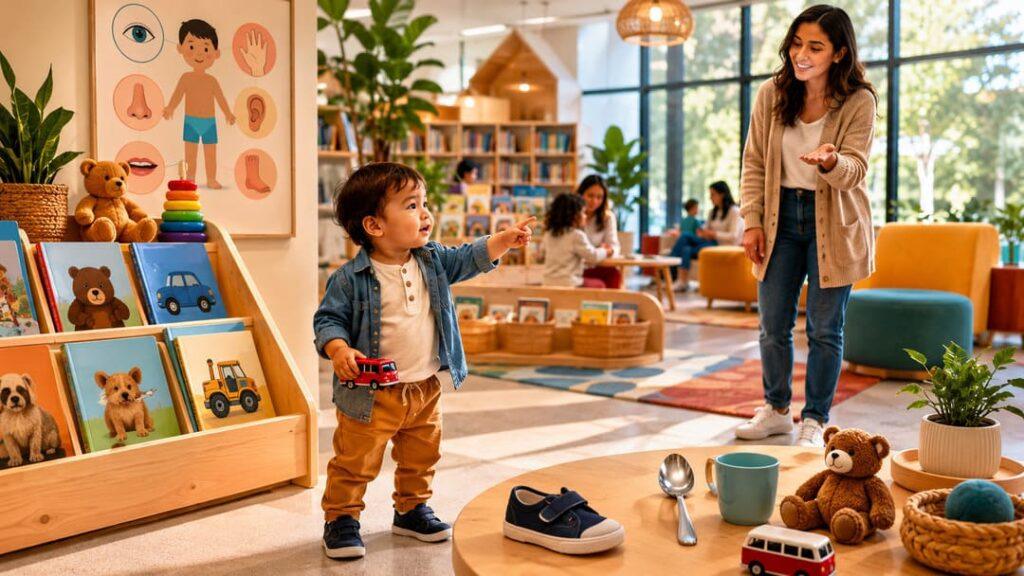
Naming develops through books, play, and daily life. A toddler may point to a bear when asked, name a vehicle in a picture, or identify eyes and feet. The CDC milestones for age two include pointing to requested book pictures and body parts, using more gestures, and saying at least two words together.
A child does not need to answer every “What is this?” question. Recognition, pointing, imitation, and spontaneous naming all provide evidence that words are being learned.
Everyday Observation Is More Useful Than Testing
Toddlers communicate differently across settings. A child may talk freely during breakfast but use mostly gestures in a noisy playground or around unfamiliar adults. One short observation can underestimate what the child knows.
Watch communication across meals, dressing, outdoor play, books, and pretend play. Notice whether new words appear, familiar words spread into new situations, and the child needs less guessing from adults.
Caregivers can support progress by adding one small step to the child’s message. If the toddler says “car,” an adult might respond, “Fast car” or “Car goes.” If the child points to a closed box, the adult can model, “Open box.”
Avoid constant requests to repeat or perform. Responsive models protect the child’s reason to communicate while showing how a short message can become more specific.
Stalled Progress and Lost Skills Need Attention
Variation is expected, but the overall pattern should keep developing. Limited vocabulary becomes more concerning when it appears with weak understanding, few gestures, little imitation, reduced social engagement, or inconsistent responses to sound.
Families should raise concerns with a pediatrician when progress appears stalled or the child is not meeting several communication milestones. A hearing assessment may be useful because hearing difficulty can affect access to speech.
A speech-language pathologist can examine vocabulary, comprehension, gestures, play, sound production, word combinations, and communication repair. Loss of words or other acquired skills deserves prompt attention rather than a prolonged wait-and-see approach.
Speech milestones from 18 to 24 months describe a shift toward communication that is broader, more intentional, and increasingly organized. The strongest signs are not perfect pronunciation or an impressive word count, but steady vocabulary growth, emerging combinations, improving understanding, and a toddler who can share more precise meanings with other people.
FAQs
How many words should a 24-month-old use?
Vocabulary varies, but many children between 19 and 24 months understand and use at least 50 different words. Word combinations, comprehension, gestures, and continued growth also provide essential developmental context.
Should a two-year-old’s speech be completely clear?
No. Toddlers commonly simplify sounds or use approximations that familiar adults understand more easily. Clarity should gradually improve as the child develops more consonants, word shapes, and spoken combinations.
When should families request a speech evaluation?
Seek guidance when vocabulary is not growing, two-word combinations are absent near age two, understanding appears limited, hearing is a concern, or the child loses words or communication skills previously used.