A plastic elephant refusing to share a watering hole may look like a tiny drama, but it gives a child a safe way to rehearse a difficult social moment. Toy animals for social communication work because they turn invisible skills—waiting, noticing feelings, repairing conflict, and responding to another person—into actions children can see and control.
Unlike toys that perform for the child, animal figures leave the story open, allowing parents to use them as simple language tools that invite choices, questions, gestures, sound effects, and back-and-forth interaction without making play feel like a lesson.
How Toy Animals for Social Communication Build Reciprocity
Social communication is not simply knowing more words. It involves noticing another person, taking turns, staying with a shared topic, interpreting signals, and adjusting a response. Toy animals can hold all of those demands inside one short scene.
Pretend play with characters supports children as they imitate, describe, and work through real-life experiences and feelings. The American Academy of Pediatrics explains how pretend play develops imagination while giving children opportunities to practice social and emotional skills.
A parent might make a cow look toward the child’s horse, pause, and say, “Can I come in?” The child then has a genuine reason to respond. That exchange is more socially meaningful than asking the child to repeat an isolated phrase because the words change what happens next.
Toy Animals Turn Social Rules Into Visible Stories
Young children are still learning that another person can want something different, feel disappointed, or need help. A toy bear can be hungry while a toy rabbit guards the food. A lion can roar too loudly and frighten a smaller animal. These scenes make social information concrete.
The figures also create useful emotional distance. A child who does not want to discuss being left out may still explain why the zebra is lonely. That separation can make it easier to explore feelings, consequences, and possible solutions without placing the child under direct pressure.
The strongest play does not depend on perfect dialogue. A pause, a pointed finger, an animal sound, or moving one figure toward another can all carry meaning. Communication begins before a complete sentence, and adults should respond to the message rather than focusing only on verbal accuracy.
The Adult Should Extend the Story, Not Control It
Adults often weaken pretend play by asking too many testing questions: “What animal is this?” “What color is it?” “What sound does it make?” Those questions can check knowledge, but they rarely build a sustained interaction.
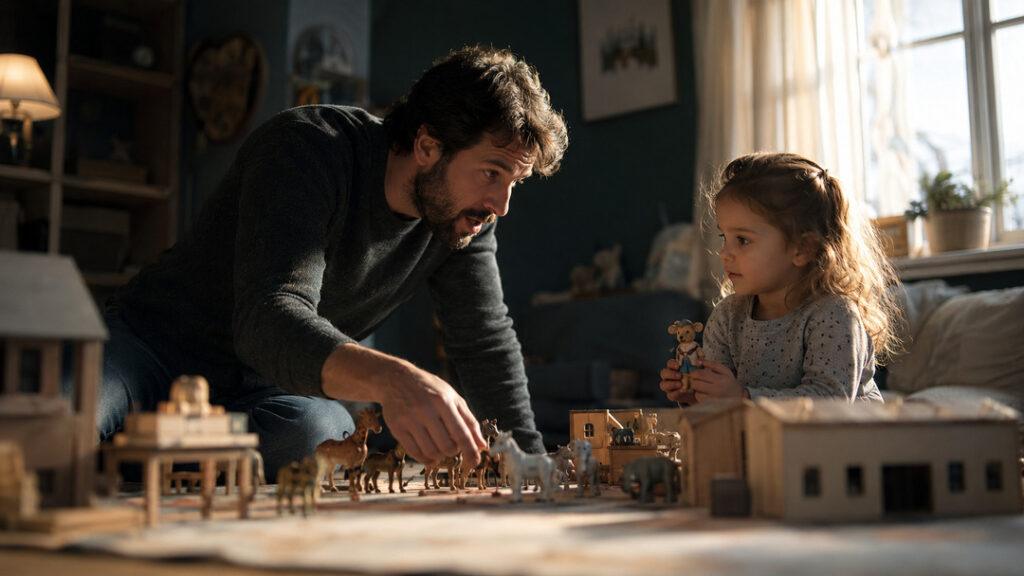
A better approach is to observe, join, and add one small idea. If the child lines up animals, the adult can place one at the back and say, “This one is waiting.” If two animals crash, the adult can model, “Ouch. Are you okay?” The goal is not to seize the plot but to create a reason for the child to notice and respond.
This back-and-forth pattern reflects the responsive interaction described in Harvard’s serve-and-return guidance. The adult notices the child’s action, answers it, and allows the child another turn. The pause is part of the teaching because it leaves space for initiative.
A Repeatable Play Sequence for Home or Class
Parents and educators do not need elaborate farms, branded sets, or realistic scenery. Three or four figures and a few household objects are enough. A block can become a bed, a bowl can become a pond, and a towel can become a mountain.
| Play Moment | Adult Prompt | Social Skill Practiced |
|---|---|---|
| Two animals want one object | “They both want it. What could they do?” | Negotiation and turn-taking |
| One animal is hurt | “The fox fell down. Who noticed?” | Attention and empathy |
| A new animal arrives | “The giraffe does not know the game yet.” | Inclusion and explanation |
| An animal makes a mistake | “The bear knocked it over. What happens now?” | Repair and responsibility |
| The group changes plans | “The pond is closed. Where can they go?” | Flexibility and joint planning |
Keep each scene short enough for the child to remain involved. Repeat familiar situations across several days, changing one detail at a time. Repetition reduces the language load, while the small change encourages flexible thinking.
Pressure Points That Can Stop the Conversation
The first risk is turning every play session into correction. Constantly fixing grammar, pronunciation, or the “right” way to use a figure can make a child cautious. Model a clearer phrase naturally, then continue the story.
The second is speaking for every character. When adults fill every silence, children become spectators. Count quietly for several seconds after a prompt, and watch for nonverbal responses as well as words.
The third is making every conflict disappear immediately. Mild pretend problems are useful: an animal cannot reach, two characters disagree, or someone forgets the rule. A manageable problem gives communication a purpose. Adults can support the child without supplying the entire solution.
Parents should also watch the level of emotional intensity. A child who becomes distressed may need a simpler story, a familiar routine, or a calm ending. Play should stretch social understanding without becoming overwhelming.
Small Figures Can Create Serious Social Practice
Toy animals are effective because they are flexible, familiar, and easy to animate. They let children experiment with friendship, disagreement, kindness, leadership, fear, and repair in a world small enough to rearrange.
The next step is not buying more pieces. It is making the interaction more responsive: follow the child’s focus, introduce one useful complication, wait for a response, and build from whatever the child communicates. Used this way, toy animals for social communication become more than vocabulary props. They become rehearsal partners for the everyday work of connecting with other people.
FAQs
What age can children begin using toy animals for communication play?
Toy animals can become useful during toddlerhood as children begin imitating actions and creating simple pretend routines. Adults should match the story, language, and number of figures to the child’s attention and developmental level.
Can children participate without speaking in full sentences?
Yes. Children can communicate by pointing, moving figures, making sounds, looking toward an adult, or choosing between options. Adults can acknowledge the message and model short words without demanding repetition.
How long should a toy-animal play session last?
Follow the child’s engagement rather than a fixed schedule. Several focused minutes can be more productive than a long, adult-directed session. End while the interaction still feels enjoyable and return to the story later.