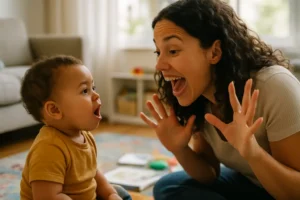
Toddlers rarely learn language because an adult turns the room into a classroom. The real power of play-based language activities is that they meet children where their attention already lives: in movement, repetition, surprise, imitation, and shared delight.
That is why the conversation around early communication needs to shift away from flashcards, pressure, and performance. Parents looking for practical support can start with simple guidance on why games work for language growth, because the strongest language moments often look less like teaching and more like playing together on the floor.
Play Lowers The Pressure Toddlers Feel Around Words
A toddler who is asked to “say cup” may freeze, turn away, or repeat the sound once without understanding why it matters. But a toddler pretending to pour tea from a toy cup has a reason to listen, gesture, copy, laugh, and eventually try the word. The difference is not small. It is the difference between language as a test and language as a tool.
Adults often mistake silence for lack of learning. In reality, toddlers are absorbing patterns long before they produce clear words. They are watching faces, connecting sounds to actions, learning turn-taking, and figuring out that communication changes what happens next.
Play gives that process a safe structure. A child can try a sound, point instead of speak, babble dramatically, or repeat only the last syllable. None of that is failure. It is practice inside a relationship.
The mistake is believing language growth must be formal to be effective. For many toddlers, formal pressure creates the opposite result. It makes speech feel like a demand. Play makes communication feel useful.
Why Play-Based Language Activities Build Stronger Daily Practice
The best language activities do not require expensive toys or complicated plans. They require repetition with meaning. A child hears “roll the ball” while actually rolling the ball. They hear “up” while being lifted. They hear “more” when snack time naturally creates a reason to request.
That kind of learning sticks because the word is tied to action. Toddlers are not memorizing vocabulary in isolation. They are connecting sound, gesture, emotion, movement, and outcome.
This is where small daily repetition becomes more valuable than long lessons. Five minutes of playful back-and-forth during breakfast, bath time, cleanup, or dressing may do more than a structured activity that the child resists. The goal is not to fill every silence. It is to create predictable chances for the child to take a turn.
Families can also use trusted child-development resources such as the CDC’s developmental milestones to understand broad communication expectations while remembering that toddlers do not develop on identical timelines.
The practical takeaway is simple: language grows best when words are attached to something the child wants to do, touch, repeat, or share.
The Adult’s Role Is Not To Perform More, But To Notice Better
Many adults respond to speech concerns by talking constantly. They narrate every object, ask rapid questions, and try to pull words out of the child. The intention is loving, but the rhythm can become overwhelming.
A more effective adult role is quieter and more strategic. Watch what the child is already interested in. Join that activity. Add one small word or phrase. Pause. Wait. Respond to whatever the child offers.
If the child pushes a toy car, the adult might say, “Car goes fast.” If the child says “go,” the adult can expand it: “Go fast.” If the child points to bubbles, the adult can hold the bottle, wait for a sound, gesture, or look, then say, “More bubbles.”
That pause matters. Toddlers need space to process. When adults fill every gap, they may accidentally take away the child’s chance to participate.
| Play Moment | Adult Language Move | Why It Helps |
|---|---|---|
| Rolling a ball | “Roll ball,” then pause | Connects word to action |
| Snack time | “More banana?” | Creates a natural reason to request |
| Bath play | “Splash, splash,” then copy the child | Builds imitation and turn-taking |
| Pretend cooking | “Stir soup,” “hot soup” | Adds simple phrases to symbolic play |
| Cleanup | “Block in,” “shoe on” | Uses routine words repeatedly |
The table shows the larger point: the activity itself does not have to be special. What matters is the adult’s timing, attention, and willingness to let the child lead.
Questions Can Help, But Too Many Turn Play Into A Quiz
One of the most common language-support mistakes is over-questioning. Adults ask, “What color is this? What animal is this? What sound does it make? What is that?” until play starts to feel like an interview.
Questions have a place, especially when the child is ready and engaged. But comments often work better for toddlers who are still building confidence. A comment gives language without demanding a performance.
Instead of asking, “What is this?” an adult can say, “Big dog.” Instead of asking, “Can you say blue?” the adult can say, “Blue block. Up, up, up.” Instead of testing animal sounds, the adult can make the sound during play and wait to see if the child joins.
This approach respects the child’s attention. It also keeps the interaction warm. A toddler who feels watched, corrected, or pressured may communicate less. A toddler who feels understood often takes more risks.
The strongest play-based approach is not passive. It is intentional without becoming rigid. Adults still model useful words, repeat sounds, expand short attempts, and create opportunities. They simply do it inside a playful exchange instead of forcing the child into a performance role.
Screens Should Not Replace The Back-And-Forth Toddlers Need
Language videos, songs, and apps may feel educational, especially when a child repeats words from a screen. But repetition from media is not the same as a living conversation. Toddlers need responsive interaction: someone notices their look, answers their sound, changes the game, waits for their turn, and reacts to their attempt.
That back-and-forth is difficult for a screen to provide. A video keeps moving whether the child points, babbles, looks away, or tries a word. A caregiver can stop, repeat, simplify, exaggerate, or turn the moment into a real exchange.
The issue is not that every screen moment is harmful. The risk is substitution. If video becomes the main language activity, the child may get exposure without enough participation. Interaction beats instruction when the goal is early communication.
The American Speech-Language-Hearing Association offers practical ideas for activities that encourage speech and language development, and the common thread is not complicated equipment. It is connection, response, and everyday repetition.
Parents should pay attention to how often language practice is happening with the child, not just around the child. A toddler overhearing adult speech is not having the same experience as a toddler taking turns in a playful exchange.
The Next Signal Is Whether Play Creates More Attempts
Parents often focus on word counts, but word counts do not tell the whole story. A toddler may be building the foundations of communication through gestures, imitation, shared attention, sound play, pretend actions, and back-and-forth routines.
The signal to watch is not perfection. It is participation. Is the child pointing more often? Copying sounds? Looking back to share excitement? Using gestures to request? Trying the same playful phrase during a familiar routine? Bringing a toy to an adult to restart a game?
Those are meaningful signs because spoken language does not appear in isolation. It grows from the child’s belief that communication works.
Still, play should not become an excuse to ignore concerns. If a toddler is not responding to sound, losing skills, rarely engaging with others, or showing limited communication across daily routines, families should raise those concerns with a pediatrician or qualified speech-language professional. Early support is not a label. It is a way to protect opportunity.
The better frame is not “wait and see” or “panic early.” It is watch closely, play intentionally, and respond quickly when concerns persist.
The promise of play-based language activities is not that every child will talk on the same schedule. It is that ordinary moments can become stronger communication opportunities when adults stop chasing perfect words and start building better exchanges. For toddlers, language grows fastest when it belongs to something real: a game, a giggle, a request, a routine, and a person who is truly listening.