A familiar song can turn a quiet child into an active communication partner before a full sentence appears. Music and early communication connect because rhythm, repetition, gesture, and anticipation give children several ways to participate—not just one demand to speak clearly.
The real value is not the song playing in the room. It is the exchange that happens around it: a caregiver pauses, the child looks or moves, and the adult responds. Families already using play-based communication ideas can treat songs as another flexible setting for shared attention rather than a performance children must copy.
Songs Give Children a Predictable Place to Join In
Conversation moves quickly. A young child must follow words, interpret tone, understand the topic, and decide when to respond. Songs slow that social demand by repeating the same sounds and actions in a recognizable order.
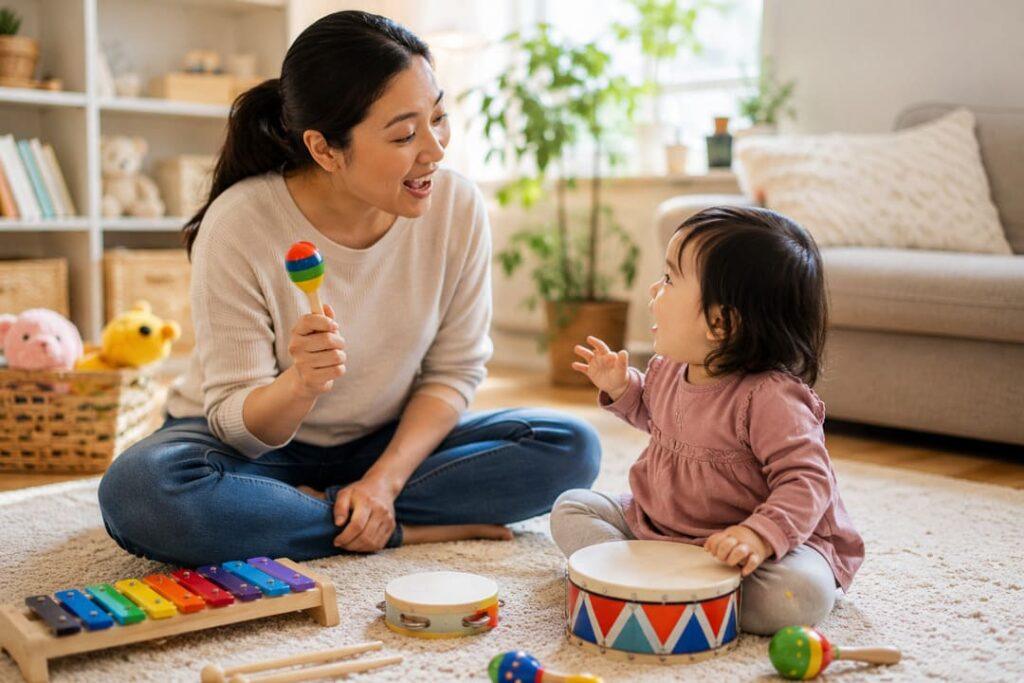
A child may first join by smiling before a favorite line, bouncing to the beat, or lifting both hands during a familiar gesture. These responses matter because they show anticipation and shared attention. Participation often appears before pronunciation.
Predictability also creates a natural opening for turn-taking. When an adult pauses before the final word in a repeated verse, the child can fill the space with a sound, movement, glance, or word. The adult then continues, showing that the child’s response affected the interaction.
Music and Early Communication Depend on Interaction
Recorded music can be enjoyable, but listening alone does not create the same communication opportunities as singing with another person. The useful ingredient is responsiveness: noticing what the child does and changing the next moment accordingly.
Harvard’s explanation of serve-and-return interaction describes the value of responsive back-and-forth exchanges between young children and caregivers. Singing can hold that pattern naturally. The adult begins a line, the child offers a gesture or sound, and the adult treats it as a meaningful turn.
This is why a slower, imperfect family song may be more useful than a polished recording. The live singer can wait, repeat, lower the volume, exaggerate a gesture, or follow the child’s idea. The relationship carries the learning.
Repetition Carries More Than Vocabulary
Songs are often promoted as a way to teach new words, but their communication value is broader. Repeated lyrics can help children notice patterns in sound, while melody and rhythm make the sequence easier to anticipate.
Action songs add another layer. A child who cannot yet say “up” may raise both arms. A child who misses a lyric may still clap at the expected moment. These movements let children connect language with meaning while remaining active in the exchange.
The American Academy of Pediatrics encourages families to sing songs and play rhythms, including opportunities for children to join and move to the beat. The practical lesson is simple: choose songs with clear actions, repeated lines, and enough space for a child to respond.
A Simple Song Routine Can Build Several Skills
Parents and educators do not need special instruments or a large playlist. One familiar song can support different communication goals when the adult changes how it is used.
| Song Moment | Adult Action | Communication Opportunity |
|---|---|---|
| Before the song begins | Show the gesture or object linked to the song | Choice-making and anticipation |
| During a repeated line | Pause before a familiar word | Vocalizing, signing, or completing |
| At an action verse | Copy the child’s movement | Imitation and shared attention |
| When the child changes the action | Follow the new idea | Initiative and flexible interaction |
| At the ending | Wait before starting again | Requesting and turn-taking |
Start with the child’s favorite part rather than insisting on the entire song. Repeat it several times, but vary one detail: sing softly, let a toy perform the movement, or replace a word with a funny sound. Small changes keep the routine predictable without making it rigid.
Everyday songs can also organize transitions. A short cleanup tune, handwashing verse, or getting-dressed chant gives language a clear purpose. Because the words occur alongside an action, the child receives contextual clues about what they mean.
Pressure Points That Can Silence Participation
The first mistake is singing without leaving any space. When adults move from one verse to the next at full speed, children may enjoy the music but have no practical opening to contribute. A deliberate pause can be more useful than another repetition.
The second is demanding exact imitation. Requiring a child to sing every word, copy every gesture, or perform on command can turn an inviting activity into a test. Accept approximations and respond to the child’s intent.
Volume and stimulation also matter. Loud recordings, flashing videos, or several instruments at once can compete with the social interaction. More entertainment does not always mean more communication. A quieter setup often makes facial expressions, gestures, and small vocal attempts easier to notice.
Parents should also avoid treating songs as a substitute for professional guidance when they have concerns about hearing, speech, language, or overall development. Music can create useful practice, but it is not an assessment or treatment plan.
The Best Song Leaves Room for an Answer
The most effective songs are not necessarily the newest, longest, or most educational. They are the ones a child recognizes, enjoys, and can enter through movement, sound, eye contact, or words.
That makes music and early communication less about building the perfect playlist and more about shaping the pause between two people. Adults should watch for initiative, answer small attempts, and let the child influence what happens next. The opportunity is not simply to help children remember lyrics. It is to help them discover that their communication can start, change, and continue a shared experience.
FAQs
What types of songs best support early communication?
Choose short songs with repeated words, predictable actions, and clear pauses. Familiar nursery rhymes, movement songs, and simple routine-based chants usually give children more opportunities to anticipate and participate.
Should adults correct children who sing the words incorrectly?
Direct correction is rarely necessary during playful singing. Respond positively to the child’s attempt, model the word naturally in the next verse, and keep the interaction moving without turning it into a test.
Can songs help a child who is not speaking yet?
Yes. A child can participate through gestures, eye contact, movement, sounds, or anticipation. These responses create communication opportunities, although developmental concerns should still be discussed with an appropriate professional.