
Imagine a classroom without walls, where lessons sprout from the soil. The Garden Language Lab turns any spot into a vibrant space for growing skills. You don’t need a big backyard. A sunny windowsill, a patio corner, or even a tabletop can become your launchpad.
Start simple. A few pots on a balcony for cherry tomatoes. A kitchen window box for basil and mint. For indoor fun, try a toy garden kit with felt flowers and pretend soil. The goal is to begin, not to be perfect.
The magic happens in the doing. The process of planting, watering, and watching is packed with talk. You naturally introduce new words like “sprout,” “tend,” and “bloom.” You practice sequencing by describing steps: “First, we fill the pot. Next, we make a little hole for the seed.”
This hands-on approach makes learning stick. For more inspiration on turning dirt into discovery, explore practical gardening projects with kids. Your journey with words is just beginning to grow.
Safety, sensory notes, and pacing for attention
Before planting the first seed, it’s important to plan for safety and sensory fun. This groundwork turns a simple patch of dirt into a safe classroom full of new words. Your goal is to make a calm place where curiosity leads.
Choosing the right child-safe gardening tools is key. Look for tools with soft grips and rounded edges. These features help build confidence and prevent small accidents.
It’s helpful to categorize tools:
- Digging Tools: Hand trowels, small shovels, and cultivators for little hands.
- Watering Tools: Lightweight watering cans with a gentle sprinkle rose or a small spray bottle for misting.
When each tool has a clear job, kids learn action words like “scoop,” “pat,” and “sprinkle” easily.
Choosing non-toxic plants is just as important as the tools. You want varieties that are safe if touched or tasted and that grow quickly to hold interest. A great sensory garden engages sight, smell, touch, and even taste.
Consider these fast-growing stars:
- Sunflowers: Their towering height and giant seeds are a visual marvel.
- Nasturtiums: Bright, edible flowers introduce peppery flavors.
- Cherry Tomatoes: Sweet, bite-sized fruits offer a tasty reward.
- Fragrant Herbs: Like mint or basil, they release scent with a gentle rub.
- Lamb’s Ear: Its fuzzy, soft leaves are irresistible to touch.
- Snap Peas: Provide a satisfying crunchy texture straight from the vine.
This table helps compare some top choices for a starter sensory garden:
| Sensory Focus | Plant Example | Why It’s Great for Kids |
|---|---|---|
| Touch & Texture | Lamb’s Ear | Soft, fuzzy leaves invite gentle touching and descriptive words like “furry” or “velvety.” |
| Taste & Crunch | Snap Peas | Grows quickly; kids can harvest and eat them raw, learning words like “crisp” and “sweet.” |
| Sight & Height | Sunflowers | Rapid growth provides a daily “wow” factor, perfect for tracking and comparing size. |
| Smell & Flavor | Nasturtiums | Edible flowers with a unique scent and taste, expanding vocabulary for smells and flavors. |
Pacing is key to avoiding frustration. Young children have short attention spans, so plan activities in short bursts of 10-15 minutes. This might mean just filling one pot with soil one day and planting seeds the next.
Follow their lead. If they are fascinated by a worm, pause the planting and explore. This flexibility keeps the mood light and joyful. The goal is discovery, not a perfect row of seeds.
By combining safe tools, engaging plants, and a relaxed pace, you create an environment where new vocabulary sprouts as naturally as the beans. Words for textures, actions, and smells will grow right alongside your garden.
Word banks: tools, actions, plant parts, textures, weather
A word bank is more than a list. It’s a living collection that brings the garden to life. It turns simple observations into meaningful talks. Think of it as your family’s lexical toolkit, ready for whenever curiosity strikes.
We’ve organized this essential garden vocabulary into five friendly categories. Each one helps kids describe what they’re doing, seeing, and feeling. The goal is to use these words naturally during your garden adventures.
Tools: The Helpers in Our Hands
Naming tools makes gardening feel official and important. When kids know what things are called, they feel more capable and involved.
- Trowel (for digging small holes)
- Rake (for smoothing soil)
- Watering can (for gentle sprinkles)
- Gloves (for protecting hands)
- Bucket (for carrying soil or weeds)
Model these words naturally: “Pass me the trowel, please” or “The watering can is almost empty.”
Actions: What We Do in the Garden
Action words give kids the language to participate. They transform watching into doing and help narrate the gardening process.
- Dig (making space for seeds)
- Pat (gently pressing soil)
- Sprinkle (watering lightly)
- Observe (looking closely)
- Measure (checking growth)
Use these in context: “Let’s dig a hole deep enough for this root” or “Watch how I sprinkle water on the leaves.”
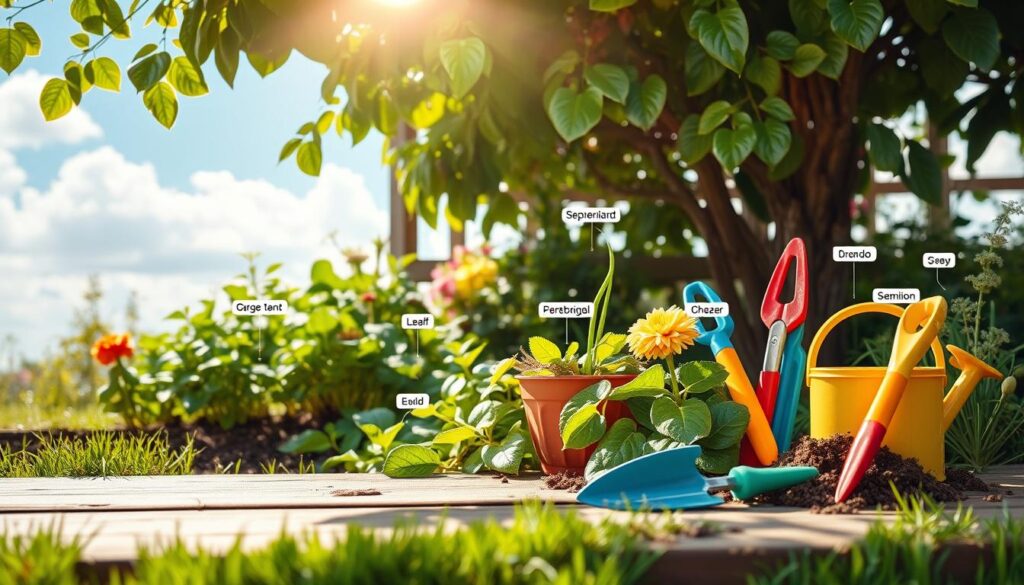
Knowing plant anatomy builds early science understanding. It helps kids notice details and appreciate how plants develop.
- Seed (the starting point)
- Root (hidden underground)
- Stem (the plant’s backbone)
- Leaf (catching sunlight)
- Petal (colorful flower part)
Point and name: “Look how long the roots have grown!” or “This stem is getting thicker every day.”
Textures: How Things Feel
Texture words connect sensory experience with language. They encourage kids to touch and explore their environment mindfully.
- Crumbly (dry, loose soil)
- Damp (moist but not wet)
- Smooth (polished stones)
- Prickly (pine needles)
- Fuzzy (some plant leaves)
Invite exploration: “Feel how crumbly this soil is” or “These petals feel so smooth and delicate.”
Weather: The Garden’s Mood
Weather vocabulary helps kids connect their gardening experience to the larger environment. It builds awareness of natural cycles.
- Sunny (bright and warm)
- Drizzle (light rain)
- Breeze (gentle wind)
- Overcast (cloudy sky)
- Humid (moist air)
Comment naturally: “The breeze is helping dry the leaves” or “Everything looks greener after that drizzle.”
The best way to build this garden vocabulary is through joyful repetition. Use the words yourself, celebrate when your child tries them, and watch their language garden grow alongside the plants. This word bank isn’t a test—it’s a collection of treasures to share.
Predict–Observe–Explain cycles for sprout investigations
Every sprouting seed has a secret, and kids are the best detectives to uncover it. The Predict-Observe-Explain cycle turns curiosity into a powerful tool for thinking critically.
This three-step process helps kids go from wondering to understanding. It makes a simple activity into a real investigation. You’re also helping them develop important language and reasoning skills.
The journey begins with a prediction. Before planting, ask fun questions. Say, “What do you think the seed will look like when it wakes up?” or “How many days until we see green?” There’s no wrong answer. You’re encouraging their guesses and building excitement.
Then comes the observe phase. This is where careful looking and detailed descriptions matter. Give your detective a magnifying glass. Ask, “Let’s use our tool! What color is the tiny shoot?” or “Is the stem smooth or fuzzy?” This helps them grow their vocabulary.
The final step is to explain. Connect what they see to their thoughts. Ask, “Why do you think it grew toward the window?” or “How did the seed coat change?” Their answers show how they think about cause and effect. Be sure to praise their logical thinking.
The real magic is in the cycle itself. By repeating predict, observe, and explain, you show learning is a journey. Each question and observation boosts their confidence. You’re teaching them how to think, not what to think.
See these cycles as mini science adventures. The aim is to celebrate the joy of asking, describing, and reasoning out loud. You’re nurturing a lifelong love for discovery.
Compare‑and‑chart growth with simple visuals
Make your garden a science lab with simple visuals. Use charts and drawings to track and compare growth. This makes time and change real for kids.
This activity boosts math and observation skills. It also lets kids see their hard work come to life.
Use the right words to help your child notice changes. Say things like “taller than,” “wider than,” or “darker green.” Talk about sequences, like “Last week it had two leaves, now it has four!”
Here are some easy ideas to start comparing:
- Plant two bean seeds in separate cups. Place one on a sunny windowsill and one in a shadier spot.
- Give one plant more water and the other less, observing the changes together.
- Use a piece of string or a ruler to measure height each week.
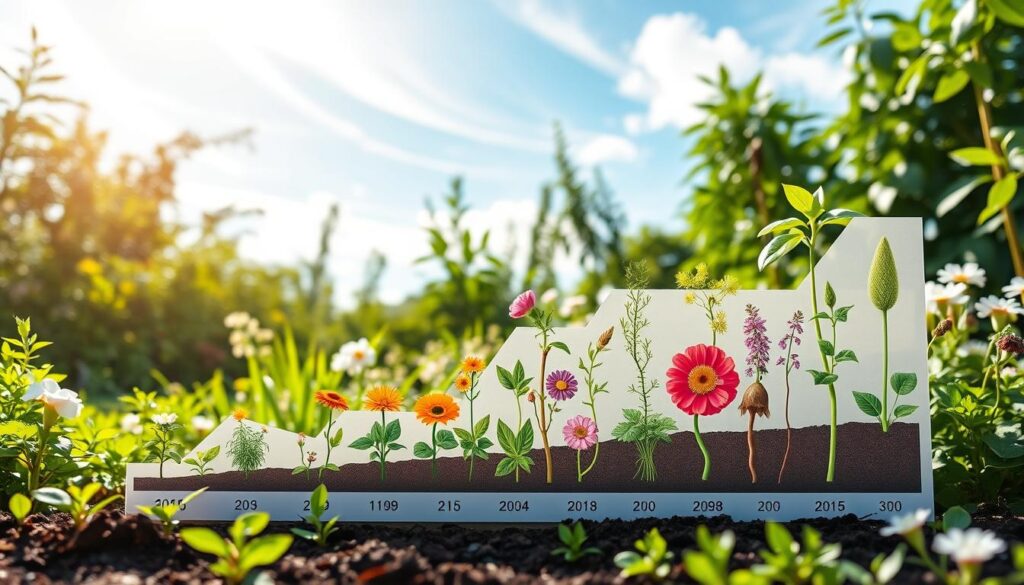
Now, let’s track that progress. You don’t need fancy tools. A hand-drawn chart or photos on your phone works great.
Here are two easy ways to visualize and compare growth:
| Tracking Method | What You Need | How It Helps Compare Growth |
|---|---|---|
| Photo Timeline | Smartphone or camera, a sticky note for the date | Take a picture of the plant in the same spot each week. Line up the photos to see dramatic changes in leaf size, stem height, and color over time. |
| Simple Height Chart | Marker, a long piece of paper or a wall chart, a ruler | Mark the plant’s height with a line and date each measurement. The rising line on the chart gives a clear, visual story of growth speed. |
Celebrate every small change. A new bud or a slightly longer vine is a big victory. Say, “Look what you helped do!”
This visual record is more than a science project. It’s a story of patience and care. It shows your child that their attention matters, making the garden a powerful teacher for growing minds.
Storytime in the garden with prompt list and titles
Books can make your garden magical. Seeds become heroes, and rain is a character. This quiet time connects the dirt-under-your-fingernails experience with the power of narrative. It offers a cozy, reflective counterpoint to active digging and watering.
It reinforces new vocabulary within a memorable plot. Most importantly, it visually and logically reinforces the sequencing of a plant’s life cycle. Children see the order of events from seed to harvest in a beautiful, structured way.
Interactive reading makes this connection even stronger. Use these simple prompts to engage your young gardener during storytime. They turn passive listening into an active discovery session.
- “Can you find a leaf in this book that looks like the one we found earlier?” This builds observation skills.
- “What do you think will happen next to this little seedling?” This encourages prediction and understanding of sequencing.
- “How is the character’s garden like ours? How is it different?” This fosters comparison.
- “Let’s point to all the ‘action’ words—dig, plant, water, grow!” This expands the verb vocabulary from your word bank.
A carefully chosen book list lays the foundation for this learning. The following table highlights classic and modern children’s books beloved for their garden themes. Each one excels at illustrating growth sequencing in its own unique way.
| Book Title | Author | Key Themes & Sequencing Focus |
|---|---|---|
| The Tiny Seed | Eric Carle | Follows a seed’s journey through seasons, perfectly illustrating the chronological sequencing of growth and obstacles. |
| Up in the Garden and Down in the Dirt | Kate Messner | Shows the dual world of a garden across months, sequencing both plant growth and hidden animal activity. |
| Planting a Rainbow | Lois Ehlert | Sequences the process of planning, planting, and growing a colorful flower garden each year. |
| The Curious Garden | Peter Brown | Charts the sequence of how one boy’s care transforms a gray landscape into a lush, green world. |
| From Seed to Plant | Gail Gibbons | A non-fiction favorite that clearly sequences the stages of plant development with simple, factual text. |
Reading these stories after garden work solidifies the day’s lessons. Children hear the words for tools, actions, and plant parts used in context. They see the predict-observe-explain cycle unfold in a story.
The narrative frame makes the concept of sequencing stick. It moves from an abstract idea to a story they can retell. This bridge between doing and reading builds deep, lasting understanding and a true love for both gardens and books.
Harvest and cook language bridge activities
When kids pick their first sun-warmed tomato, a special bond forms. This moment is the reward for all your hard work in the garden. It creates a language bridge from the garden to your kitchen.
Preparing food you grew is a fun way to learn new words. Start by sorting your harvest. Categorizing helps introduce new words and ideas. Use two baskets: one for fruits and one for vegetables.
Use simple tools to make learning fun. A child-safe knife for chopping herbs and small bowls for mixing are great. Below are three fun activities that teach categorization.
| Activity | Materials & Tools | Language Focus | Example |
|---|---|---|---|
| Sort Fruits vs. Vegetables | Harvest basket, two labeled containers | Category names, descriptive words (juicy, crunchy) | “The strawberry is a sweet, juicy fruit. The carrot is a crunchy, orange vegetable.” |
| Identify Herb vs. Green | Fresh basil, mint, lettuce, spinach | Sensory vocabulary (smelly, fragrant, tender, crisp) | “Rub the mint leaf. It’s fragrant and smelly. Feel the spinach. It’s tender and smooth.” |
| Tool Match-Up | Trowel, watering can, nylon knife, measuring spoons | Action verbs (dig, water, chop, measure) | “We use the trowel to dig. We use the nylon knife to chop herbs safely.” |
Then, try a simple recipe. Making herb butter or strawberry salsa is a great start. These recipes are safe and easy to follow. They help you practice sequencing words.
- First, we wash the strawberries or herbs.
- Then, we chop them with our safe tools.
- Next, we mix them with other ingredients.
- Lastly, we taste our creation!
This process helps with order words and listening. Washing and sorting cherry tomatoes is also fun. It’s all about careful hands and talking about what you’re doing.
Tasting is the best part. Use sensory language to describe what you taste. Ask if the herb butter is creamy or fluffy. Does the strawberry salsa taste sweet, tangy, or both? This makes new words stick in your mind.
Celebrate this achievement! Seeing a child enjoy something they grew is amazing. This pride boosts their confidence and expands their vocabulary. You’ve not just grown plants; you’ve grown a communicator.
Printable labels, growth chart, and observation log
Your garden language lab becomes organized and repeatable with simple printable tools. These resources turn daily moments into structured learning.
Picture-and-word labels for seeds, tools, and plants build essential garden vocabulary. Sorting these labels helps children practice categories plants/tools. This visual system makes the garden’s parts easy to name and understand.
A simple growth chart lets your child measure a plant’s journey. They can mark height each week. This visual record makes it easy to compare growth over time. Seeing change on paper makes the concept real.
An observation log with drawing prompts structures the scientific cycle. Children can predict/observe what will happen next. They note the sequencing of events from seed to sprout. This log turns watching into active discovery.
These printables make skills from previous sections concrete. Tracking progress in the garden mirrors tracking language development. Talk and Play’s speech milestones overview provides a helpful framework on developmental stages. Use these tools to cultivate a rich learning environment that grows with your child.