For many families, bilingual development support is not only about vocabulary lists or choosing one language over another. It is about helping a child communicate with parents, grandparents, teachers, siblings, neighbors, and peers in the languages that shape daily life. The strongest starting point is often simple: ask what the family wants for the child, what languages are used at home, and what communication opportunities already exist in the community.
Research on Spanish-English bilingual families supports that family goals deserve careful attention. In a 2023–24 survey of 84 Spanish-speaking parents, 95% of families said bilingualism was their goal for their child, including families of children with neurodevelopmental disabilities and families of neurotypical children, according to a survey of Spanish-speaking parents. That does not mean every family receives the same advice or feels equally confident. The same survey reported that 82.9% of parents in the neurodevelopmental disability group decided to raise their child bilingually, compared with 100% in the neurotypical group.
Bilingual Development Support Starts With Family Goals
Good bilingual development support begins before activities are selected. Families may want their child to speak with grandparents, participate at church or community events, understand stories in Spanish, answer teachers in English, or move comfortably between both languages. Those goals are not small preferences. They shape which words, routines, books, and people become part of the child’s communication practice.
Bilingual Development Support And Disability Questions
The 2023–24 parent survey also found that 17.1% of parents in the neurodevelopmental disability group reported raising their child as a monolingual English speaker because of beliefs such as bilingualism causing confusion or concerns related to diagnosis. This finding should be read with care. The survey documents parent beliefs and choices; it does not, by itself, test an intervention or prove what will happen for any one child.
Still, the result points to a practical need. Parents of children with developmental differences may hear mixed messages. A speech-language pathologist, early intervention provider, or school team can help families discuss language goals without assuming that a diagnosis automatically rules out two-language exposure. Advice should be individualized, and families should be told what is known, what is uncertain, and what will be monitored over time.
Listen Before Giving Advice
Community programs and schools can support families by asking open questions before recommending materials. Which language does the child hear at meals? Who reads or tells stories? Does the child use different words with different people? Are there relatives who feel left out when services operate only in English? These questions make parental involvement more realistic because they connect language planning to routines the family already recognizes.
What Parent Involvement Can Look Like At Home
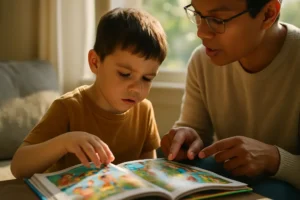
Parental involvement does not have to look like a formal lesson. For young children, responsive talk during ordinary routines can give them repeated chances to hear words, practice turn-taking, and connect language with shared attention. A child helping wash fruit, building with blocks, or looking at family photos may hear labels, comments, questions, and short explanations in the home language or in English.
Responsive Talk Is A Practical Tool
A 2025 longitudinal U.S. study of 446 Spanish-speaking emerging bilingual children reported that maternal warmth and responsiveness in early childhood predicted later self-regulation, which mediated higher English vocabulary in elementary school; the study also found that Spanish vocabulary at preschool age predicted stronger English vocabulary performance, as described in this longitudinal study of 446 children. The study focused on mothers, so it should not be read as placing responsibility only on mothers. Fathers, grandparents, older siblings, child care providers, and community adults can also create meaningful language interactions, though this particular research measured maternal practices.
For parents, the message is not to create a perfect language lesson. Warm, responsive interaction may include noticing what the child is focused on, naming it, waiting for a response, expanding what the child says, and accepting communication attempts that are not yet fully clear. If a child says “car,” an adult might answer, “Yes, the red car is going up,” in the language that fits the moment.
Home Languages Can Support English Growth
The finding that Spanish vocabulary in preschool predicted later English vocabulary is useful because it challenges the idea that home language use is a distraction from English. It does not mean every child will develop at the same rate or that one routine works for all families. It does suggest that home-language experiences can be part of a long-range communication plan rather than something families need to set aside.
Families who want more examples of home routines can review home language support ideas that focus on conversation, shared reading, and daily activities rather than isolated translation drills.
Community Engagement That Reduces Barriers
Community engagement matters because families do not raise bilingual children in isolation. A library story time, clinic intake form, school meeting, parent workshop, neighborhood playgroup, or cultural event can either invite participation or make families feel that one language belongs and the other does not.
For bilingual children, access is not only about translating a flyer. It can mean greeting families in the home language when possible, scheduling events at workable times, inviting caregivers to share songs or stories, and making sure interpreters are available for conversations about development. It can also mean explaining developmental information without turning bilingualism into the presumed source of every speech or learning concern.
Community programs should be transparent about limits. A librarian, volunteer, or parent group leader is not a substitute for an evaluation by a qualified professional when a child has persistent communication concerns. At the same time, community settings can create low-pressure opportunities for children to hear and use both languages in meaningful social situations.
Shared Spaces Build More Chances To Communicate
Children need communication partners. A bilingual child who hears Spanish at home and English at school may benefit from chances to use both languages with different people, for different reasons. Community events can give children a reason to greet, request, explain, protest, joke, and tell stories. These are communication acts, not only vocabulary targets.
Families can also compare information sources with care. For older learners and caregivers reviewing writing-related supports, they might find Top Ten Writing Services, a related site in the same network, useful. However, parents should consider if any resource aligns with their young child’s language goals, developmental level, and family context.
Practical Tools For Bilingual Development Support
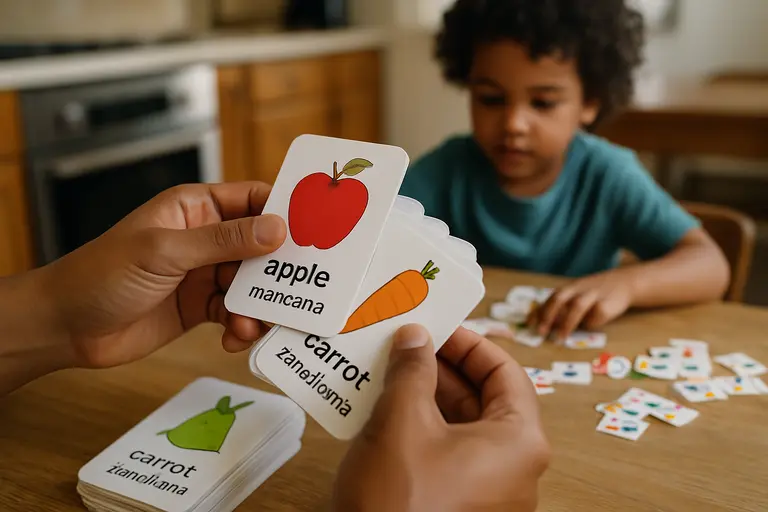
Tools are most useful when they match a real interaction. A bilingual book, picture card, song, or parent handout is not effective simply because it includes two languages. It has to help the child communicate with someone, about something that matters, in a setting where the child has time to respond.
- Shared reading: Adults can read in either language, pause for the child to point or comment, and talk about pictures rather than rushing through every page.
- Family story prompts: Photos from birthdays, meals, errands, or holidays can support retelling with words such as who, where, what happened, and what happened next.
- Routine-based words: Families can choose useful words for meals, bath time, play, greetings, repair requests, and comfort.
- Community word banks: Teachers and families can share words a child needs for school, home, relatives, and local activities.
- Progress notes: Caregivers can record new words, gestures, phrases, and communication attempts in both languages, without treating one language as the only measure of growth.
Use Tools To Support Interaction, Not Testing
A common mistake is turning every bilingual activity into a quiz. Asking “How do you say this in English?” again and again may not show what the child understands or can communicate. A more natural option is to model the word in context, wait, and respond to the child’s attempt. If the child uses a Spanish word during English play, the adult can accept the message and, if useful, model the English word without stopping the interaction.
The aim of bilingual development support is participation. A child who points, gestures, uses a home-language word, answers with one English word, or combines both languages may be communicating something meaningful. Adults can document those attempts and share them with teachers or clinicians so decisions are based on a fuller picture.
Community And Parent Partnerships For Bilingual Children
Strong partnerships respect both evidence and family knowledge. Parents know who the child talks to, what routines are stressful, which relatives are central, and which language choices feel possible. Professionals bring tools for observing communication, identifying concerns, and planning next steps. Community groups can make language practice more social and less isolated.
A realistic plan might include home-language reading with a grandparent, English vocabulary from school routines, Spanish conversation during meals, and a monthly library or community program where the family feels welcome. The plan should be adjusted if the child shows frustration, if a family’s schedule changes, or if professional evaluation points to a different need.
Bilingual development support works best when adults avoid one-size-fits-all advice. Research can guide decisions, but it cannot describe every child, diagnosis, family structure, or community setting. The most responsible approach is to ask families about their goals, protect access to the home language, support English growth with responsive interaction, and monitor communication across both languages over time.