Fun vocabulary activities work best when they do not feel like a lesson. Toddlers and preschoolers learn new words faster when language is tied to movement, objects, emotion, routine, and play they already care about.
That matters because many families are trying to support early communication while also managing busy schedules, screens, preschool expectations, and uneven attention spans. The opportunity is not to turn the home into a classroom; it is to make ordinary moments more language-rich without making children feel tested.
Fun Vocabulary Activities Work Best When Adults Stop Quizzing
A child who hears “What color is this?” ten times in a row may answer correctly, but that is not the same as building flexible vocabulary. Real word learning happens when children hear words used naturally, repeatedly, and meaningfully.
Instead of asking a child to identify every object, adults can describe what is happening. “The truck is rumbling under the bridge” gives the child action, sound, location, and context. A flashcard might teach “truck.” Play teaches what a truck does.
The strongest vocabulary practice often sounds like conversation, not instruction. Children need chances to hear new words, try them, mispronounce them, connect them to familiar experiences, and hear adults expand the idea without turning every mistake into a correction.
That is why language growth games are such a natural fit for early learning. Games give children repetition without boredom and structure without pressure.
Everyday Objects Can Carry Bigger Words
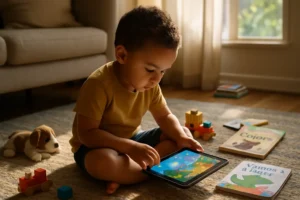
Toddlers and preschoolers do not need expensive materials to grow vocabulary. They need adults who notice the language hidden inside common routines.
A spoon can introduce scoop, stir, shiny, metal, round, empty, full, clean, and sticky. A laundry basket can introduce soft, rough, matching, folded, inside, under, beside, and missing. A walk outside can introduce crunchy leaves, steep steps, smooth stones, tiny insects, and loud engines.
The trick is to go one step beyond naming. Naming says, “That is a dog.” Vocabulary-building says, “That dog is enormous. He is sniffing the grass.” The second sentence gives the child richer language without demanding a performance.
Families can also use guidance from speech and language development activities when they want practical ways to support communication at different ages. The best activities are usually simple enough to repeat daily.
| Activity | Best For | Vocabulary Focus |
|---|---|---|
| Mystery bag | Toddlers | Object names, textures, simple actions |
| Pretend store | Preschoolers | Food words, counting words, polite phrases |
| Animal rescue play | Toddlers and preschoolers | Animal names, sounds, locations |
| Cooking together | Preschoolers | Verbs, sequence words, sensory words |
| Picture walk in books | Toddlers and preschoolers | Describing words, prediction, emotions |
Books Become Vocabulary Tools When Adults Slow Down
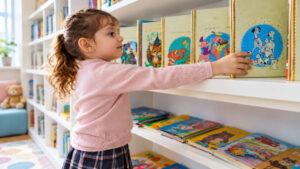
Reading with young children does not have to mean finishing every page. Sometimes the best vocabulary moment happens when the adult pauses and talks about one picture.
A child may not remember a formal definition, but they may remember that the bear was enormous, the puppy was muddy, or the girl looked frustrated. Picture books make abstract words visible. Emotions, sizes, actions, locations, and categories all become easier to understand when the child can point to them.
For toddlers, adults can name and repeat: “Baby. Sleepy baby. The baby is sleeping.” For preschoolers, adults can stretch the conversation: “Why do you think the boy is hiding behind the chair?”
A slower book routine gives children more room to think, point, guess, and respond. That response may be one word, a sound, a gesture, or a full sentence. All of it counts as communication practice.
The mistake is treating reading as a race to the final page. Vocabulary grows when the child has time to connect words to meaning.
Movement Helps Words Stick
Young children are physical learners. They often understand a word more deeply when they can do it, not just hear it.
Words like jump, crawl, balance, stretch, freeze, tiptoe, spin, carry, push, pull, and slide are easier to learn when the child’s body is involved. A living-room obstacle course can become a vocabulary activity without looking like one.
Adults can add language before, during, and after the movement. “Crawl under the chair.” “You jumped over the pillow.” “Now the bear is stuck between the blocks.” These phrases teach action words, position words, and problem-solving language at the same time.
This is especially useful for children who resist sit-down activities. A child who will not answer questions at the table may happily learn words while chasing bubbles, building a tunnel, or pretending to be an animal.
Pretend Play Gives Preschoolers More Precise Language
Pretend play is where vocabulary starts to become flexible. A block is not only a block; it can be a phone, a sandwich, a bridge, or a ticket. That shift invites children to use words in more imaginative ways.
A pretend restaurant can teach menu, order, spicy, sweet, hungry, customer, plate, server, and receipt. A doctor game can introduce patient, bandage, heartbeat, medicine, gentle, worried, and better. A rescue scene can teach trapped, safe, heavy, ladder, emergency, and careful.
Adults do not need to dominate the story. They can join as a character and add language naturally. “I am the customer, and I need something crunchy.” That gives the child a reason to think, choose, and respond.
Pretend play turns vocabulary into problem-solving. Children are not just repeating words. They are using language to move a story forward.
The Signals That Vocabulary Practice Is Actually Working
Progress is not always a sudden burst of perfect sentences. Sometimes it looks like a child using one new describing word, pointing with more purpose, asking for a specific object, or copying a phrase during play.
Parents should also watch for frustration. If an activity becomes too adult-led, too corrected, or too long, the child may withdraw. Better vocabulary practice is brief, playful, and easy to repeat.
Developmental guidance, including early childhood milestones, can help families understand broad communication expectations, but children still grow at different rates. A milestone checklist should guide attention, not create panic.
The next signal to monitor is whether the child is using words across situations. A toddler who says “big” only during a book is learning. A toddler who later calls a dog, truck, or tower “big” is beginning to own the word.
Fun vocabulary activities are not about pushing children to sound older. They are about giving toddlers and preschoolers more useful words for the world they already see, touch, question, and imagine. When adults make language playful, specific, and emotionally safe, vocabulary becomes less like homework and more like discovery.