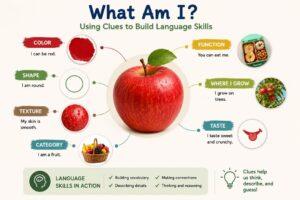
The classic I Spy game is often treated as a way to pass time in a waiting room or car, but its real value is the conversation hidden inside the guessing. Used deliberately, I Spy for speech and language development can strengthen vocabulary, listening, sound awareness, categories, describing words, and sentence formation without turning play into a lesson.
The game works because one player holds information the other player needs. That simple gap gives a child a reason to observe carefully, choose useful words, ask for clarification, and revise a guess. It belongs naturally beside other play-based language activities because the talking serves an immediate purpose.
I Spy Works Because the Child Has Something to Solve
A prompt such as “I spy something red” looks simple, yet it asks the child to listen for a defining feature, scan the environment, compare possibilities, and choose an answer. When the clue becomes “I spy something red, round, and good to eat,” the child must combine color, shape, and function.
Giving clues demands even more language. The child has to decide which feature will help the listener without revealing the object too quickly. A good clue is an exercise in perspective-taking because the speaker must consider what another person can see, hear, and infer.
The American Speech-Language-Hearing Association recommends everyday activities involving colors, shapes, categories, familiar objects, questions, and descriptive guessing among its speech and language development activities. I Spy brings several of those skills into one repeatable routine.
A correct guess is only one part of the exchange. The child is also learning that words can narrow possibilities, guide another person’s attention, and repair confusion when the first clue does not work.
How to Play I Spy for Speech and Language Development
Choose a place with several visible, familiar objects. The first player silently selects one item and gives a clue beginning with, “I spy with my little eye something…” The other player guesses, requests another clue, or explains why a possible answer fits.
Start with clues the child can understand. Color is a practical entry point because it narrows the choices without requiring a long explanation. Shape, size, location, texture, sound, category, and function can be introduced as the child becomes comfortable.
The adult should model the type of clue expected. Instead of saying only “blue,” try, “I spy something blue that we wear on our feet.” If the child replies with one word, expand it naturally: “Yes, the blue shoes are beside the door.”
Give children opportunities to lead. Choosing the hidden object forces the clue-giver to think about what the listener knows and which detail will be most useful.
Avoid requiring a perfect sentence before accepting a guess. Gestures, pointing, partial words, home-language responses, and approximations can all keep the interaction moving. Communication should come before correction.
Five Versions That Target Different Language Skills
The basic rules do not need to change. Shift the clue type, and the game begins to target a different part of language.
| I Spy Version | Example Clue | Main Language Target |
|---|---|---|
| Colors | I spy something yellow | Color vocabulary and visual attention |
| Sounds | I spy something beginning with /b/ | Listening and beginning-sound awareness |
| Categories | I spy an animal | Grouping and word relationships |
| Describing words | I spy something tiny, smooth, and round | Adjectives and precise vocabulary |
| Sentences | I spy something we use when it rains | Sentence formation and object functions |
For color play, begin with one feature and then combine details: “I spy something green and soft.” This encourages the child to hold two pieces of information together rather than guessing from color alone.
For sound play, choose familiar objects and say the sound rather than relying only on the letter name. “I spy something that starts with /m/” directs attention to the opening sound in “mug” or “map.” Keep the first contrasts obvious.
Category I Spy helps children connect individual words to larger groups. Use foods, animals, clothing, furniture, vehicles, toys, or outdoor objects. After a correct guess, ask, “What makes it a vehicle?” to extend the exchange.
Describing-word rounds can include size, shape, texture, temperature, speed, position, or number. Sentence rounds add function and relationships: “I spy something that keeps food cold” or “I spy something that is under the table.”
Better Prompts Turn One-Word Guesses Into Sentences
Some of the strongest language practice happens after the guess. A child who says “cup” can be invited to explain, compare, or add detail without being told that the first response was inadequate.
Useful follow-ups include “What helped you know?”, “Where do you see it?”, “What do we do with it?”, and “How is it different from the other one?” These prompts move the child from naming toward connected ideas.
Adults can also use expansion. If the child says, “Dog,” respond with, “Yes, the small brown dog is sleeping near the chair.” The adult supplies a richer sentence while preserving the child’s meaning.
Children who are ready for longer language can be asked to give two connected clues: “It is beside the window, and we use it when the room is dark.” They can also explain why a wrong guess does not match.
Back-and-forth timing matters. Harvard’s Center on the Developing Child describes responsive exchanges between children and caring adults as serve and return interactions. In I Spy, that means noticing the child’s word, gesture, look, or hesitation and responding in a way that invites the next turn.
Pause after giving a clue. Children may need time to scan the room, retrieve a word, and organize a response. A quiet wait can be more supportive than another question.
Pressure Points That Can Make the Game Go Quiet
I Spy becomes frustrating when the object is too obscure, the clue is too vague, or the adult keeps changing the rules. Select familiar objects and make the first clue broad enough to invite thinking but specific enough to create a realistic path to success.
Rapid correction can also shut down participation. If the child guesses “shoe” when the answer is “sock,” compare the features: “A shoe does go on your foot. My object is softer and goes inside the shoe.” The wrong answer becomes part of the reasoning.
Some children may struggle when the visual field is crowded. Reduce the number of objects, play with toys arranged on a tray, or use one page of a picture book. Others may prefer to point while the adult supplies the words.
Do not use pronunciation accuracy, eye contact, or complete grammar as the price of taking a turn. A child can practice a target sound in I Spy, but the game should not become a stream of demands to repeat the same word correctly.
Watch the child’s engagement. Turning away, repeated random guesses, silence, or irritation may signal that the clues are too difficult, the pace is too fast, or the round has lasted too long. The useful challenge is the one the child will rejoin.
Keep the Game Growing With the Child
Once color clues become easy, combine features, introduce categories, or ask the child to explain why a guess fits. Older children can create clues that exclude obvious choices, compare two similar objects, or give a full sentence without naming the object’s category.
Move the game into everyday routines. At breakfast, spy something crunchy or something used for pouring. On a walk, spy something that moves, makes a sound, or belongs in nature. During cleanup, spy an object that belongs in a particular box.
Bilingual children can give and answer clues in either language, compare two labels, or teach another player a describing word. Children who use augmentative communication can point to symbols, select descriptors, or combine words on their system as part of the same turn-taking structure.
The goal is not to make every round harder. Repetition helps children become more independent with a familiar format. A successful game may last three minutes and end while the child still wants another turn.
I Spy for speech and language development remains useful because it can grow from a color-matching game into a conversation about sounds, categories, features, functions, and relationships. The key pressure point is not finding the cleverest clue; it is protecting the child’s reason to participate. When the exchange stays responsive, specific, and playful, ordinary surroundings become material for richer language.
FAQs
What age can children begin playing I Spy?
Children can begin with simple pointing and color clues during the toddler and preschool years. Adults can provide two choices or model answers before gradually introducing longer descriptions, categories, and sound-based clues.
Can I Spy help a child practice speech sounds?
Yes. Choose visible objects beginning with the target sound and model the sound clearly. Keep guessing and conversation central so the activity does not become repetitive pronunciation drilling or pressure to speak perfectly.
What should I do when a child cannot find the object?
Add a second clue, reduce the number of visible choices, point toward the correct area, or offer two possible answers. Give enough support to preserve participation without immediately revealing the object.