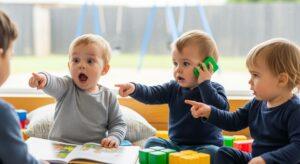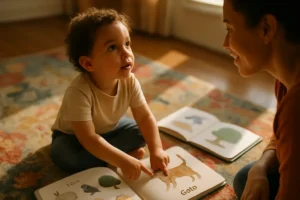
Play-based language activities are often treated like “extra” preschool fun, but they sit much closer to the center of early communication than many adults realize. The child pretending to run a grocery store, negotiate a turn with blocks, or describe a painted monster is not just playing; they are practicing the language of thinking, planning, listening, and being understood.
That matters because preschool children are under more pressure than ever to look school-ready before they have had enough time to talk, test, repeat, and imagine. Worksheets can measure what a child already knows, but play gives adults a clearer view of how a child uses language when the conversation is alive.
For families and educators looking for a practical entry point, creative routines like crafts that teach describing words, requests, and sequencing show why language grows best when children have something real to do, touch, choose, and explain. The craft is not the goal by itself. The stronger goal is the back-and-forth conversation that happens while the child decides what comes next.
Play Turns Language Into Something Children Need
Preschoolers do not usually develop strong communication by memorizing isolated vocabulary. They learn words because words help them get a turn, solve a problem, make someone laugh, protest a rule, describe a picture, or continue a pretend story. That is the quiet power of play: it gives language an immediate purpose.
A child building a tower may need words like taller, wobbly, more, mine, wait, fall, again, and careful. A child playing restaurant may practice greetings, questions, requests, categories, numbers, and sequencing without being told they are doing “language work.” The activity creates a reason to communicate, and the adult’s role is to stretch that communication without taking over.
The strongest play-based moments are not loud or complicated. They often happen when an adult follows the child’s lead, adds one useful phrase, and waits long enough for the child to respond. That pause is easy to underestimate. It tells the child, “Your words matter here.”
The Misunderstood Value Of Play-Based Language Activities
The biggest misunderstanding about play-based language activities is that they are casual because they look casual. A good play routine may look simple from the outside, but underneath it are opportunities for vocabulary, grammar, social communication, narrative skills, problem-solving, and early literacy.
Early childhood practice works best when it fits how young children actually learn. The National Association for the Education of Young Children frames developmentally appropriate practice around joyful, engaged learning that recognizes each child’s strengths, context, and development. That idea matters because preschool language is not one-size-fits-all. Children bring different home languages, temperaments, experiences, attention spans, and comfort levels into every interaction.
A child who says little during a formal prompt may become much more expressive while pretending a stuffed animal is sick. Another child may not answer direct questions but may narrate every step of a block crash. Play reduces performance pressure. It makes room for real communication practice instead of rehearsed answers.
The Adult’s Role Is To Add Language, Not Control The Game
The adult in play-based language work is not an entertainer, quizmaster, or director. The adult is a responsive communication partner. That means watching what the child is already doing and adding language that is just slightly more advanced than what the child can produce alone.
If a child says, “Car go,” the adult might answer, “Yes, the red car is going fast.” If the child points to a missing puzzle piece, the adult might say, “You need the corner piece.” If the child grabs a toy, the adult can model, “Can I have a turn?” rather than turning the moment into a lecture.
This approach is subtle, but it changes the emotional climate of learning. Children are more likely to try new words when they do not feel corrected at every turn. They need adults who expand, model, and invite — not adults who interrupt the play every ten seconds with another test.
The best question is not always “What is this?” Sometimes it is “What should happen next?” or “How can we fix it?” Those questions open the door to longer answers, cause-and-effect thinking, and more flexible language.
Everyday Play Can Target Specific Language Skills
A strong preschool language routine does not require expensive materials. It requires intention. The same bin of blocks, toy animals, crayons, cups, or picture books can support different communication goals depending on how adults use them.
| Play Activity | Language Skill It Builds | Adult Prompt To Try |
|---|---|---|
| Pretend store | Requests, turn-taking, categories | “What do you want to buy first?” |
| Block building | Describing words, spatial words, problem-solving | “Where should the tall block go?” |
| Sensory bin | Vocabulary, verbs, comparing | “What feels soft, rough, or heavy?” |
| Puppet play | Conversation, emotions, storytelling | “Why is the puppet sad?” |
| Snack routine | Sequencing, choices, polite requests | “Tell me what we need before we eat.” |
| Picture book play | Prediction, narrative, new words | “What do you think happens next?” |
The table is not meant to turn play into a rigid lesson plan. Its value is in showing how ordinary moments can become language-rich when adults know what to listen for and how to respond. The child still gets to play; the adult simply becomes more strategic.
That distinction matters. If every play moment becomes an adult-led lesson, children may lose interest. If play has no adult language support at all, some children may miss chances to stretch their communication. The sweet spot is guided but flexible interaction.
Strong Language Play Includes Listening, Not Just Talking
Adults often focus on how many words a child says, but preschool communication is larger than word count. Listening, waiting, noticing facial expressions, following directions, understanding sequence, and responding to another person’s idea are all part of language growth.
That is why group play can be so powerful. When children build a pretend zoo together, they must negotiate roles, name animals, decide where things go, explain rules, and repair misunderstandings. A conflict over who gets the tiger can become a language opportunity if the adult helps children use words to solve it.
The risk is that adults step in too fast. Solving the problem for children may keep the room calm, but it can remove the exact language practice they need. A better move is to give them usable words: “You can say, ‘I’m using it now, then you can have it.’”
Families who want age-based ideas can also use the American Speech-Language-Hearing Association’s practical guidance on speech and language development activities to match support with a child’s stage. The key is not to race ahead. The strongest progress often comes from meeting the child where they are and adding one reachable step.
The Signals Adults Should Notice Next
The next step is not buying more toys. It is paying closer attention to the quality of the interaction. Does the child initiate? Do they respond? Can they ask for help? Do they use words to describe, reject, imagine, explain, or repair confusion? Do they understand simple directions during real routines?
Adults should also notice whether the child’s language changes across settings. Some preschoolers talk freely at home but become quiet in group care. Others speak mostly during movement, art, or pretend play. These patterns are useful because they show where communication feels safe and where support may be needed.
There is also a warning sign for adults: do not confuse silence with lack of understanding, and do not confuse constant talking with strong communication. A child may know many labels but struggle to answer questions. Another may use short phrases but show strong understanding through play. Language development is not just about volume; it is about meaningful back-and-forth.
Play Builds The Language Children Actually Use
Play-based language activities deserve more respect because they build the kind of communication preschool children need outside a lesson: asking, explaining, imagining, negotiating, listening, and trying again after being misunderstood. Those are not soft skills. They are the foundation for classroom participation, friendships, early literacy, and confidence.
The pressure to make preschool look more academic can easily push adults toward activities that appear productive but do not create much conversation. The better path is more deliberate: protect play, join it thoughtfully, and use it to give children language they can use immediately.
Play-based language activities work because they meet children where language is most alive. The next meaningful sentence may not come from a flashcard or a formal prompt. It may come from a block tower falling, a puppet refusing soup, or a child proudly explaining what they made and why it matters.