Let’s cut through the noise. The biggest myth is that talking is everything.
Think of it like a blockbuster film. The script is important, but the visuals, music, and subtle glance tell the real story.
Research shows over half of our meaning is in non-verbal cues. The “55% rule” is a thought-provoking idea, not a hard fact.
Why does a toddler’s pout mean so much before they can speak? How does a pre-teen’s slouch show their mood like a billboard?
This isn’t just a trick. It’s how families and societies work. It’s based on sociology and neuroscience.
Your living room is more than a movie spot. It’s a place to learn about humans.
Facial Expression Games
The family dinner table can turn into a place to learn about faces. It’s not about learning emoticon charts. It’s about active, playful co-creation of your family’s emotional intelligence. We’re moving from just watching to understanding the silent language of faces.
The study of body motion, including facial expressions, is called kinesics. It’s key to social communication. A raised eyebrow can say more than a period. A tightened jaw can show a boundary. Our goal is to make this invisible language visible and fun.
Let’s play the classic The Mirror Game but with a twist. Sit facing your child and make a “thinking” face. Ask them to mirror it, then talk about it. What does a “thinking” brow look like? Is it one or two furrows?
This game helps build an emotional lexicon. You’re not just copying; you’re learning about the human face. Talk about facial symmetry—how a genuine smile engages the eyes, while a polite one might only lift the mouth corners.
Next, play The Micro-expression Olympics. This game is based on Paul Ekman’s work on micro-expressions. Micro-expressions are quick, true emotions that show before we hide them. One person tries to hide a feeling behind a neutral face. The others try to spot the true emotion.
The winner isn’t who hides best, but who spots the truth. It turns your living room into a lab for empathy.
For a more structured game, try the Expression Guessing Game. Write down complex emotions on cards, like “sarcastically amused” or “nervously hopeful.” Players draw a card and show the emotion with their face. No words, no sounds. It’s playful learning at its best.
These games do more than pass the time. They are exercises for empathy. They train the brain to connect with the emotional current in any room. This skill is key to social communication.
To help you choose your family’s next game, here’s a breakdown of our core facial workouts:
| Game Name | Primary Focus | Core Skill Developed | Fun Factor |
|---|---|---|---|
| The Mirror Game | Facial Awareness & Symmetry | Building a detailed emotional vocabulary; recognizing the physical markers of specific feelings. | High (Interactive and collaborative, low pressure) |
| Micro-expression Olympics | Authenticity Detection | Spotting involuntary, genuine emotions hidden behind social masks; sharpening observational speed. | Very High (Fast-paced, detective-like, and surprisingly competitive) |
| Expression Guessing Game | Nuanced Expression & Decoding | Communicating and interpreting complex, blended emotions without verbal cues. | Highest (Often leads to laughter and insightful misunderstandings) |
The payoff is huge. When your child can tell a sarcastic smirk from a genuine grin, they’ve gained a superpower. They can navigate disputes, sense a friend’s anxiety, or understand your pride without words. This is the goal of honing social communication.
Personal Space Activities
If personal space were a real estate market, your child might be either a clingy tenant or a distant landlord—both missing the lease agreement on emotional expression. This isn’t about policing inches. It’s about decoding the silent, spatial dialect we all speak.
Proxemics, the study of space, tells us territory is emotional. Is your kid a satellite, locked in a tight orbit? Or a distant moon, observing from afar? Each position broadcasts a different emotional weather report.
Our mission is to make the abstract tangible. We turn invisible bubbles into visible boundaries. We map the emotional geography of a room.
Research on “posture expansiveness” reveals a power link. Claiming physical space—standing tall, arms open—boosts psychological confidence. It’s a feedback loop. The space you occupy shapes how you feel, and vice versa.
Ready for some family fieldwork? Here are activities that turn your living room into a lab for spatial intelligence:
- The Hula-Hoop Frontier: Give everyone a Hula-Hoop. This is their mobile comfort zone. Role-play conversations where you must keep your hoop from touching another’s. Then, discuss when it feels okay to let the hoops overlap—like with a best friend versus a stern principal.
- Territory Negotiations: Play “King of the Hill” on a large cushion. The rule? You can’t push. You must use polite words and body language to claim the space. It teaches territoriality without aggression.
- The Confidence Expander: Have your child practice two postures for one minute each: slumped shoulders, then “superhero stance”—feet wide, hands on hips. Ask how each felt. This links physical posture to emotional state.
- Spatial Storytime: Read a picture book and pause to ask, “How close are these characters? Why?” Analyze the illustrations for proximity cues.
Respecting a boundary is a profound act of emotional intelligence. It’s reading the invisible fence. It’s the choreography that prevents everyday collisions.
These games teach more than manners. They teach kids to navigate the world’s unspoken real estate. They learn that space, properly understood, is a form of emotional expression.
Gesture & Movement Practice
Gesture is more than waving your hands. It’s about using your whole body to communicate. Think of it as a way to express yourself fully, like a choreographer.
Bad gestures can mess up your message, like junk mail. But good ones add emphasis and excitement. They make your words stand out.
At TED Talks, speakers use gestures to grab attention. One might use sweeping motions, while another might just wave their hands. The right gesture can make a big difference.
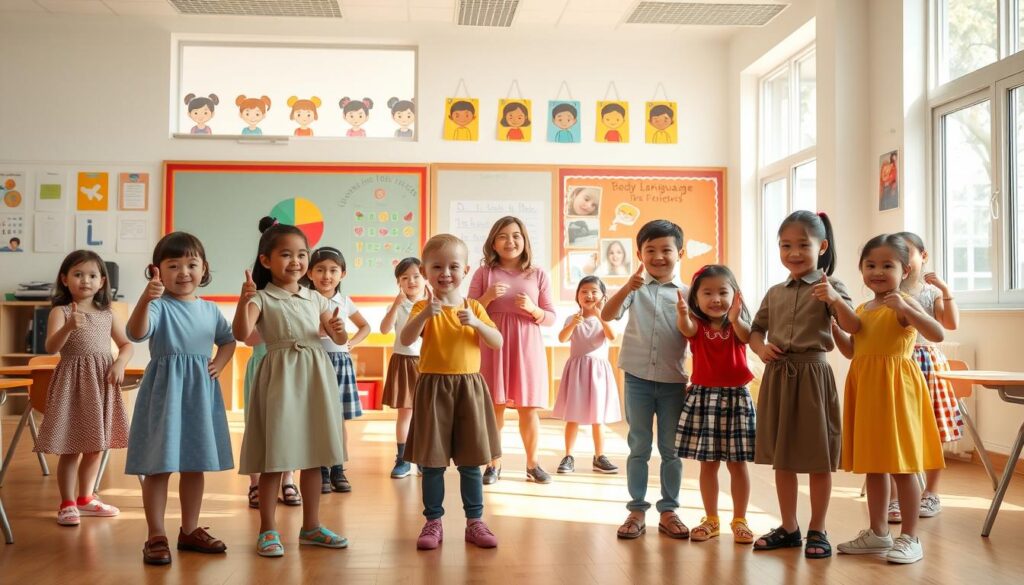
To practice, try Gesture-Based Storytelling. It’s like acting out a story. When you say “the enormous, gigantic whale,” stretch your arms wide. For a tiny seed, pinch your fingers together.
This method helps kids remember things better. It’s not just about hearing the story. They’re also feeling it through their body.
For older kids, teach Purposeful Gestures. Research shows our dominant hand often shows our positive thoughts. If your child is talking about their hopes, watch their dominant hand.
Make it a game. Have them say something twice, once without gestures and once with. They’ll notice the difference. It’s all about how we naturally communicate.
This turns everyday talk into a masterclass in non-verbal communication skills. Want a later bedtime? A calm gesture can make a big difference. It’s all about how we move our bodies.
The goal is to help kids express themselves fully. A confident wave or a clear point can show they’re fluent. Your home is where they can practice. Let the movement begin.
Eye Contact Building Exercises
Eye contact is key in human connection. Too little, and you’re out of social cash. Too much, and you’re seen as fake.
Remember that awkward moment when someone told you to look at them? It felt like a challenge. This method doesn’t make you a better communicator. It makes you stare intensely, like a character in a thriller.
We aim to teach the opposite. We want you to be relaxed and natural in your interactions. Eyes are not just windows to the soul. They’re a way to connect.
The Game You Didn’t Know You Needed: Eye Contact Counting (With a Twist)
Counting how long you can stare is basic. We’re going for more. Focus on what happens during eye contact.
Play Eye Contact Counting at dinner or during commercials. But watch for when it starts to feel uncomfortable. This is your chance to learn about your comfort zone.
Is it at two seconds? Four? Does it change when you’re talking or listening? This isn’t about judging. It’s about understanding your limits.
The Triangle Technique: Your Get-Out-of-Jail-Free Card for Social Anxiety
Direct stares can be overwhelming. The solution is to soften your focus.
Try the “Triangle Technique.” Look at the left eye, then the right, and then the mouth. Repeat this. It’s a small break from intense staring.
This isn’t avoiding eye contact. It’s being sophisticated. You’re engaged but not intense.
The Neuroscience of a Glance: Why This Isn’t Just Fluff
Why bother? Because eye contact is backed by science. It lowers stress and releases oxytocin, the social glue.
Oxytocin makes us feel connected. It’s like a brain handshake that says, “We’re good.”
These games are more than tricks. They’re about rewiring your brain for connection. You’re making your brain’s social circuits stronger.
From Practice to Presence: Building the Confident Connector
The goal is not to stare forever. It’s to be able to connect and know when to soften. You’re learning to wield social power with a glance.
By mastering these exercises, you become more than a good reader of social cues. You become a writer of them. Your eyes become welcoming, not defensive. And that’s how you connect confidently.
Cultural Non-Verbal Norms
Think about the thumbs-up. It’s okay in your living room but not in the Middle East. This shows how gestures and emotional expression vary by culture. Teaching our kids about this helps them understand the world better.
Experts divide cultures into low-context and high-context. The U.S. is a low-context culture, where words are clear. But in Japan or Saudi Arabia, the situation and silence speak more than words. Knowing this helps us navigate different cultures.
Touch is also important. In Latin America, a hug is a hello. But in Northern Europe or Japan, it’s too close. A child’s head is sacred in some cultures, and touching it is rude. Our bodies show respect in different ways.
To teach this to a family, play “Gesture Translator.” It’s a game that helps understand gestures like nods. In America, a nod means yes, but in Bulgaria, it means no. It’s about asking questions and starting conversations.
| Nonverbal Cue | Common U.S. Interpretation | Variation in Another Culture | Key Insight |
|---|---|---|---|
| Thumbs-Up Gesture | Approval, “Good job!” | Offensive insult in Iran, Afghanistan | Gestures are not universal symbols; their meanings are locally assigned. |
| Nodding Head | Agreement, “Yes” | Often signifies “No” in Bulgaria, Greece | Even fundamental signals can have opposite meanings, requiring context. |
| Personal Space (Proxemics) | ~2 feet for casual conversation | Much closer in Middle East; farther in Nordic countries | Comfort with proximity is cultural, not personal. Standing your ground can be rude. |
| Touch on the Head (Haptics) | Affectionate, playful | Deeply disrespectful in Thailand, Sri Lanka (head is sacred) | Touch is a powerful carrier of cultural and religious values. |
| Silence in Conversation | Awkward, a gap to be filled | Valued for thoughtfulness, respect in Japan (high-context) | Silence itself is a form of emotional expression, loaded with cultural meaning. |
This isn’t just about learning facts. It’s about understanding different perspectives. When someone seems quiet, they might be saying a lot. Teaching our kids to adapt to different cultures is key.
By learning about nonverbal cues, we show our kids that their way is just one of many. This doesn’t make their identity less important. It makes it richer. A smile or a tear is understood everywhere, but how we show it varies.
Supporting Special Needs Children
Imagine every social cue is a flickering streetlight in a fog. This is the daily reality for many children with special needs learning the dance of body language for kids. The silent rulebook isn’t just hard to read. For them, it might as well be written in invisible ink.
Our mission here isn’t about fixing a deficit. It’s about translation. For children with autism, ADHD, or social communication disorders, we become interpreters of a world full of unspoken signals.
Structured tools are our best dictionaries. Video modeling, like that used in apps such as Speech Blubs, is genius. It uses mirror neurons by having kids imitate gestures and expressions of peers. We also create “social scripts.” These make nonverbal expectations explicit and predictable. “When someone steps back, it means they need space,” becomes a concrete, learnable line.
Therapeutic wisdom shows us how to build a bridge of safety. A consistent, moderate amount of head nodding from a parent signals “I am listening.” A warm, steady vocal tone acts as an anchor. This isn’t about performing. It’s about providing a reliable emotional baseline from which a child can start to explore.
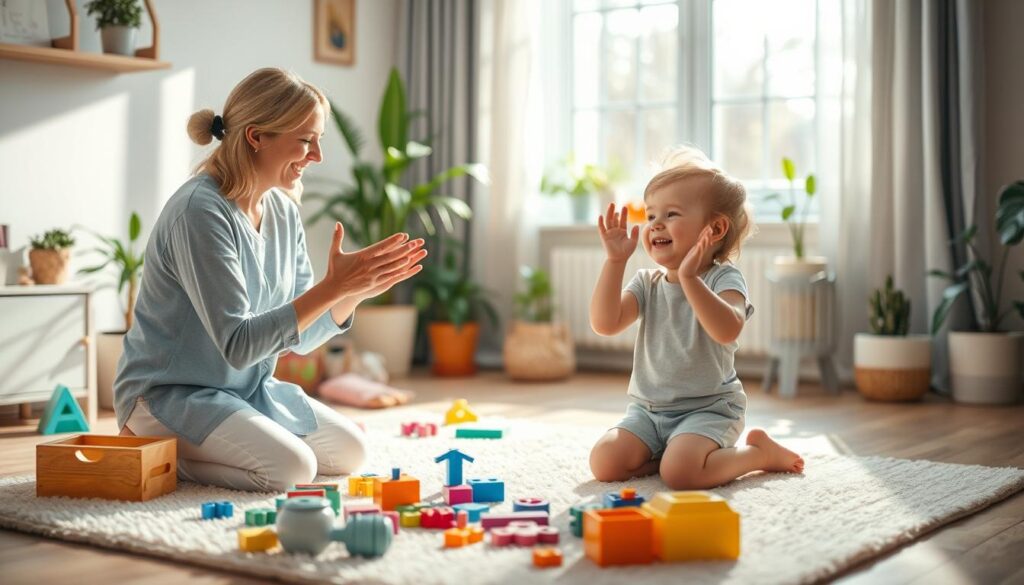
Strategy must be tailored. What works for a child with autism may differ for a child with Down syndrome or ADHD. The table below breaks down this compassionate decoding.
| Condition | Key Nonverbal Challenge | Tailored Strategy | Parental/Caregiver Role |
|---|---|---|---|
| Autism Spectrum | Difficulty reading subtle facial cues and understanding personal space. | Use explicit social scripts and video modeling to make abstract cues concrete. Focus on one gesture at a time. | Be a consistent, calm model. Use a predictable nonverbal style to reduce anxiety. |
| ADHD | Impulsivity in gestures, difficulty maintaining appropriate eye contact or staying calm. | Kinesthetic activities that channel energy into purposeful movement. Use timers for “listening with your eyes” practice. | Provide clear, immediate feedback on personal space. Celebrate controlled, deliberate gestures. |
| Down Syndrome | Potential for slower processing of rapid social cues and motor planning for gestures. | Use slow-motion video replay. Practice expressions and gestures in front of a mirror with ample time. | Offer generous response time. Physically guide gentle gestures, focusing on warmth over precision. |
| General Social Communication Disorder | Broad difficulty with the give-and-take of nonverbal dialogue. | Role-play with dolls or figures to externalize interactions. Use emotion cards linking faces to feelings. | Narrate your own nonverbal cues aloud. “My smile shows I’m happy you’re here.” |
This entire endeavor is a blueprint for patience. Every small gesture recognized—a matched smile, a respectful step back—is a major victory. We’re not teaching children to pass a test. We’re giving them a flashlight to navigate the fog. Mastering body language for kids in this context is less about fluency and more about forging a connection, one decoded signal at a time.
Real-World Applications
The real test of non-verbal fluency isn’t in the mirror but in daily life. Living room games and exercises are just rehearsals. The main stage is the classroom, playground, and boardroom.
Let’s look at the classroom hand-raise. Is it a timid, wrist-flicker or a firm, elbow-locked gesture? This simple gesture is a child’s first step into public advocacy. A confident raise shows readiness and is a skill that pays off in school and meetings.
On the playground, a negotiation over a swing is a key moment. The child who stands tall and makes calm eye contact invites a dialogue. The one with crossed arms and a downward gaze is building a fort, not a friendship. These small interactions are the heart of social communication.
Formal presentations, like the science fair or school play, are high-stakes. The content is important, but how you deliver it matters. Let’s compare the body language of two hypothetical students.
| Non-Verbal Element | The Confident Presenter | The Nervous Presenter | The Silent Message Sent |
|---|---|---|---|
| Posture | Feet planted, shoulders back, spine aligned. | Weight shifting, slouched, “closed” torso. | “I am grounded and credible.” vs. “I want to escape.” |
| Eye Contact | Scans the room, holds gaze for 2-3 seconds per person. | Looks at notes, feet, or the exit sign. | “I am engaging with you.” vs. “I am afraid of you.” |
| Gestures | Purposeful, used to emphasize points. Palms open. | Fidgeting, hands in pockets, or arms tightly crossed. | “My ideas have dimension.” vs. “I am containing my anxiety.” |
| Vocal Tone (Non-Verbal Aspect) | Steady pace, varied pitch, clear volume. | Monotone, rushed speech, trailing off. | “I am passionate and clear.” vs. “I just want this to end.” |
| Overall Impact | Commands attention, builds trust, enhances message. | Undermines content, loses audience, projects uncertainty. | Competence and leadership. vs. Doubt and inexperience. |
This isn’t just about school. It’s about how your body affects your mind. Standing confidently, even when you don’t feel it, can boost your testosterone and lower your cortisol. It’s a way to trick your biology into supporting your confidence. This trick works for job interviews, salary negotiations, or big pitches.
From the timid hand-raise to the powerful podium presence, the connection is clear. The skills you’re teaching at home help kids become master communicators. They learn to show the world the best version of themselves.
So, from the timid hand-raise to the powerful podium presence, the line is direct. The toolkit you’re building turns real-world interactions from sources of anxiety into arenas of competence. It prepares them not just to speak, but to be heard. Not just to be present, but to have presence. That’s the endgame: to help them master the grammar of social communication long before they need to write the most important essays of their lives.
Assessment Checklists
Assessment in our family lab is like a fun treasure hunt for clues. We’re not grading; we’re guiding. It’s a way to make playful observation more structured, like a series of discovery maps.
Think of these checklists as a first step for your family. They turn vague ideas into clear, useful insights. The goal is to answer one simple question together: “Where are we now?”
Our first map looks at Emotional Expression Congruence. This is key for honest communication. Does the smile really reach the eyes? Does the “I’m fine” match the slumped shoulders?
Use this list to see if words and body language match. It helps spot when they don’t, sending mixed signals.
- Facial Affect: Does the expressed emotion (joy, frustration, surprise) match the tone of voice and context?
- Physical Alignment: Are gestures and posture congruent with the stated feeling? (e.g., clenched fists with anger, open palms with giving).
- Timing & Duration: Does the non-verbal reaction appear and fade naturally, or does it seem forced or held?
The second map looks at Conversational Flow. It moves from static expressions to the dynamic dance of talking. How do non-verbal cues manage the rhythm of a conversation?
This checklist focuses on the silent signals that say “I’m listening,” “Go on,” or “I have something to add,” without words.
- Eye Contact Management: Frequency and duration of breaks. Is it used to regulate turn-taking?
- Gesture Vocabulary: Use of “open” (inviting) vs. “closed” (blocking) gestures during storytelling or debate.
- Listener Feedback: Presence of nodding, slight leaning in, or humming sounds to show engagement.
- Personal Space Harmony: Does the physical distance adjust comfortably to the conversation’s emotional temperature?
How do you use these maps without feeling like you’re being tested? Turn it into a family detective game. Over dinner, review one checklist category each week. The table below isn’t a scorecard—it’s a snapshot for your analysis together.
| Observed Cue | What We Saw | Our Insight | Next Step |
|---|---|---|---|
| Smile doesn’t reach eyes | During a rushed “good job.” | The praise felt automatic, not connected. | Try pausing, making full eye contact, then praising. |
| Crossed arms during chat | When discussing weekend plans. | Might signal resistance or just being cold. | Ask: “Are you unsure about the plan, or just chilly?” |
| Constant foot-tapping | While listening to a long story. | Could indicate impatience or excess energy. | Offer a fidget toy or suggest a “walk and talk.” |
| Leaning in closely | When sharing a secret. | Shows engagement and creates intimacy. | Acknowledge the positive cue: “Thanks for getting close to tell me that.” |
This process helps with meta-cognition—thinking about your own thinking (and expressing). It’s like the sage’s superpower. You’re not just communicating; you’re observing how you communicate.
So, keep these checklists handy. Use them with curiosity, not judgment. They guide you, not criticize. Mastering non-verbal signals is about building a shared language of nuanced, congruent emotional expression.
Professional Resources
Your living room lab is a powerful place for decoding silent signals. Every good scientist knows when to consult the literature. Think of these resources as your graduate-level seminars in body language for kids.
Structured programs like PlanetSpark’s Communication Skills Program offer something unique. They use AI and games to make skill-building fun. It’s not just screen time. It’s targeted drill work for the digital age.
For more focused support, peer-modeling apps like Speech Blubs use a solid scientific method. Kids learn by mirroring other kids. It’s like a virtual playdate designed to build confidence.
Then there are the deep dives. Sites like PositivePsychology.com provide the academic backbone. They offer research summaries and practical worksheets. This is for the parent who wants to understand the ‘why’ behind the activity.
Curating your toolkit is a strategic move. These professional resources act as force multipliers for your everyday efforts. They help you move from intuitive observation to informed coaching. Mastering body language for kids is a journey. Sometimes the best map comes from those who have already charted the terrain.