Language activities for toddlers do not need flashcards, expensive toys, or a speech plan that makes parents feel like therapists. A small basket filled with familiar household objects can create the kind of screen-free, repeatable talk routine toddlers actually understand: look, touch, name, choose, pretend, request, and take turns.
That matters because many families are trying to reduce passive screen time without replacing it with another complicated task. A talk basket works because it turns the home into a small, predictable language space, especially when it becomes part of a wider communication-rich home instead of a one-time activity.
Why Simple Objects Build More Language Than Fancy Toys
Toddlers learn language through use, not decoration. A spoon, cup, sock, toy animal, brush, block, or ball may look ordinary to an adult, but to a toddler, each object can start a full conversation.
A spoon can stir, tap, feed, fall, hide, and come back. A sock can be soft, blue, dirty, missing, big, small, on, or off. A ball can roll, bounce, stop, go, disappear, and return. Simple objects invite action words, describing words, requests, choices, and playful mistakes.
Fancy toys often do too much for the child. They light up, sing, talk, count, and perform. The toddler watches. The adult watches. The toy carries the language.
A talk basket does the opposite. It leaves space for the child and parent to create the words together. That space is where real communication practice begins.
How a Talk Basket Turns Play Into Communication
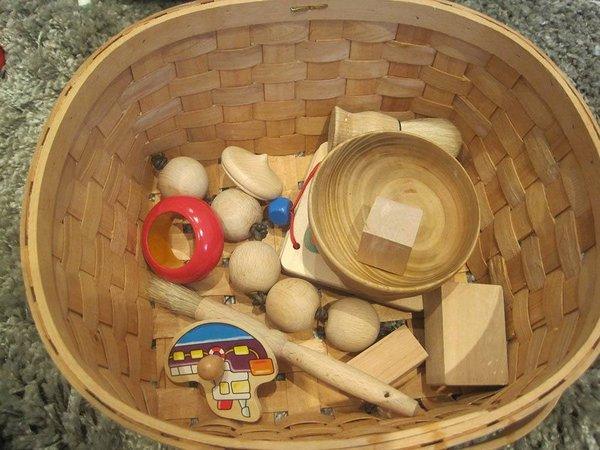
A 10-minute talk basket is simple: place five to eight safe objects in a small basket, sit close to the child, and let the child pull out one item at a time. The parent follows the child’s interest instead of forcing a lesson.
If the child grabs the ball, the parent says, “Ball. Roll ball. My turn. Your turn.” If the child reaches for the cup, the parent can model, “Cup. Drink. More?” If the child only points or makes a sound, that still counts as communication.
That aligns with current pediatric media guidance, which encourages families to notice what screens may crowd out and to create routines such as screen-free zones around meals, bedtime, and connection-heavy moments.
The goal is not to quiz. “What is this?” repeated over and over can shut some toddlers down. Better prompts sound natural: “You found the spoon,” “The cow is sleeping,” “Open cup,” “Uh-oh, sock fell,” or “Do you want ball or car?”
The strongest language activities for toddlers create a reason to communicate. The basket gives the child something to request, reject, show, hide, trade, describe, and repeat.
What To Put Inside a Toddler Language Basket
A good talk basket is built around safe, familiar, washable objects. Parents should avoid choking hazards, sharp items, breakables, batteries, magnets, long cords, and anything that requires close safety concern.
The best items are not necessarily toys. They are objects the child already sees in daily routines. That familiarity helps toddlers connect words to real life instead of treating the activity like a separate lesson.
| Basket Item | Language Skill It Builds | Parent Prompt |
|---|---|---|
| Spoon | Action words | “Stir, eat, tap” |
| Toy animal | Sounds and naming | “Cow says moo” |
| Sock | Describing words | “Soft sock, blue sock” |
| Ball | Turn-taking | “My turn, your turn” |
| Cup | Requesting | “More water?” |
| Brush | Pretend play | “Brush hair” |
| Block | Position words | “Block on top” |
This table is only a starting point. A parent can rotate items every few days, but too much novelty can make the routine harder. Toddlers often talk more when the activity feels predictable.
The Prompts That Help Toddlers Talk Without Pressure
The best prompts are short, warm, and easy to copy. Toddlers do not need long explanations during play. They need language that matches what they are seeing and doing.
Start with one-word models: “cup,” “ball,” “sock,” “open,” “roll,” “more.” Then expand slightly: “red cup,” “roll ball,” “more milk,” “big sock.” If the toddler says “ball,” the parent can answer, “Yes, ball roll.” If the toddler says “more,” the parent can add, “more cup” or “more ball.”
This is called expansion in everyday parenting language: take what the child gives and gently build on it. The child hears a slightly more advanced version without being corrected.
Choices also work well. “Ball or spoon?” gives the toddler a reason to point, reach, vocalize, or say a word. Waiting matters too. A quiet pause gives the child time to respond before the adult fills the silence.
Parents can also make playful mistakes. Put the sock on the child’s hand and say, “Sock on hand?” Many toddlers love correcting adults. That kind of silly mismatch can spark spontaneous language because the child has a reason to react.
Why the 10-Minute Limit Helps Parents Stay Consistent
A language routine that lasts too long usually disappears. Ten minutes is enough to create repeated turns without exhausting the child or parent.
The short format also helps families use the basket during hard parts of the day: after nap, before dinner, during a sibling’s homework time, or when the child is asking for a screen. The point is not to ban screens from family life. The point is to protect pockets of face-to-face interaction.
A talk basket gives parents something practical to do in those spaces. It replaces “don’t watch that” with “let’s play with this.”
When a Quiet Toddler Needs More Than Activities
A talk basket can support language, but it is not a substitute for professional help when a child is missing communication milestones or losing skills. Parents should watch the whole communication picture: gestures, eye contact, response to name, imitation, understanding, play, pointing, and social interest.
Children vary in how quickly speech develops, but early speech and language growth follows a general developmental path. Milestone resources for early speech development can help parents decide when to ask more specific questions.
A toddler who is not using gestures, not trying to communicate, not understanding simple directions, losing words, or becoming harder to engage should be discussed with a pediatrician or speech-language professional. Early support does not mean the parent failed. It means the child may need more targeted help.
Language activities for toddlers work best when they are simple enough to repeat and flexible enough to feel like play. The 10-minute talk basket succeeds because it respects how toddlers actually learn: through touch, movement, attention, imitation, emotion, and shared routines. In a home full of screens, noise, and pressure, a small basket of ordinary objects can give language its most powerful ingredient back another person ready to respond.