A child points toward a bird, looks at a parent, and makes an excited sound. That brief exchange captures the foundation of shared attention and communication: two people focusing on the same experience and recognizing that the moment belongs to both of them.
These interactions matter because children communicate long before every idea can be expressed in a sentence. Adults who notice the child’s focus, respond to early signals, and allow adequate child response time can turn an ordinary moment into a genuine exchange without making it feel like a lesson.
Shared Attention Gives Communication Common Ground
Shared attention happens when a child and another person focus on the same object, activity, or event. The connection might begin when a child points to a passing truck, follows an adult’s gesture toward a picture, or brings a toy over to share.
The object alone is not the central feature. What matters is the awareness that someone else is attending to it, too. That shared reference gives a word, sound, gesture, or expression a clearer meaning.
If a child looks at bubbles and smiles, an adult can respond, “More bubbles?” The child might nod, reach, vocalize, or say “more.” Both people understand what the message concerns because their attention is already aligned.
This creates a reason to communicate. The child is not naming an object simply to demonstrate knowledge. They are attempting to continue an enjoyable activity, share surprise, request help, or direct another person’s attention.
Shared Attention and Communication Extend Beyond Eye Contact
Shared attention is sometimes reduced to “making eye contact,” but communication is more varied than that. A child may coordinate attention by shifting their gaze, pointing, holding up an object, moving closer, making a sound, changing facial expression, or waiting for another person’s reaction.
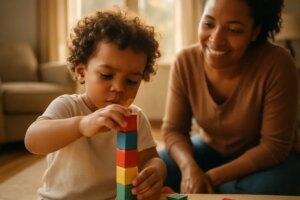
Two people also do not need to stare at each other continuously. A parent and child assembling a puzzle may spend most of the interaction looking at the pieces. Their attention is still shared when they take turns, respond to each other’s actions, and work toward the same goal.
This distinction matters for children who communicate differently. Speech, signs, pictures, body movements, facial expressions, and augmentative and alternative communication can all contribute to an exchange. The useful question is not whether the child performs one expected behavior. It is whether the child and adult are finding a workable way to connect around a shared focus.
The social communication benchmarks include skills such as gaining another person’s attention, sharing attention, responding to communication, and using gestures. These behaviors develop as part of a broader communication system rather than as isolated performances.

Following the Child’s Focus Reduces Communication Pressure
Adults often try to create shared attention by redirecting children: “Look at this book,” “Watch what I’m doing,” or “Come see this toy.” Sometimes that works, but following the child’s existing interest may create a stronger opening.
If a child is pushing a toy car repeatedly, the adult can join that activity instead of replacing it. A short comment such as “Fast car” or an imitation of the car’s sound adds language without demanding an answer.
Following does not mean surrendering every routine to the child. It means first identifying what currently holds the child’s attention and using that interest as common ground. Once the exchange is established, the adult can introduce a small variation: a tunnel for the car, a second vehicle, or a playful pause before another turn.
The sequence is simple: notice, join, then expand. Starting with observation helps adults avoid flooding the interaction with instructions and questions before the child has had a chance to participate.
Everyday Activities Create Different Openings
Shared attention does not require specialized materials. Meals, books, walks, chores, and play already contain objects and events that both people can notice together.
| Everyday activity | Possible shared focus | Adult response | Possible child response |
|---|---|---|---|
| Snack preparation | A banana being peeled | “The peel is coming off” | Looks, reaches, points, or comments |
| Block play | A tower falling | “It crashed!” | Laughs, vocalizes, rebuilds, or requests more |
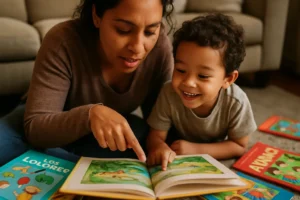
| Shared reading | An unusual picture | “That dog is wearing boots” | Points, smiles, labels, or turns the page |
| Outdoor walk | A loud vehicle | “I hear something big” | Looks, gestures, imitates the sound, or names it |
| Laundry | A missing sock | “Where could its partner be?” | Searches, shows, gestures, or answers |
| Bath time | A floating cup | “It stayed on top” | Touches, pours, watches, or asks for another turn |
No particular response is required for the interaction to be worthwhile. The adult’s job is to make the shared focus understandable and leave room for the child to contribute.
Repeating a familiar activity can also help. When children know what usually happens next, they may begin anticipating a turn, supplying a sound, reaching for an object, or signaling that they want the routine repeated.
Respond to the Whole Message, Not Only the Words
A child’s communication often arrives through several channels at once. They may point toward a shelf, look at an adult, make a questioning sound, and then attempt a word. Responding only to the spoken portion can miss most of the message.
Instead, acknowledge the likely meaning: “You’re showing me the red box. Do you want it opened?” This gives language to the interaction while respecting the child’s original contribution.
The response should remain proportional. Adults do not need to turn every gesture into a long explanation. A short phrase connected to the child’s focus is often easier to process and leaves more space for another turn.
Responsive back-and-forth exchanges are central to serve-and-return interactions. Children “serve” through actions such as looking, reaching, babbling, pointing, or speaking, and attentive adults return that communication in a related way.
This is participation before performance. Communication grows through meaningful exchanges, not by requiring children to label every object or repeat each adult model immediately.
Look for Connection Across Routines, Not Perfect Behavior
One missed point, brief interaction, or preference for independent play does not establish a communication problem. Attention changes with fatigue, familiarity, sensory demands, interest, and the number of people present.
Parents can look for broader patterns. Does the child sometimes direct another person toward something interesting? Do they respond when someone joins an activity? Can they communicate enjoyment, rejection, curiosity, or a request through any reliable method?
Avoid repeatedly testing these abilities. Calling a child’s name over and over, moving objects into their line of sight, or insisting on eye contact can add pressure without revealing how the child communicates naturally.
Concerns deserve professional guidance when a child rarely responds to sounds or social approaches, loses previously used communication abilities, or regularly struggles to share needs and interests across familiar situations. A pediatrician or speech-language pathologist can consider the full pattern rather than judging a single behavior.
Shared attention is valuable because it gives communication an immediate purpose. A child has something to show, request, reject, enjoy, or investigate, and another person is available to respond.
Supporting shared attention and communication therefore begins with a modest shift: notice where the child’s interest already lives. Joining that moment with a relevant word, expression, gesture, or action can create the common ground from which longer and more confident exchanges grow.
Frequently asked questions
At what age does shared attention begin?
Early forms emerge during infancy through gaze, facial expressions, sounds, and responses to caregivers. More coordinated behaviors, such as pointing between an object and another person, develop gradually rather than appearing on one fixed date.
Can shared attention happen without spoken words?
Yes. Children can share attention through pointing, showing, reaching, gaze shifts, signs, sounds, facial expressions, pictures, or communication devices. Spoken language is one possible part of the exchange, not a requirement.
Should parents insist that a child look at them?
No. Sustained eye contact is not the only evidence of connection. Focus instead on whether the child notices, responds, shares an activity, or communicates through a method that feels comfortable and effective.