ASHA Communication Milestones were updated on November 1, 2023, giving parents a refreshed way to look at early hearing, speech, and language development from birth through age 5. The American Speech-Language-Hearing Association also released feeding and swallowing checklists for birth through age 3, according to its ASHA announcement. These checklists can help families notice patterns, but they do not diagnose a child or replace an evaluation by an audiologist or speech-language pathologist.
What ASHA Communication Milestones Changed
The Update Has A Clear Age Range
The 2023 update covers communication skills across early childhood, including hearing, speech, and language. The communication checklists run from birth to age 5. The feeding and swallowing checklists run from birth to age 3. That distinction matters because parents may be watching several types of development at once: how a baby responds to sound, how a toddler uses words, how a preschooler follows directions, and how eating or swallowing skills are developing.
The update does not mean every child should look identical at the same month of age. Milestones are reference points. They are best read as a pattern over time rather than as a single pass-or-fail item on one day. A child may show a skill at home but not during a visit, or may use a word with one caregiver before using it with others.
How ASHA Communication Milestones Are Organized
The ASHA Communication Milestones checklists group skills by age range. That format can make them easier for parents to use during everyday routines. A family does not need to run a formal lesson to notice whether a baby quiets when spoken to, whether an older infant babbles longer strings of sounds, or whether a toddler combines words during daily activities.
Parents should also keep the limits of any checklist in mind. A checklist can organize observations, but it cannot explain why a child is missing skills. Hearing differences, language exposure, developmental differences, motor needs, family context, and many other factors may affect what adults see. If many skills in an age range are not present, ASHA encourages families to contact an audiologist or speech-language pathologist rather than waiting and guessing.
What Parents Can Look For By Age
Early Responses, Sounds, And Gestures
The early items in the updated checklists focus on responses to people and sound before clear talking appears. For birth to 3 months, one example is that a baby quiets or smiles when an adult talks. From 4 to 6 months, examples include vocalizing different vowel sounds and beginning to combine those sounds with consonants. From 7 to 9 months, a child may babble long strings such as “bababa” or “mamama.”
By 10 to 12 months, ASHA examples include pointing, waving, showing or giving objects, and beginning to follow directions. These skills can be easy to miss if adults are watching only for first words. Gestures, shared attention, and responses to speech give useful information because communication grows through more than spoken vocabulary.
- Watch for responses to voices and familiar sounds during calm routines.
- Notice repeated babbling patterns, not only clear words.
- Write down gestures such as pointing, waving, showing, and giving objects.
- Track whether the child follows simple directions in familiar situations.
Word Combinations And Preschool Skills
For 19 to 24 months, one example from the updated checklists is putting two or more words together, such as “more water” or “go outside.” This type of combination shows that the child is beginning to connect words for meaning, not simply naming isolated items.
For ages 4 to 5 years, examples include recognizing and naming 10 or more letters and usually writing their own name. These later items show how communication milestones begin to connect with early literacy. Still, parents should be cautious about treating one literacy-related item as a full picture of a child’s language. A preschooler’s understanding, speech clarity, sentence use, and participation in conversation all deserve attention.
Speech Clarity Needs A Wider Lens
Intelligibility Research Is Not A One-Number Rule
Speech clarity is often the area that worries families first, especially when relatives or teachers have difficulty understanding a child. A research study of children ages 30 to 119 months reported growth curves for how well listeners understood single words and multiword productions. For single words, the study reported about 50% intelligibility at roughly 31 months, 75% at roughly 49 months, and 90% at roughly 83 months. For multiword utterances, it reported about 50% intelligibility at roughly 34 months, 75% across roughly 46 to 61 months, and 90% across roughly 62 to 87 months, according to the JSLHR intelligibility study.
Those numbers are helpful because they show that clarity grows over years, not all at once. They also show why a simple rule such as “everyone should understand a child by a certain birthday” can be too blunt. Parents who want a closer look at clarity can compare these ideas with a related article on speech intelligibility milestones.
Why Percentages Can Mislead
Intelligibility percentages depend on what is being measured and who is listening. Single words may be easier or harder to understand than longer phrases, depending on the child and the task. Familiar listeners often understand more than unfamiliar listeners because they know the child’s common words, routines, and sound patterns.
For that reason, parents can make their notes more useful by recording context. Instead of writing “not clear,” try noting who understood the child, what the child was trying to say, and whether the message was a single word or a longer sentence. These details can help a speech-language pathologist interpret what is happening without assuming that every unclear word has the same cause.
What To Do If Skills Seem Delayed
Start With Hearing, Interaction, And Daily Notes
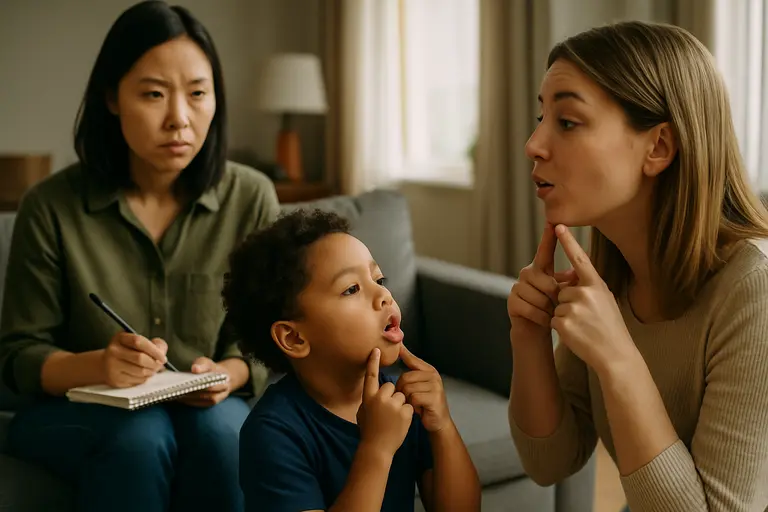
If a child is missing many milestones in an age range, a professional conversation is a safer choice than waiting without support. Because the updated checklists include hearing, speech, and language, parents should not focus only on word count. A child’s response to sound, attention to speech, gestures, and ability to follow familiar directions can all be useful observations to share.
Parents do not need perfect records. A short dated note can be enough: what the adult said, how the child responded, whether the child used a sound, gesture, word, or phrase, and whether the response was typical for that child. Video examples may also be useful for discussion with a clinician if the family is comfortable sharing them and local privacy rules or clinic policies allow it.
Support Without Turning Home Into Testing
Home should not feel like a constant exam. The goal is to notice communication during routines the child already knows: meals, diaper changes, getting dressed, bath time, books, outdoor play, and cleanup. A parent can pause briefly, give the child time to respond, and accept different forms of communication, including gestures, sounds, words, or short phrases.
Families often gather information from several places: pediatric visits, early childhood programs, therapy providers, and parent education sites. A useful addition for those compiling community and education resources could be a related community resource site, perfectly complementing other speech and language references. The key is to separate general information from child-specific advice. A checklist can prepare better questions, but it cannot determine a diagnosis by itself.
Bilingual And Family Contexts Need Care
When The Checklist Does Not Match A Child’s Language Experience
Parents in bilingual or multilingual homes may read milestone lists with mixed feelings. The research notes for the communication milestones describe the skill ranges in relation to American English-speaking children. That means families should be cautious about using the checklist as the only measure of a child who hears or uses more than one language.
This does not mean bilingual development should be ignored. It means the child’s full communication environment matters. A child may use one set of words with one caregiver and another set in a different setting. A professional evaluation can consider a broader picture than a one-language checklist can show.
Use Professional Judgment Rather Than Guesswork
If parents are worried, they can bring examples from all languages the child hears or uses. They can describe who speaks each language, which routines happen in each language, and how the child communicates with different people. Those details give clinicians more context than a single score or quick comparison.
Transparency matters here: no public milestone checklist can account for every child, every language background, and every family routine. The safest use of the update is to treat it as a structured starting point for observation and referral questions, not as a label.
Using ASHA Communication Milestones At Home
A Parent-Friendly Way To Review Skills
A practical way to use the checklists is to review one age range at a time and mark what the child does often, sometimes, or not yet. “Sometimes” is useful information. It may show that a skill is emerging, that the child needs a familiar routine, or that adults need more examples before deciding whether concern is warranted.
ASHA Communication Milestones can help parents organize what they notice across hearing, speech, and language, especially during the first five years. The most helpful next step is not to pressure a child to perform each item. It is to watch real communication, write down patterns, and ask for an audiology or speech-language evaluation when many expected skills are absent or unclear.