
Grocery store language activities can do more than teach the names of apples, cereal, and milk. A pretend shop gives children a reason to request, compare, count, describe, choose, ask, answer, and take turns—the same kinds of language they can later use during a real errand. The strongest version is not a miniature vocabulary lesson; it is a social routine where words make something happen.
That makes pretend shopping a practical extension of play-based language activities. The child can be the shopper, cashier, stocker, or parent, while the adult adjusts the language demand without taking control of the game.
Pretend shopping creates a natural reason to talk
Children often use more language when words help them accomplish something. In a pretend grocery store, communication has an immediate purpose: finding an item, choosing between options, asking for help, paying, or telling someone where something belongs.
The setting also gives children a familiar structure. Many already recognize baskets, shelves, food packages, checkout counters, and shopping routines, so they do not have to invent an entirely new world before they can participate. Familiar routines reduce the language load and leave more room for interaction.
Pretend shopping is flexible enough to meet children at very different language levels. One child may point to a banana and say “that,” while another may ask, “Can I have two bananas, please?” Both are practicing communication within the same game, just at different levels of complexity.
Because the roles naturally change, the language changes with them. A shopper requests, a cashier responds, and a stocker sorts or explains. That variation keeps the activity from becoming repetitive and creates multiple opportunities to practice vocabulary, sentence building, listening, and social exchange.
Grocery store language activities work because every role needs words
Pretend stores naturally create communication problems to solve. A shopper has to ask for something. A cashier needs to answer, clarify, or offer a choice. A stocker sorts items into groups and decides where they belong.
Recent guidance on how pretend play builds language points to the same advantage: familiar pretend roles give adults opportunities to model vocabulary, expand what children say, and use open-ended questions without separating language from the activity.
Instead of drilling “apple, banana, orange,” build a reason to use those words. Put the fruit behind the counter and let the child request it. Hide one item and have the cashier explain that it is out of stock. Give the shopper two choices and ask which one they want.
The language becomes functional inside the game.
Build the store around five kinds of everyday language
A grocery store can target several skills, but trying to practice everything at once can make the interaction feel adult-directed. Pick one or two goals and let the rest appear naturally.
| Language target | Pretend-store example | Real-life connection |
|---|---|---|
| Requesting | “Can I have the red apples?” | Asking for an item or help |
| Categories | “The yogurt goes with the dairy foods.” | Finding where items belong |
| Quantity | “We need two bananas.” | Understanding amounts |
| Describing | “I want the small green box.” | Clarifying which item |
| Social exchange | “How much is it?” “Thank you.” | Talking with store workers |
The table is not a script. A child using gestures or single words can participate by pointing, choosing, handing over an item, or saying one key word. A child using longer sentences can explain choices or manage customer requests.
Make requesting harder only when the child is ready
Requesting is easy to build into the game because the shopper needs the cashier to do something. Start with two visible options: “Do you want milk or juice?” A child can answer by looking, pointing, reaching, signing, or speaking.
Then make the request more specific. Instead of simply “apple,” the adult might model, “I want an apple,” followed later by “Can I have two green apples?” The goal is gradual language expansion, not requiring a perfect sentence before the child receives the pretend food.
Choices can become more interesting too. Offer a large box and a small box. Put two similar cans on different shelves. Ask whether the shopper wants one, two, or three items.
Each change adds useful concepts while keeping the purpose clear: communication completes the shopping task.
Categories and descriptions turn shelves into a vocabulary system
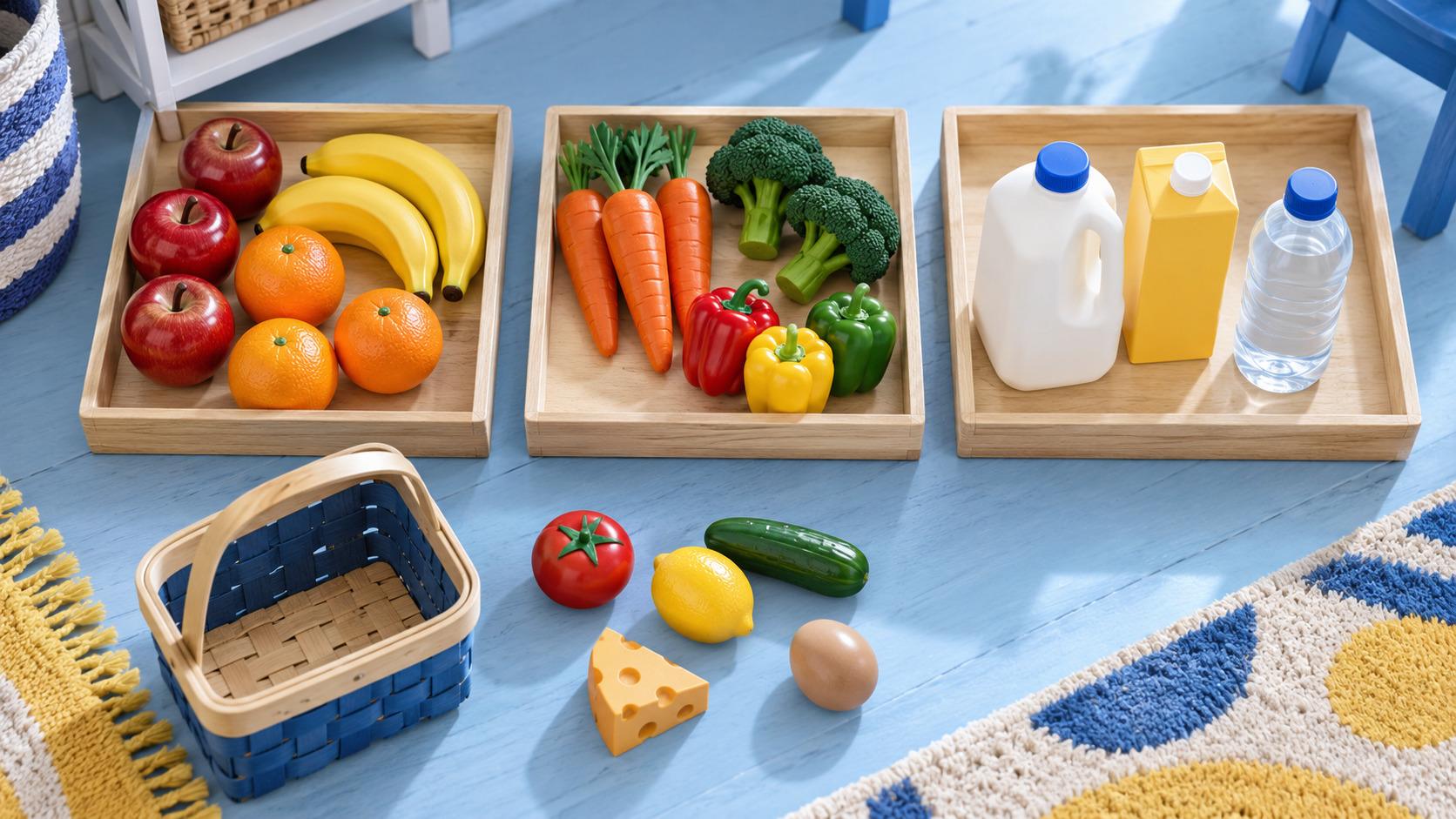
A pretend grocery store is useful for showing that words belong in groups. Fruits can go together, as can vegetables, drinks, snacks, frozen foods, or breakfast items.
Children do not need formal category labels at first. An adult can say, “Let’s put all the drinks here,” and sort juice, milk, and water together. Later, ask the child to stock the store or explain where an unfamiliar item should go.
Descriptions make categories more precise. Compare a big orange with a small orange, a full carton with an empty one, or a cold item with something that belongs on a shelf.
A recent discussion of guided play in a grocery-store setting describes choosing category words, spatial words, and useful phrases before play begins. At home, keep it simpler: choose a few words such as produce, basket, empty, beside, more, and enough, then use them naturally as the game unfolds.
Let the cashier create the social challenge
The cashier role moves the activity beyond naming objects. Now the child has to greet someone, listen to a request, respond to a question, handle a misunderstanding, or close the exchange.
Make the interaction slightly unpredictable. The cashier might say, “We do not have strawberries today. Would you like blueberries?” Or the shopper may forget what they need and ask for help.
Role reversal matters. When the child becomes the cashier, the adult can make a vague request such as, “I need something for breakfast.” The child now has to ask a question, offer options, or infer what might fit.
This is where social language gets a job. Phrases such as “Can I help you?”, “Which one?”, “Anything else?”, and “Here you go” belong to a recognizable interaction rather than a repetition exercise.
Carry the pretend language into the real grocery aisle
The strongest next step is transfer. Before a real shopping trip, let the child help choose three items for a short list. At the store, reuse familiar words from play: basket, aisle, more, less, top, bottom, one, two, big, small.
Do not expect the real store to feel as easy as the pretend one. Noise, people, waiting, unfamiliar workers, and competing sights can make communication harder. A child who speaks freely at home may prefer to point or answer briefly in public.
Look for small connections instead: finding an item by category, remembering a quantity, choosing between two products, or saying hello to the cashier. Transfer can happen in small steps.
Grocery store language activities are most useful when children experience language as part of getting something done. Pretend shopping gives requests, categories, quantities, descriptions, choices, and social phrases a purpose; real errands give those same skills a new context. The goal is not a flawless shopping script. It is helping children discover that communication can guide an interaction, solve a problem, and make everyday routines easier to navigate.
Frequently asked questions
What age is pretend grocery store play good for?
Pretend grocery shopping can be adapted for toddlers, preschoolers, and early elementary children. Younger children may point, choose, and name items, while older children can manage roles, descriptions, quantities, and longer social exchanges.
What can I use to make a pretend grocery store at home?
Use safe empty food boxes, play food, baskets, reusable bags, paper shopping lists, and a simple pretend checkout area. Expensive store sets are unnecessary when familiar household materials can support the same interaction.
What language skills can grocery store play support?
Pretend shopping can create practice with requesting, choosing, describing, categorizing, quantity words, location concepts, questions, turn-taking, and social phrases. Choose only a few targets at a time so the activity remains playful.