For families raising bilingual children, the phrase English-only Head Start can raise practical questions about classroom talk, parent communication, and long-term home language development. On August 6, 2026, the U.S. Department of Health & Human Services proposed rules that, according to the research provided for this article, would require all Head Start instruction to be delivered in English and would remove existing requirements for bilingual instructional support. As of September 2, 2026, that proposal had already been announced, so families and educators need clear information about what could change if such rules were adopted.
This discussion is educational, not legal advice. It focuses on child communication, bilingual development, and family-school partnership. The strongest evidence available from the supplied research does not suggest that young children must lose the home language in order to learn English. In fact, Head Start’s own guidance says children benefit from continued first language development while learning English, as described in its home language support guidance.
What The Proposed Rule Changed
English-only Head Start In Context
The proposed rule was significant because Head Start serves many children who are learning English while also developing another language at home. The research notes report that, in 2026, roughly 35% to 40% of children enrolled in Head Start were dual language learners, with Early Head Start at about 40% dual language learner enrollment. That means language policy is not a small administrative detail; it affects a large share of classroom communication.
The proposed English-only Head Start rule also would have arrived in a system where bilingual staff already support children and families. The research notes report that more than 30% of Head Start staff nationwide are bilingual. If bilingual instruction or bilingual family services were reduced, programs could lose more than a teaching method. They could lose a practical bridge between adults and children who are still building understanding across two languages.
Why Head Start Families May Feel The Shift
Preschool children do not use language only to name colors, count objects, or answer teacher questions. They use language to ask for help, join play, explain feelings, resist a task, tell a story, and repair confusion. A child who can do many of those things in Spanish, Arabic, Mandarin, Haitian Creole, or another home language may not yet be able to do them in English with the same confidence.
If a classroom limits adult responses to English only, some children may have fewer immediate ways to show what they know. That does not mean they lack ideas, social interest, or readiness to learn. It may mean the adults around them have less access to the child’s strongest language. In early childhood, that distinction matters because educators are observing development through everyday interaction.
Families may also feel the change during conferences, enrollment conversations, developmental check-ins, and problem-solving meetings. The research notes report concerns that proposals could substitute translation apps for bilingual staff in some situations. Translation tools can be useful for simple exchanges, but they do not replace the relationship-building, cultural knowledge, and back-and-forth clarification that skilled bilingual staff can provide.
What Research Says About Bilingual Support
English-only Head Start And Spanish Development
The concern with English-only Head Start is not that English instruction is harmful. English access can be valuable, especially for children who will attend English-medium schools. The concern is whether English instruction must come at the cost of the home language.
A study of Spanish-speaking preschoolers ages 38 to 48 months compared English-only instruction with transitional bilingual instruction. The children who received transitional bilingual instruction showed significantly higher growth in Spanish oral vocabulary and Spanish literacy, including letter-word identification, than peers in English-only instruction, according to the 2010 preschool study. That finding is especially relevant because it points to a specific risk: English-only instruction may weaken growth in the language children already use with family members.
The supplied research also notes a longitudinal study of bilingual children entering Head Start. Children with only Spanish exposure at home made rapid gains in English vocabulary under English-dominant instruction, but gaps widened in Spanish comprehension. That pattern is not surprising to many bilingual families: children often grow quickly in the school language once they enter an English-heavy setting, while the home language needs steady, meaningful use to keep developing.
English Growth Does Not Require Language Loss
One communication myth is that children learn English faster if adults stop using the home language. The sources provided here do not support that as a general rule. Head Start’s guidance explicitly connects home language development with English learning, rather than presenting the two as opposites.
For parents, this matters because guilt and pressure can easily enter language decisions. A parent may wonder whether speaking the home language at dinner, during discipline, or while reading books will slow English learning. Based on the evidence described in the research supplied here, families do not need to abandon the home language to support English. Children need frequent, meaningful interaction in languages they use with real people.
That interaction can be simple: shared meals, songs, storytelling, pretend play, errands, family calls, and reading routines. For families looking for child-centered literacy ideas beyond classroom policy debates, Leap Year Publishing provides resources that are part of the same educational network.
Practical Communication Risks For Families And Teachers
Family Engagement Depends On Shared Understanding
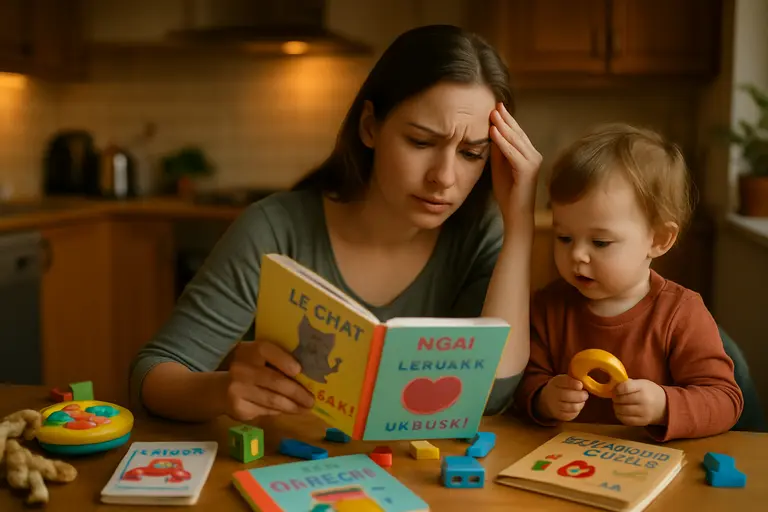
Family engagement depends on whether adults can understand one another well enough to make decisions for the child. If a parent cannot explain sleep changes, health concerns, behavior patterns, or language use at home, teachers may miss context. If teachers cannot explain classroom observations clearly, families may leave meetings unsure what is being recommended or why.
For dual language learners, this communication affects both learning and assessment. A child may appear quiet in an English-only classroom but be highly verbal at home. Another child may understand routines but hesitate to speak because the classroom language still feels new. Without family input in a shared language, educators may draw conclusions from an incomplete picture.
For a related discussion of family and classroom planning, see this related family guidance on the same topic.
Classroom Relationships Need More Than Translation Tools
Translation apps may help adults identify a word or send a short message. They are less reliable for building classroom relationships with toddlers and preschoolers, especially during play, conflict, toileting routines, separation from parents, or emotional distress. Young children often communicate through partial words, gestures, facial expressions, code-switching, and familiar routines. A bilingual adult can often interpret those signals in context.
Teachers also use language to extend children’s thinking. They model longer sentences, introduce new vocabulary, narrate problem-solving, and invite children to explain. If teachers are restricted from using a child’s stronger language, they may have fewer ways to connect new ideas to what the child already understands.
- For children: fewer chances to show knowledge in the strongest language may make skills look weaker than they are.
- For families: reduced bilingual communication may make it harder to share concerns, ask questions, and understand classroom expectations.
- For teachers: less flexibility may limit how they comfort, assess, and teach dual language learners during daily routines.
English-only Head Start Questions For Families
What Parents Can Ask Programs
Families do not have to wait for policy debates to ask practical questions. Parents can ask how their child’s home language is used during greetings, play, books, songs, behavior support, and family communication. They can ask whether bilingual staff are available, whether interpreters are used for meetings, and how teachers learn about the child’s language abilities at home.
Parents can also ask how the program distinguishes between second-language development and possible speech or language concerns. A bilingual child may mix languages, pause while searching for words, or understand more than they say in English. Those patterns can be part of bilingual development, though any concerns about hearing, communication, or development should be discussed with qualified professionals.
What Families Can Keep Doing At Home
Even if English-only Head Start rules were adopted, families would still be able to support the home language outside the classroom. Home language use can continue through conversation, family stories, prayers, songs, games, cooking, community events, and reading. The goal is not to create formal lessons every day. The goal is to keep the language useful, warm, and connected to people the child loves.
Families should also be careful about promises that any single language plan will guarantee academic outcomes. The research available here supports home language development as beneficial, but children vary in exposure, temperament, disability status, family circumstances, and school quality. A reasonable plan protects communication in both languages while watching the child’s real progress over time.
The proposed rule raised serious questions because dual language learners make up a large part of Head Start enrollment, and the available evidence supports bilingual and home language support rather than a forced choice between English and the family language. For young children, language policy is not abstract. It shapes who understands them, how they participate, and whether school builds on the communication they already bring from home.