Bilingual child gestures are more than cute hand movements. For many young children, pointing, showing, giving, and moving the hands during speech can offer clues about what they understand, what they are trying to say, and how they connect language with real objects and events. For bilingual children, gestures may be especially useful to observe because speech can be distributed across two languages rather than appearing evenly in one.
That does not mean gestures are a stand-alone test of language ability. They are one part of a child’s communication profile. Recent studies suggest that gestures can relate to later language growth, but findings vary by language, task, age, and the kind of gesture being measured. Parents and educators can use this research carefully: not to pressure children to perform, but to notice communication attempts and respond with meaningful words.
Why Bilingual Child Gestures Matter
Young children often communicate before they can say everything they mean. A toddler may point to a cup, hold out a toy, reach toward a caregiver, or gesture while making a sound. These actions can carry meaning even when spoken vocabulary is still limited.
What Bilingual Child Gestures Can Signal
In a Spanish-English study of bilingual Latino toddlers, researchers reported that gesture production at 18 months predicted word- and sentence-level skills at 36 months in English, even after accounting for spoken language. The study included 46 children and was published in the July–August 2025 period; deictic gestures, such as pointing, made up about 40% of gestures at 18 months, while iconic gestures made up about 1% Spanish-English toddler study.
This finding is useful, but it should be read with care. The prediction was reported for English only in that study. It should not be stretched to mean that every bilingual toddler who points more will automatically have stronger skills in both languages later. Bilingual development is shaped by many inputs, including who speaks each language, how often the child hears each language, and what kinds of interactions happen around the child.
Why Speech Alone May Miss Part Of The Picture
Many bilingual children know or hear words in more than one language. A child may understand an object name in one language, hear another word for it from a different caregiver, and still use a point or reach before saying either word. If adults count only spoken words in one language, they may miss early meaning that the child is already expressing through the body.
The strongest message about bilingual child gestures is not that they replace spoken language. Rather, gestures can show what a child is ready to communicate. A point toward a dog, a hand motion for eating, or a gesture paired with a sound can give adults a chance to respond with language that fits the moment.
What Recent Studies Can And Cannot Tell Us
Research on gestures in bilingual children is growing, but it is still specific to particular groups, ages, and tasks. That matters for families and educators because findings from one bilingual pairing may not apply perfectly to another.
Language And Task Can Change Gesture Use
A 2026 study of preschool-age Thai-English bilingual children and their mothers found that gesture use differed across native and second-language contexts. Mothers used more beat gestures when speaking English than when speaking Thai, and children’s gesture rates also varied by task. Book sharing elicited more gestures than toy play or reminiscing. The researchers reported that task often mattered more than language for overall gesture frequency Thai-English gesture study.
For adults, this helps explain why a child may seem more expressive in one activity than another. A child who gestures often during a picture book may gesture less during free play. That difference does not automatically mean the child has lost a skill. The situation may simply invite different kinds of communication.
Limits Of The Evidence
The available research should not be used to make broad claims about all bilingual children. The Spanish-English toddler findings involved 46 children. The Thai-English work examined a different bilingual group and included specific tasks such as book sharing, toy play, and reminiscing. Both studies are helpful, but neither can answer every question about every language pair, family pattern, or classroom setting.
It is also possible for two children to gesture in very different ways and both be developing communication. One child may point often. Another may use fewer hand movements but rely more on eye gaze, sounds, words, or body movement. If adults have concerns about a child’s understanding, speech, social interaction, or communication progress, a qualified speech-language professional can look at the full picture across both languages.
Practical Ways Adults Can Respond
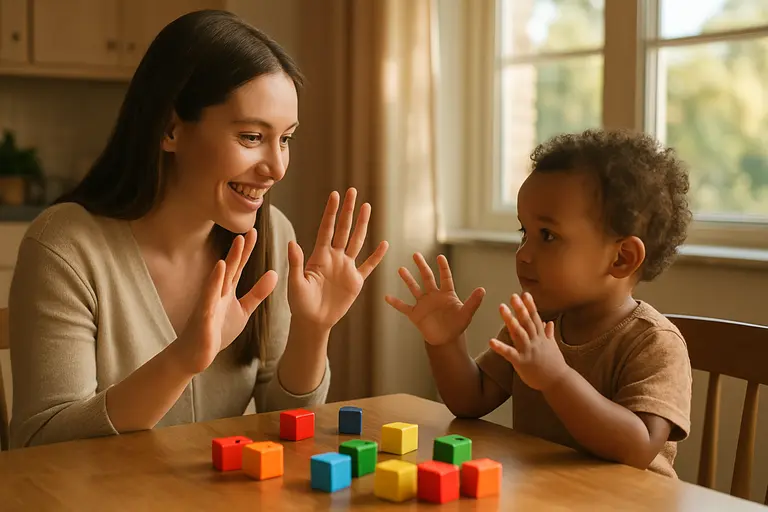
Parents and educators do not need to turn every gesture into a lesson. The goal is to make communication feel useful. When a child gestures, the adult can notice the message, say words that match it, and respond in a way that shows the gesture was understood.
Translate Gestures Into Natural Words
If a toddler points to a banana, an adult might say, “Banana. You want the banana,” then offer it if appropriate. If the child holds out a broken toy, the adult might say, “It broke. Help?” This kind of response connects the child’s action with spoken language without requiring the child to repeat the word.
For families, bilingual child gestures can be supported in either language. A parent can name the object in Spanish, English, Thai, French, or another home language, depending on the family’s natural pattern. The research does not support telling families to drop a home language in order to improve gesture or speech development. The safer takeaway is to respond clearly, warmly, and consistently in the languages the family uses.
Use Books, Play, And Daily Routines
Because research has found that gesture rates can vary by task, adults can watch which activities invite the child to communicate. Book sharing may encourage pointing to pictures, naming, page-turning, and showing. Toy play may invite giving, reaching, pretending, and requesting. Mealtime, dressing, and cleanup may create repeated chances to pair gestures with useful words.
- During book sharing: pause when the child points, name the picture, and add a short phrase.
- During play: follow the child’s gesture before adding your own words or model gesture.
- During routines: pair repeated actions with simple language, such as “shoes on” or “more water.”
- Across languages: let familiar caregivers respond in the language they naturally use best.
Families who want more examples can read about hand gestures parents use to support learning. Related educational resources in the same network are also available through our partner site, Agheiro.
Bilingual Gestures In Everyday Learning
The practical value of bilingual child gestures is that they help adults slow down and see communication as more than spoken words. A child’s point, reach, hand movement, or gesture with speech can open a small window into what the child is noticing and trying to share.
For parents, the most useful response is often simple: notice the gesture, interpret it kindly, say the matching word or phrase, and give the child time. For educators, gestures can be observed across activities instead of judged from one moment. A child who is quiet during group instruction may communicate more during shared reading, play, or a familiar routine.
Care is still needed. Gestures are informative, but they are not proof that a child will or will not have later language difficulty. They should be considered alongside speech, understanding, social communication, hearing history, language exposure, and family concerns. If a child rarely communicates needs, does not respond to familiar people or routines, loses skills, or shows ongoing difficulty understanding language, families should seek individualized guidance from a qualified professional.
Used thoughtfully, gesture observation can make adult support more responsive. It reminds us that bilingual children may show knowledge through hands, eyes, body movement, sounds, and words across more than one language. That wider view can help parents and educators build communication from what the child is already trying to say.