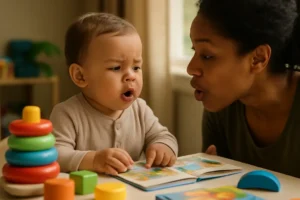
A child says something, the listener looks confused, and the conversation stalls. Communication repair in children is the skill of noticing that a message did not land and trying another way to make it understood—not simply saying the same thing louder or being corrected until every sound is perfect.
Breakdowns can happen because a message is vague, a word was missed, the room is noisy, or the listener lacks context. Children already learning about asking questions can build on those same conversational skills when they need to clarify their own message.
Misunderstandings are part of real conversation
Even strong communicators are misunderstood sometimes. A listener may miss a word, interpret a sentence differently, or lack the background information needed to follow the message. For children, these moments are especially common because speech, vocabulary, grammar, and conversational judgment are still developing together.
The useful skill is not avoiding every breakdown. It is learning what to do next. A child who can recognize confusion and try another strategy is beginning to take more responsibility for keeping the interaction going.
Adults can help by making misunderstandings specific instead of simply saying, “What?” or “Say it again.” Comments such as “I heard you say something about the park, but I missed who went with you” give the child a clearer clue about what information is missing.
This kind of support also keeps the focus on shared understanding rather than perfection. The child learns that communication can be adjusted, expanded, or clarified when needed, which makes breakdowns less frustrating and gives them more than one path toward being understood.
Communication repair in children is about fixing the message
A repair begins when one person signals, directly or indirectly, “I didn’t understand.” The child then decides what to change. Sometimes repeating works. Other times they need to slow down, emphasize a key word, add information, point, show something, or rebuild the sentence.
A preschool repair-strategy study published in 2024 examined typically developing 4- to 6-year-olds and found several repair approaches, including repetition, changes in delivery, revision, and added information. Strategy patterns also differed between online and face-to-face interaction. The practical lesson is that communication repair is a skill with more than one possible response.
That gives adults a better goal than “Say it correctly.” The question becomes, “What could help your listener understand this time?”
Teach a small repair menu before frustration starts
Children can practice a short set of options during calm conversation: repeat once, slow down, say the important word clearly, rephrase, add one detail, or point and show.
The child does not need to follow a rigid sequence. The point is to avoid getting trapped in endless repetition.
| When the listener is confused | Repair the child can try | What changes |
|---|---|---|
| A word was missed | Repeat once | Gives another listening chance |
| Speech was too fast | Slow down | Changes delivery |
| Wording was unclear | Say it differently | Revises the message |
| Context is missing | Add who, what, where, or when | Adds information |
| Words are not enough | Point, gesture, draw, or show | Adds another communication mode |
The strongest lesson is change the message when repetition fails. If the listener still looks confused after the same sentence twice, a third identical attempt may not solve the problem.
Practice breakdowns inside play
Pretend play can make repair practice low pressure. During a toy restaurant game, an adult might misunderstand one order: “You want the banana?” when the child asked for the burger. The child can repeat, point, or add a description.
Guessing games work too. The child describes an object without naming it, and the adult occasionally asks for more information. “It’s over there” might become “The blue box beside the chair.” The repair becomes part of solving the game.
Shared reading can create opportunities in the other direction. A study of preschool repair requests found that typically developing 4-year-olds requested clarification when an adult provided insufficient information during a book-sharing task. Children therefore need tools both for being misunderstood and for telling someone else, “Which one?” or “Can you say that again?”
Keep these moments believable. If an adult pretends not to understand every sentence, normal conversation quickly starts to feel like a test.
Repeat, rephrase, add, or show depending on the problem
Different breakdowns call for different repairs. If the listener simply did not hear, repetition may be enough. If they heard every word but still do not know which toy the child means, the missing ingredient is information, not volume.
Rephrasing can make a large difference. “He got it” might become “My brother took my red truck.” The second message supplies context even if the child’s speech sounds exactly the same.
Gestures, signs, pictures, showing an object, or AAC can also repair a message. Communication succeeds when shared understanding improves. The target is more than repetition.
Adults can model the same flexibility: “That sounded confusing. I’ll say it another way.” This shows children that repair is a normal part of conversation, not evidence that they failed.
Do not make every misunderstanding a speech correction
If every breakdown becomes pronunciation practice, a child may learn to repeat one word again and again rather than figure out what the listener actually needs.
Speech clarity can matter, but so can vocabulary, sentence structure, context, attention, listener familiarity, and the environment. An adult can give specific feedback: “I heard ‘park,’ but I missed the first part,” or “I know you mean a toy, but I’m not sure which one.”
Specific feedback narrows the problem. The principle is repair before correction: help the interaction succeed first, then decide whether speech or language teaching is actually needed.

Watch for flexibility across people and situations
Progress does not mean a child is never misunderstood. Look instead for a growing ability to notice confusion, stay engaged, and try something different.
A child may begin by repeating, then start adding details, changing words, or using gestures. Later, they may anticipate what an unfamiliar listener needs and give more context from the start. Research has found that children’s repair strategies become more varied with development and can change depending on the communication context.
Persistent difficulty deserves a wider look when a child is frequently misunderstood, becomes highly frustrated during ordinary communication, has broader difficulty understanding or using language, or cannot clarify messages even with support. Those patterns can be discussed with a pediatrician or speech-language pathologist.
Communication repair in children teaches something larger than recovering from “What did you say?” It teaches children that when a message fails, they have options. Repeating, revising, adding information, slowing down, pointing, showing, or requesting clarification can keep real conversations moving and make communication more resilient.
Frequently asked questions
What is communication repair in children?
Communication repair is the ability to recognize that a message was misunderstood and try another way to clarify it. A child might repeat, rephrase, add information, slow down, point, gesture, or show what they mean.
Should I ask my child to repeat themselves when I do not understand?
Repeating once can help, especially if you simply missed the message. If repetition does not work, give specific feedback and encourage a different strategy, such as adding details, rephrasing, pointing, or showing.
When should difficulty repairing communication become a concern?
Consider professional guidance when misunderstandings are frequent, create substantial frustration, or occur alongside broader difficulties understanding or using language. A pediatrician or speech-language pathologist can look at the child’s overall communication pattern.