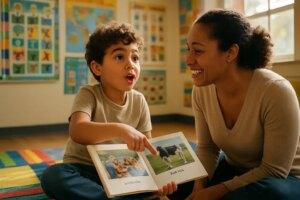
Child Self-Report is gaining attention in bilingual assessment because children can sometimes describe their own language use in ways that are practical for schools and researchers. Recent Spanish-English bilingual research does not suggest that children’s answers should replace parent report or direct language testing. It does suggest that a child’s perspective can add useful information, especially when response rates from home questionnaires are low.
For families, this can feel both encouraging and confusing. Many parents know how often a child hears Spanish or English at home, but they may not see every classroom, playground, sibling, or peer interaction. Children may notice different parts of their daily language life. The most responsible approach is to treat those perspectives as complementary, not competing.
What Child Self-Report Adds To Bilingual Assessment
Why The Child’s View Can Matter
A bilingual child’s language experience is not limited to one setting. Home, school, relatives, media, books, and peer conversations can all shape how much a child hears and uses each language. Parent report remains valuable, but it may not fully capture what happens outside the parent’s view.
A study published on September 2, 2026 examined parent and child reports in 489 Spanish-English bilingual children from Pre-K through third grade, with a mean age of about 7.24 years. In that study, child questionnaires had a 92.9% response rate, while parent questionnaires completed at home had a 31% response rate; correlations between child and parent reports of proficiency and experience ranged from medium to large in the reported analyses parent and child report study.
That response-rate difference is practically meaningful. It does not prove that children always report more accurately than parents. It does show that collecting the child’s perspective during a school-based process may be feasible when home forms are not returned. For teams trying to understand bilingual language experience, that matters.
What The Correlations Suggest
The 2026 study reported that parent-reported input and output predicted children’s self-reported bilingual experience with correlations of r = .39 and r = .40, respectively. These are not perfect matches. They are also not random. A cautious reading is that parent and child reports often overlap, while still capturing somewhat different information.
That distinction is helpful for practice. If a child says they use English often with friends and Spanish mostly with family, while a parent emphasizes Spanish at home, both reports may be true. The difference may point to context rather than error.
How The Houston Questionnaire Supports Child Self-Report
Child Self-Report Measures Need Structure
Young children cannot be expected to provide adult-style language histories. Their answers need developmentally appropriate questions, response formats, and administration procedures. That is why structured tools matter.
The Houston Questionnaire, developed in 2022, was studied with 113 Spanish-English bilingual children ages 4 to 8. The measure yielded three distinct but related factors: self-perception of Spanish proficiency, self-perception of English proficiency, and bilingual experience. The study reported strong internal reliability and significant correlations between self-ratings and behavioral assessments in both languages Houston Questionnaire validation.
Those findings support a careful point: Child Self-Report can be measured in a structured way with young bilingual children. They do not mean every informal question asked of a child will be reliable. The quality of the tool and the fit for the child’s age and language background still matter.
Proficiency And Experience Are Not The Same
One strength of the Houston Questionnaire work is that it separated self-perceived proficiency from bilingual experience. A child might feel confident speaking English but still hear Spanish frequently at home. Another child might hear both languages daily but feel less confident answering questions in one of them.
This distinction helps families avoid a common misunderstanding. A child’s comfort in one language does not automatically tell us how much exposure they receive in that language. Likewise, exposure does not guarantee equal confidence, vocabulary, or performance across tasks.
Using Parent And Child Reports Together
Look For Patterns, Not One Perfect Answer
The most useful question is not whether the parent or child is “right.” A better question is what each report reveals about the child’s language life. Parent reports may be strongest for home routines, early language history, caregiver language use, and family expectations. Children may add information about school, friends, preferences, and how they see their own ability.
The 2026 study also found that grade level predicted child self-reported proficiency: as grade increased, self-reported English proficiency increased and Spanish proficiency decreased when parent-reported proficiency was held constant. Grade level did not predict self-reported bilingual experience. This pattern suggests that children’s sense of ability may shift across grades even when reported experience does not shift in the same way.
- Ask about where each language is used, not only which language is “stronger.”
- Compare parent and child answers for settings: home, school, relatives, friends, and reading.
- Treat differences as prompts for follow-up questions rather than as automatic contradictions.
- Pair reports with direct language measures when assessment decisions matter.
- Revisit language experience over time because school demands and peer use can change.
Avoid Turning Reports Into Labels
Child Self-Report should not become a shortcut for labeling a bilingual child as proficient or not proficient. The research supports its use as one source of information, not as a stand-alone answer. This is especially relevant because bilingual language skills can vary by task. A child may tell a personal story well in Spanish, answer classroom questions more easily in English, or understand more than they choose to say in either language.
Families looking for practical home supports may also find it useful to connect language experience with everyday interaction. For example, story retelling, open-ended questions, and home-language reading can create more chances to observe how children use both languages. Related parent strategies are discussed in bilingual narrative skills resources.
Practical Questions For Families And Schools

Questions That Respect Both Languages
Children often answer more clearly when questions are concrete. Instead of asking, “Are you good at Spanish?” an adult might ask, “Who do you usually speak Spanish with?” or “Which language do you use when playing with your cousins?” These questions still depend on memory and self-awareness, but they reduce pressure to judge one language as better than the other.
For bilingual development, tone matters. Children may pick up on whether adults view one language as more valued. A supportive assessment process should invite honest answers without implying that using one language more than another is a failure.
How To Read Conflicting Answers
Differences between parent and child answers can be informative. A parent may report frequent Spanish input because adults speak Spanish at home. A child may report speaking more English because they answer siblings in English or spend most of the school day using English. Both statements can describe different sides of the same experience.
The safest interpretation is context-based. Ask who, where, when, and for what purpose. A child’s language for math instruction, playground games, bedtime stories, and grandparent conversations may not be the same. Organizations across education and workforce fields, including related sites such as Alliance Recruitment, often stress the value of matching information to the real setting; bilingual assessment benefits from the same practical habit.
Children’s Self-Report In Bilingual Assessment
A Balanced Way To Use The Evidence
The current evidence supports careful use of children’s own reports in bilingual assessment. The strongest message is not that children can fully assess themselves. It is that their answers can be gathered at high rates in some school-based research settings and can align meaningfully, though not perfectly, with parent reports and behavioral measures.
Child Self-Report works best as part of a broader picture: parent input, direct language tasks, teacher observations when available, and clear attention to where each language is used. Its limits are real. Young children may misunderstand questions, overestimate or underestimate ability, or answer based on recent experiences. Parent reports also have limits, especially for settings parents do not observe.
For bilingual children, that balanced view is a strength. Language experience is personal, social, and setting-specific. Listening to the child can help adults ask better questions, notice shifts across grade levels, and support both languages with more care. The goal is not to make a child prove they are bilingual in one fixed way. The goal is to understand how their two languages are actually used in daily life.