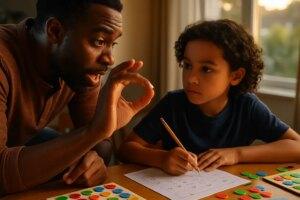
Children’s communication skills are not built by hearing words float through the room. They grow when a child asks, waits, listens, explains, disagrees, repairs a misunderstanding, tells a tiny story, and gets a real response from another person.
That is why the screen-time conversation is starting to sound less like a fight over minutes and more like a question about practice. A child can be comfortable tapping, swiping, and choosing videos, yet still need more help with waiting for a turn, answering a question, reading a face, or staying with a back-and-forth exchange. Those skills can be strengthened through daily routines, especially when parents make space for active listening games that feel playful instead of forced.
Why Children’s Communication Skills Need Daily Rehearsal
Communication is not one skill. It is a stack of small abilities that children build through repetition.
A young child has to notice another person, understand a message, choose a response, use words or gestures, wait for feedback, and adjust if the other person does not understand. That is a lot of work for a developing brain.
Children practice that work during ordinary moments: asking for a snack, cleaning up toys, telling what happened at preschool, pretending a bear is sick, or negotiating whose turn comes next. These moments may look small, but they are social language practice.
The problem is that modern family life often removes the friction that teaches communication. Adults anticipate needs before children ask. Screens soothe boredom before a child has to explain frustration. Autoplay fills quiet space before a child starts a conversation.
Children still need quiet, waiting, small conflicts, silly storytelling, and face-to-face repair. Without those moments, communication can become something adults expect children to have without giving them enough time to rehearse.
How Screens Can Crowd Out Back-and-Forth Talk
The strongest screen-time concern is not that every show is harmful. The concern is displacement.
A 2024 JAMA Pediatrics cohort study of children ages 12 to 36 months found that higher screen exposure was associated with fewer adult words, fewer child vocalizations, and fewer conversational turns. At 36 months, each additional minute of screen time was linked with fewer adult words, child vocalizations, and back-and-forth exchanges in adjusted models, giving parents a useful way to understand the risk behind the parent-child talk data.
That does not mean a screen automatically causes weak communication. It means a child who spends more time passively watching may spend less time practicing the very skills parents want to see improve.
If a tablet replaces a meltdown, a hard conversation may be avoided. If it replaces every wait, every car ride, every restaurant moment, and every boring stretch of the afternoon, the child may lose repeated chances to build patience, requesting, storytelling, and emotional language.
The Skills Children Miss When Adults Do All the Talking
Some children are quiet because they are shy, tired, overwhelmed, or still developing speech. Others are quiet because adults have become too efficient.
A parent may ask and answer at the same time. “Do you want the blue cup? Yes, you want the blue cup.” A caregiver may correct too quickly. A sibling may speak for the younger child. A busy adult may give directions but not leave space for response.
That pattern creates a home full of adult language but not enough child participation.
Children’s communication skills need real conversational turns. A turn can be a word, a gesture, a facial expression, a point, a sound, or a short answer. The adult’s job is to notice it and build on it.
Instead of asking rapid questions, parents can comment and wait. “You found the truck.” Pause. “It is stuck.” Pause. “Help?” That small pause invites the child into the exchange.
The same approach works with older children. Instead of “How was school?” followed by silence, try a more concrete opener: “Tell me one thing that was funny,” or “Who did you sit near at lunch?” Specific prompts make communication easier because the child does not have to search the whole day for an answer.
A Home Checklist for Better Communication Practice
The best communication routines are not complicated. They are small, repeatable, and tied to moments that already happen.
| Daily Situation | Communication Skill It Builds | Parent Prompt |
|---|---|---|
| Snack time | Requesting and choosing | “Do you want apple or crackers?” |
| Toy cleanup | Following directions | “Put the blocks in the box.” |
| Pretend play | Storytelling | “What is the bear doing?” |
| Family walk | Naming and commenting | “I see a big truck.” |
| Waiting turn | Patience and turn-taking | “My turn, then your turn.” |
| Bath time | Sequencing and body words | “Wash hands, then feet.” |
| Bedtime | Memory and narrative | “What happened first today?” |
The checklist works because it moves communication out of a lesson and into real life. Children do not need a special desk to practice language. They need adults who slow down enough to let them participate.
Simple Routines That Build Better Communication
Parents can start with three changes.
First, protect a few talk-heavy parts of the day. Meals, bath time, bedtime, walks, and car rides are good places to reduce passive screens because they naturally invite language. A child can choose, complain, ask, remember, notice, and respond.
Second, use fewer questions and more comments. Too many questions can make a child feel tested. Comments give language without pressure: “That tower is tall,” “Your shoes are muddy,” “The dog is loud,” or “You look frustrated.”
Third, wait longer than feels natural. Many children need extra seconds to process a question and organize a response. Adults often fill the silence too quickly. Waiting gives the child ownership of the next turn.
Parents can also model repair language: “I don’t understand yet,” “Show me,” “Try again,” “Do you mean the red one?” These phrases teach children that communication does not have to be perfect to work.
The goal is more shared attention, not constant talking. Sometimes the best language moment starts when an adult follows what the child is already doing.

When Frustration Becomes the Signal
A child who struggles to communicate may show it through behavior before words. Tantrums, grabbing, withdrawal, hitting, repeating the same demand, or refusing to answer can all be signs that communication feels too hard. The same idea appears in newer pediatric media guidance, which asks families to consider the child, content, calming habits, what media is crowding out, and ongoing communication. That media crowding-out framework is more useful than panic because it asks what screen time is replacing.
Parents should look for patterns, not isolated hard days. A tired child after a long afternoon is different from a child who consistently cannot follow simple directions, rarely responds to people, does not use gestures, loses skills, or cannot communicate basic needs.
Support may also be needed when a child avoids conversation with peers, cannot tell simple events in order, becomes very frustrated when misunderstood, or relies almost entirely on adults to speak for them.
The next pressure point for families is not whether screens exist. It is whether children still get enough daily practice with the human side of communication: listening, waiting, asking, explaining, pretending, repairing, and responding.
Children’s communication skills will not grow from perfect parenting or screen-free perfection. They grow from repeated, ordinary exchanges that give children a reason to use their voice, body, attention, and ideas. In a world full of instant digital answers, the most useful thing parents can protect is still the slow back-and-forth of real conversation.