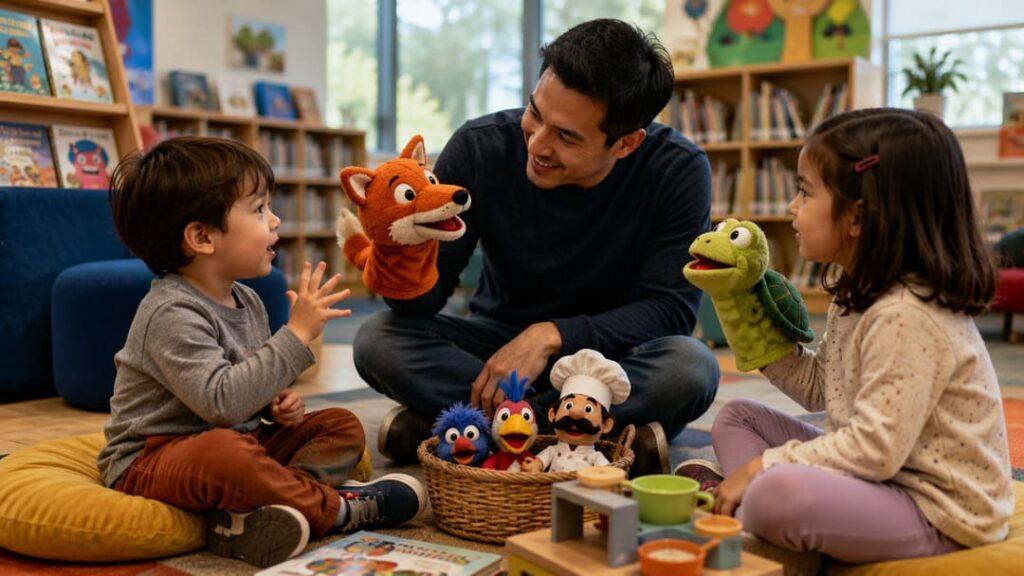
Puppets can change a conversation before either person says a word. During puppet play for language development, a child who hesitates when questioned directly may suddenly answer a silly character, correct its mistake, explain a problem, or give it instructions.
The puppet is not powerful because it teaches a scripted lesson. It works because it creates emotional distance, shared attention, and an imaginary reason to communicate. Used alongside other play-based language activities, puppet play can make vocabulary, turn-taking, feelings, and conversation feel safer and more purposeful.
Why Talking to a Puppet Can Feel Easier
Direct questions can place a child at the center of attention. Even a simple “What did you do today?” may feel demanding when an adult is watching closely and waiting for a complete answer.
A puppet redirects some of that attention. The child is no longer speaking only to the adult; they are helping a confused bear, answering a curious rabbit, or telling a forgetful dinosaur what happened. The character absorbs some of the pressure.
Puppets also give children control over distance and participation. A child can speak through the puppet, whisper an idea to it, make it nod, or use gestures before adding words. These are meaningful conversational turns, even when they do not begin as full sentences.
The character can make mistakes that invite language naturally. If a puppet puts a shoe on its head, the child has a reason to protest, explain where the shoe belongs, and tell the puppet what to do next.
Start Puppet Play for Language Development With a Simple Problem
An elaborate puppet theater is unnecessary. A sock, paper bag, stuffed animal, finger puppet, or toy figure can become a character once the adult gives it a voice and a small problem.
Begin with situations the child already understands. The puppet may be hungry, unable to find its cup, nervous about bedtime, or unsure how to build a tower. Familiar problems reduce the demand for new knowledge and leave more space for communication.
Let the puppet speak slowly and pause. “I need something to eat, but I don’t know what to choose.” Then wait for a word, look, gesture, or movement from the child. Avoid answering for the character too quickly.
The American Speech-Language-Hearing Association’s collection of speech and language activities emphasizes talking during everyday play, expanding children’s words, using pretend situations, and helping children describe familiar objects and actions.
Follow the child’s response rather than forcing the original plan. When the child gives the puppet a toy car instead of food, the puppet can say, “A car? I can drive to the store!” Unexpected ideas are openings for conversation, not mistakes that need to be redirected immediately.
Let the Puppet Depend on the Child’s Ideas
Give the puppet a problem that cannot be solved without the child’s participation. It might need help choosing clothes for the weather, finding the right tool, completing a simple routine, or deciding what to say to another character. This makes the child’s communication necessary to the play.
Keep the first response easy to enter. The child might point to an object, choose between two options, nod, or hand the puppet something it needs. The adult can then turn that action into language: “You gave the bear the spoon because it wants to eat.”
Allow the puppet to misunderstand occasionally. If the child says “under the chair,” the puppet might look beside it and wait for correction. The child now has a natural reason to repeat, clarify, or add detail without being asked to practice a sentence for its own sake.
Let the child’s solution change the direction of the scene. A puppet planning to build a house may end up making a garage, boat, or animal shelter after hearing the child’s idea. The child should see that communication has an effect on what the character does next.
End the exchange before the play becomes tiring or overly directed. A brief conversation with several genuine turns is more useful than a long performance controlled by the adult. Leave the puppet’s next problem unresolved when appropriate so the child has a reason to return later.
Five Puppet Games That Create Reasons to Talk
The strongest puppet activities give the child information, choices, or ideas the character needs. The language has a visible purpose inside the play.
| Puppet Activity | Simple Scenario | Language Opportunity |
|---|---|---|
| Confused puppet | The puppet uses an object incorrectly | Explaining, correcting, and describing |
| Puppet shop | The character wants to buy something | Requesting, choosing, and polite phrases |
| Feelings detective | The puppet describes a problem | Naming emotions and giving reasons |
| Missing object | The puppet cannot find a toy | Location words and questions |
| Story puppet | The character begins an adventure | Sequencing and imaginative language |
A confused puppet can call a spoon a brush or try to sleep inside a toy box. The child may correct the label, demonstrate the object’s function, or explain why the action does not make sense.
During a puppet shop, the child can become the cashier while the character requests food, clothing, or toys. The adult can model phrases such as “May I have the red apple?” without requiring the child to repeat them exactly.
A missing-object game encourages useful questions and spatial words. The child can tell the puppet to look under the chair, beside the box, or behind the pillow.
For story play, begin with one clear event: “The dragon found a tiny key.” Let the child decide what the key opens, who appears next, or how the problem ends. The puppet keeps the story moving by reacting rather than controlling every event.
Give Emotional Language to the Character First
Children may find it easier to discuss a puppet’s feelings than answer direct questions about their own. A puppet can feel worried about meeting someone new, disappointed when a tower falls, or angry because another character took its toy.
Begin with visible clues. Change the puppet’s posture, voice, movement, or position and ask, “What do you notice?” The child might describe the puppet as quiet, hiding, shaking, or looking down before naming an emotion.
Once the feeling has a label, explore the reason. “The rabbit feels nervous because it does not know anyone at the party.” This connects emotional vocabulary to events rather than presenting words such as happy, sad, and angry as isolated labels.
Invite the child to help. They might comfort the puppet, explain what it could say, or act out a solution with another character. This creates practice with phrases such as “Can I play?”, “Please stop,” “I need help,” and “Do you want to sit with me?”
Do not use the puppet to pressure a child into revealing personal feelings. The character can remain fictional. Emotional play should offer a doorway, not demand a confession.
Protect the Back-and-Forth Rhythm
Puppet play becomes language practice through turn-taking, not through a long adult performance. Give the character short lines and leave room for the child to influence what happens.
Harvard’s Center on the Developing Child describes responsive serve-and-return interaction as a back-and-forth exchange in which an adult notices a child’s communication and responds to it. A puppet can support that rhythm when the adult treats the child’s sound, gesture, look, or word as a meaningful contribution.
If the child says one word, expand it without making repetition a condition for continuing. When the child says “cookie,” the puppet might reply, “You found my chocolate cookie! I was looking under the table.”
Switch roles when the child is interested. Giving the child control of the puppet can encourage independent questions, pretend voices, directions, and story ideas. The adult becomes the responsive partner rather than the leader of every exchange.
Silence can also be a turn. Let the puppet wait, look curious, or offer two choices. A well-timed pause gives the child space to enter the play.
Pressure Points That Can Make the Puppet Go Quiet
Too many questions can make puppet play feel like an assessment wearing a costume. If every line asks the child to name, repeat, or explain something, the character loses its playful purpose.
Mix questions with comments, mistakes, reactions, and actions. Instead of asking, “What color is this?” the puppet might say, “I wanted the blue cup, but I picked the yellow one.” The child can respond without being placed on command.
Avoid correcting pronunciation, grammar, or word choice after every turn. Respond to the child’s meaning first, then model a fuller version naturally. A child who says “bear sad” can hear, “Yes, the bear is sad because its friend went home.”
The puppet should never be used to trick, shame, or threaten. A character that says, “Tell me or I’ll be upset,” creates pressure rather than communication. Keep problems manageable and let the child decline a role or change the story.
Watch for repeated withdrawal, attempts to leave, silence, or irritation. These may signal that the adult is performing too much, the scenario is unfamiliar, or the child needs a shorter exchange.
Let the Child Decide Where the Conversation Goes
Progress may appear in small changes: the child answers the puppet more quickly, adds a second word, asks a question, changes the story, or uses emotional language without prompting. These shifts matter more than completing a planned script.
Reuse favorite characters while changing their situations. A familiar puppet can visit a pretend doctor, make lunch, lose a mitten, prepare for school, or apologize after making a mistake. Familiarity reduces the effort of learning new rules while the language continues to grow.
Children who communicate through gestures, signs, picture symbols, communication devices, or more than one spoken language can participate fully. The puppet can wait, follow a point, respond to a symbol, or repeat a home-language word as part of the play.
Puppet play for language development succeeds when the character gives children more freedom rather than another demand to perform. The main opportunity is not making a child speak on cue. It is creating a responsive, imaginative exchange in which their words, gestures, feelings, and ideas can change what happens next.
FAQs
What age is puppet play suitable for?
Puppet play can be adapted for toddlers, preschoolers, and elementary-age children. Younger children may use gestures and single words, while older children can develop characters, negotiate problems, and create longer stories.
What should I do if my child will not talk to the puppet?
Let the child watch, move the puppet, point, or choose between two options. Avoid demanding speech. Participation may begin through actions before words become part of the exchange.
Do I need to buy professional puppets?
No. Socks, paper bags, stuffed animals, finger puppets, and ordinary toy figures can all become characters. The responsive conversation matters more than the puppet’s appearance or cost.