A child may remember every exciting part of an event and still tell it in an order no one else can follow. Story sequencing activities help turn that collection of details into a connected account by teaching children how to identify what happened first, what changed next, and how the event ended.
The goal is not to make every story sound rehearsed. It is to give children a structure they can use when explaining a routine, retelling a book, describing something that happened, or planning what to do next. Families can build that structure naturally through pictures, everyday events, and other playful sequencing activities.
Sequencing Gives a Child’s Ideas Somewhere to Go
Children often begin stories with the detail that feels most interesting rather than the event that helps the listener understand what happened. A child may announce, “The cake fell!” without explaining that someone carried it across the room, tripped over a toy, and dropped the plate.
That opening is not necessarily a memory problem. The child may remember the complete event but need support deciding which information the listener needs first.
Sequence words provide a simple framework. “First,” “next,” “then,” and “last” mark how one event connects to another. They also help children explain procedures, anticipate routines, follow directions, and describe cause and effect.
A sequence is more than the correct order of pictures. The child also needs to understand why one event comes before another and how each step changes what can happen next.
Begin Story Sequencing Activities With Familiar Routines
Daily routines are often easier to sequence than unfamiliar stories because children already understand the actions. Brushing teeth, making toast, getting dressed, washing hands, packing a school bag, and preparing for bed all have recognizable steps.
Start by completing the routine together while describing the order: “First, we turn on the water. Next, we wet our hands. Then, we use soap. Last, we dry them.” Keep the language connected to the action rather than asking the child to memorize the words separately.
Later, revisit the routine when the materials are no longer present. Ask the child to explain what happened or arrange photographs showing the main steps. This shift from doing to remembering creates a manageable narrative challenge.
The American Speech-Language-Hearing Association recommends using everyday interactions and familiar activities to strengthen preschool communication. Its guidance on building language through daily experiences includes talking through activities, expanding children’s responses, and helping them tell simple stories.
Begin with three steps if four feel difficult. A bedtime sequence might be pajamas, teeth, and bed. Once the child can organize those events, add choosing a book or turning off the light.
Move From Doing the Routine to Retelling It
Once a child can follow a familiar routine, begin shifting some of the responsibility for the sequence. Pause before each step and ask, “What comes next?” The child can answer with words, gestures, or by finding the needed object.
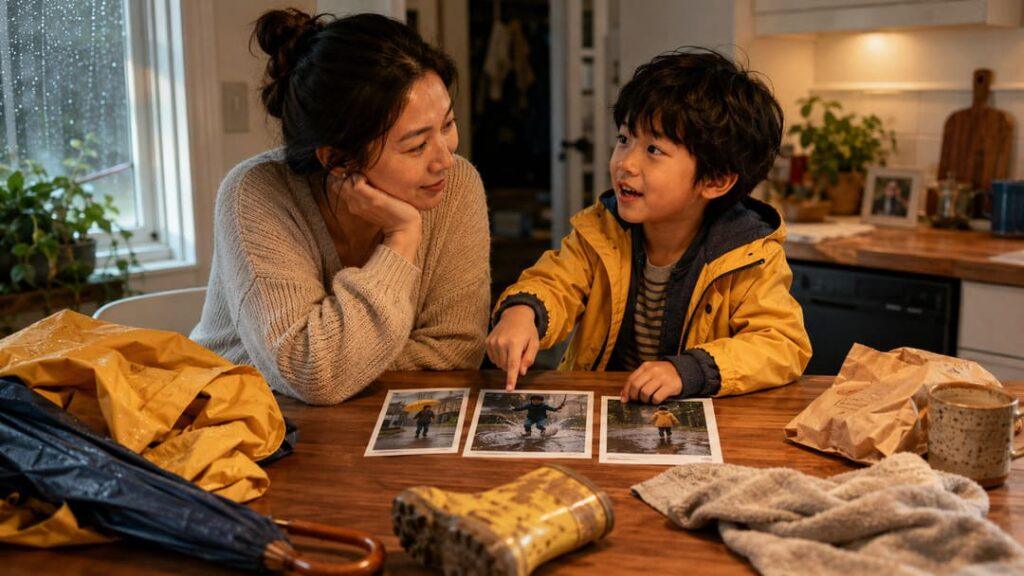
Use simple photographs when memory alone is difficult. Take one picture for each main step, mix them up, and let the child arrange them before retelling the routine. Personal images often feel more meaningful than generic sequence cards because the child recognizes the people, objects, and setting.
Change one detail after the sequence becomes familiar. Ask what would happen if toothpaste were added before opening the tube or if shoes were put on before socks. These playful mistakes encourage the child to explain why order matters rather than simply repeating a memorized list.
Invite the child to teach the routine to another person, a toy, or a puppet. Giving instructions requires the child to notice missing information and organize each step clearly enough for a listener to follow. Teaching a routine turns remembered actions into purposeful language.
Keep the retelling flexible. A child may use “after that” instead of “then” or combine two small steps into one sentence. The goal is not exact wording. It is helping the child build a sequence that another person can understand from beginning to end.
Use Pictures, Actions, and Memories for Different Challenges
Sequencing can be practiced through several formats. Each one asks the child to organize information in a slightly different way.
| Activity | Example | Main Language Demand |
|---|---|---|
| Picture sequence | Arrange images of planting a seed | Order visible events |
| Daily routine | Explain how to make a sandwich | Recall familiar steps |
| Movement sequence | Clap, jump, turn, and sit | Follow and retell actions |
| Personal event | Describe a visit to the park | Organize remembered details |
| Story retell | Explain what happened in a book | Connect characters and events |
Picture sequences make the order visible. Choose three or four clear images showing a meaningful change, such as an empty pot, soil being added, a seed being planted, and a sprout appearing. Ask the child to arrange the cards before telling the story.
Movement sequences reduce the demand for objects or printed materials. Perform three actions together, then ask, “What did we do first?” The child can repeat the movements while adding sequence words.
Personal events require more independent organization because the child must select details from memory. Use recent, familiar experiences such as baking, visiting a playground, losing a toy, or caring for a pet.
Different formats should not be treated as identical tasks. A child who orders picture cards successfully may still need support telling a personal story without visual cues.
Turn Ordered Pictures Into Connected Language
Placing cards in the correct order is only the beginning. The stronger language opportunity comes when the child explains what is happening and connects one image to the next.
Start with direct prompts: “What is happening here?” and “Which picture comes next?” Then invite a fuller retell: “Tell me the whole story from the beginning.”
Adults can model sequence words without requiring the child to repeat a fixed sentence. If the child says, “Girl got cup,” the adult might respond, “First, the girl got a cup. What did she pour into it next?”
Add language for reasons and results as the child becomes comfortable. “Then the ground became wet because it rained” explains more than “Then it rained.” Words such as because, so, before, and after help children show how events relate.
Responsive timing matters during these exchanges. Harvard’s Center on the Developing Child describes serve-and-return interaction as a back-and-forth process in which adults notice children’s communication and respond to it.
During sequencing play, that means following the child’s idea before adding language. A gesture, partial sentence, or unexpected interpretation can become the next conversational turn rather than something to correct immediately.
Give the child time to study the pictures and retrieve the words. A pause allows ideas to become organized before the adult supplies another question or answer.
Familiar Events Can Become Small Personal Stories
Personal storytelling becomes easier when adults help children identify a clear beginning, change, and ending. A trip to the playground might begin with arriving, continue with climbing and falling, and end with receiving help and returning to play.
Photographs can provide useful support. Choose a small number from one event rather than scrolling through an entire album. Ask the child to arrange them and explain what happened between the photographed moments.
Not every event needs to be told in perfect chronological detail. The aim is to help the listener understand the main experience. Adults can ask, “What does someone need to know before this part makes sense?” or “How did the problem get solved?”
Invite children to add feelings and reactions once the basic order is clear. “First, I could not find my shoe. Then, I felt worried. Last, Dad found it under the couch.” This creates a more complete account without losing the sequence.
Children may tell personal stories differently across languages and cultures. Accept the child’s home language, storytelling style, and family vocabulary. Sequence words can be modeled without suggesting that there is only one acceptable way to share an experience.
Pressure Points That Can Scramble the Story
Too many pictures can overload the task. A six-card sequence may require the child to track several characters, actions, and transitions at once. Begin with fewer events and add complexity only when the child can explain the shorter version.
Avoid correcting every grammatical error during the retell. Stopping repeatedly to repair verb tense or pronunciation can make the child lose the sequence they were trying to hold. Respond to the meaning first, then model a clearer version naturally.
Questions can also become excessive. If the adult asks who, what, where, when, and why after every card, the child may wait for prompts rather than learning to organize the story independently.
The adult should support the structure without taking ownership of it. Use a gesture toward the next picture, offer a sequence word, or repeat the child’s last idea before supplying the missing event.
Be careful with sequences that allow several logical interpretations. A coat may be put on before shoes in one family and after shoes in another. Ask the child to explain the reasoning rather than treating one familiar routine as the universal answer.
Watch for random card placement, repeated restarts, silence, or visible frustration. These signals may mean the story is unfamiliar, the images are unclear, or the child is being asked to manage too many steps.
Look for Coherence Rather Than Perfect Recall
Progress does not require an identical retell each time. Listen for a clearer beginning, fewer unexplained jumps, more independent use of sequence words, and stronger links between actions.
Children may also begin carrying the structure into daily conversation. They might explain how a toy broke, describe what happened at school, or tell another person how to play a game with less adult support.
Increase the challenge gradually. Remove one picture after the child has practiced the sequence, ask for a different ending, combine two short events, or let the child photograph and arrange a routine independently.
Story sequencing activities are most valuable when they help a child make ideas understandable to another person. The central opportunity is not memorizing “first, next, then, and last.” It is learning how order creates meaning.
When families use familiar routines, clear pictures, responsive prompts, and patient pauses, children gain a structure they can carry into stories, explanations, instructions, and everyday conversations. A well-organized story begins with events in order, but it grows when the child understands how those events belong together.
FAQs
What age can children begin story sequencing activities?
Children can begin with simple two- or three-step routines during the toddler and preschool years. Older children can organize longer picture sequences, retell personal experiences, and explain causes, feelings, and outcomes.
What should I do if a child puts the pictures in the wrong order?
Ask the child to explain the arrangement before correcting it. The sequence may reflect a reasonable interpretation. When it does not, act out the steps or discuss what must happen before the next event.
Are daily routines better than fictional stories for sequencing practice?
Daily routines are often easier starting points because children already know the actions. Fictional stories add useful challenges involving characters, motives, problems, and events that must be remembered rather than directly experienced.