Is bedtime a battle for you? You’re not alone. Almost 70% of parents deal with bedtime resistance. The tears, the requests for water, and “just one more” pleas are common.
What if a better bedtime routine could solve this? A structured storytelling routine can cut down on resistance by 40%. It turns bedtime into a calm, peaceful time.
This method tackles the reasons behind tantrums, like feeling overwhelmed or scared. It creates emotional safety with a routine. Your child feels safe and understood.
This isn’t just about sleep. It’s a blueprint for growth. In a calm setting, you improve their narrative skills and vocabulary. You turn a chaotic moment into a learning opportunity.
Small, consistent changes can change your evenings. Let’s look at how to make bedtime a peaceful, bonding time for both of you.
Why bedtime is prime time for language
Bedtime is a special time for learning new words. The calm of the evening helps your child’s brain grow. It’s a time when they can soak up new ideas easily.
As the evening routine starts, stress hormones like cortisol go down. A calm brain is ready to learn. It can pick up new words and ideas without getting distracted.
Stories at bedtime are like emotional bridges. They help kids understand feelings they can’t express. About 78% of preschoolers can’t find the right words for complex emotions. Stories give them the words they need.
The routine itself teaches important skills. Phrases like “First, we put on pajamas. Next, we brush teeth. Then, we pick a book” teach sequencing. This is a natural way to learn about order and time.
Bedtime signals to the brain that it’s time to relax. Good sleep has many benefits. It helps solidify memories and improves emotional control.
Bedtime is a special time for learning. Your child feels safe and connected. They are more open to asking questions and trying new words.
| Factor | Daytime Play | Bedtime Routine |
|---|---|---|
| Brain State | Alert, often distracted | Calm, focused, and receptive |
| Stress Level | Can be variable or high | Low (cortosterone drops) |
| Willingness to Ask Questions | May be hesitant | High due to emotional safety |
| Introduction of Sequencing Words | Occasional, unstructured | Daily, built into the routine’s steps |
| Emotional Connection | Shared but often active | Deep, quiet, and one-on-one |
Reading at bedtime is more than just a story. It’s a chance to build vocabulary and narrative skills in a loving environment. This makes bedtime a unique time for growth.
A 3‑part routine: wind‑down talk → shared book → one‑minute retell
Bedtime is a special time for language growth. It starts with a calm, predictable routine. This routine turns bedtime into a productive 20 to 45 minutes.
Studies show this order releases oxytocin, the bonding hormone. It also lowers cortisol, the stress hormone. This helps the brain learn and relax.
This is your bonding time. Find a cozy spot and talk about the day. Ask questions like, “What made you smile today?” or “What was tricky?”
It’s about processing emotions. It helps your child learn to share and understand feelings.
- Phase 2: Shared Book (15-20 minutes)
Interactive reading is next. This is where dialogic reading really comes alive. Don’t just read the words.
Ask questions, point to pictures, and connect the story to your child’s life. This makes learning fun and exposes them to new words.
- Phase 3: One-Minute Retell (5-10 minutes)
After reading, ask your child to tell you the story in one minute. Keep it fun.
This helps strengthen memory and practice storytelling. It turns listening into speaking. Every try is a success.
These steps create a powerful cycle. Wind-down talk prepares the brain. The shared book introduces new words and ideas. The quick retell reinforces learning.
The best part? This routine is adaptable. Adjust it for late nights or weekends. What’s key is keeping the sequence consistent.
Dialogic reading at night: PEER/CROWD prompts with examples
Dialogic reading is not just for school. It’s great for cozy bedtime chats too. It makes you and your child talk about the story and pictures.
It’s like a game of back-and-forth. You ask a question, and your child answers. Then, you build on their response. This way, they learn more than just listening.
Stories help kids learn about feelings. For example, asking, “Let’s find out what Luna the Rabbit does when she feels scared,” teaches them about emotions. It also helps them understand others better.
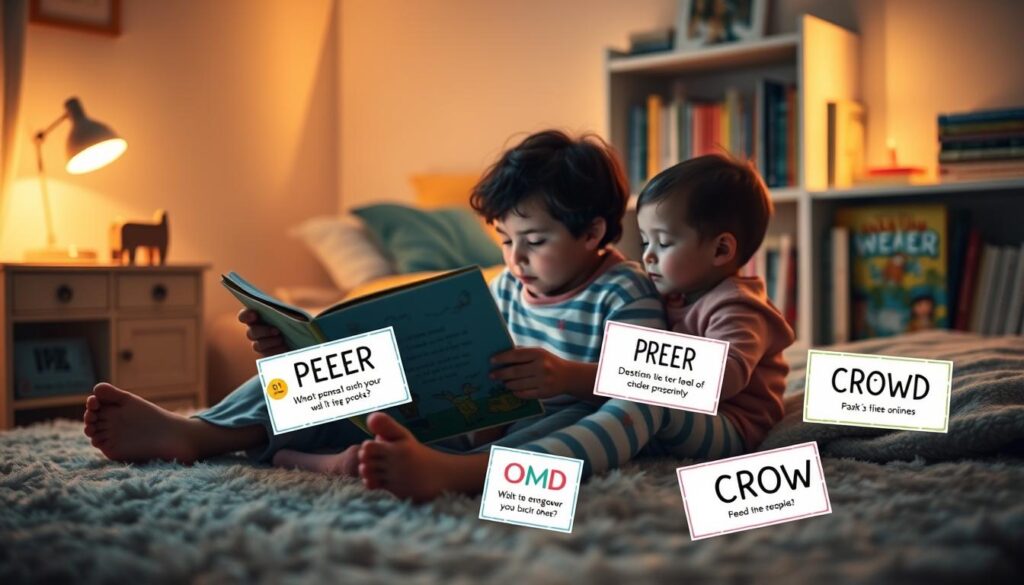
Dialogic reading uses two easy methods: PEER and CROWD. You don’t need to remember them. Just think of them as helpful guides for your conversation.
The PEER sequence is a natural way to talk. First, you Prompt your child with a question. Then, you Evaluate their answer. Next, you Expand on their answer. Lastly, you ask them to Repeat the new idea.
Here’s a quick example from a bedtime book about a bear:
- Prompt: “What is the bear doing?”
- Child: “Sleeping.”
- Evaluate & Expand: “Yes, he’s sleeping! He’s hibernating in his warm, cozy cave for the whole winter.”
- Repeat: “Can you tell me what hibernating means?”
The CROWD framework offers five types of prompts. Using just one or two makes a big difference.
| Prompt Type | What It Does | Bedtime Story Example |
|---|---|---|
| Completion | Leaves a blank for your child to fill in a rhyming or predictable word. | “The owl said, ‘Whooo goes there?’ and the little mouse said…” |
| Recall | Asks your child to remember what happened earlier in the story. | “Before the moon came out, what did the family do to get ready for bed?” |
| Open-ended | Encourages a longer answer about the pictures. | “Tell me what’s happening on this page.” |
| Wh- | Uses who, what, where, when, and why questions. | “Why do you think the blanket is so important to the character?” |
| Distancing | Connects the story to your child’s own life and experiences. | “That bear looks so cozy in his cave. What makes your bed feel cozy?” |
You don’t need to use every prompt every night. Start with one “Recall” question or a fun “Distancing” connection. This keeps the mood calm and sleepy.
This interactive talk is great for encouraging speech sounds and practice in a relaxed setting. Your gentle prompts give your child the confidence to try new words.
So tonight, try swapping one simple statement for a curious question. Watch how a single prompt can turn page-turning into a rich, language-building dialogue that ends the day on a connected note.
Choosing and rotating sleepy‑time stories (including bilingual options)
Not every book is good for bedtime. The right ones help your child relax and learn new words. A good “sleepy-time” library is key. It grows vocabulary and storytelling skills, helping your child sleep better.
The best bedtime stories have a calm pace and themes of safety and comfort. Stay away from stories with too much action or suspense.
Choose books with soothing words. Words like “cozy,” “snuggle,” and “twilight” are perfect. Repetitive phrases make the story predictable, which is comforting and helps with reading.
Illustrations should spark conversations. Ask, “What do you see on this page?” This turns looking at pictures into a joyful language moment.
Rotating your bedtime stories is a smart move. It keeps your child interested and helps them learn more words and story structures.
Keep a small collection of 5-7 books. Swap them out every week or two. This helps your child understand new vocabulary better.
| Age Group | Best Story Type | Key Features | Theme Examples |
|---|---|---|---|
| Toddlers (1-3) | Short, repetitive stories | Simple rhymes, familiar routines, sturdy pages | Goodnight rituals, animals sleeping, family love |
| Preschoolers (3-5) | Gentle nature adventures | Mild conflict resolution, descriptive language, friendship | Forest walks, helping others, magical but calm journeys |
| School-Age (5-8) | Stories with emotional depth | Character development, richer plots, themes of resilience | Overcoming fears, family histories, gentle mysteries |
Enthuastically include bilingual books in your rotation. They are a great resource. Bilingual bedtime stories celebrate family heritage and culture.
They help children think about language. Hearing the same story in two languages helps them compare sounds and words. This expands vocabulary in both languages in a comforting way.
Pair your curated library with daytime engaging language games for powerful learning. The right story, chosen with care, turns bedtime into a cornerstone for calm and communication.
Building a “story basket” with puppet, object, and rhyme card
A story basket is more than just a container. It turns reading into a fun adventure. It holds props that make learning words and stories real. By picking a few items, you make bedtime a special time for your child to grow.
Your basket needs three main things. Each one helps with different parts of learning language. Together, they make bedtime learning fun and complete.
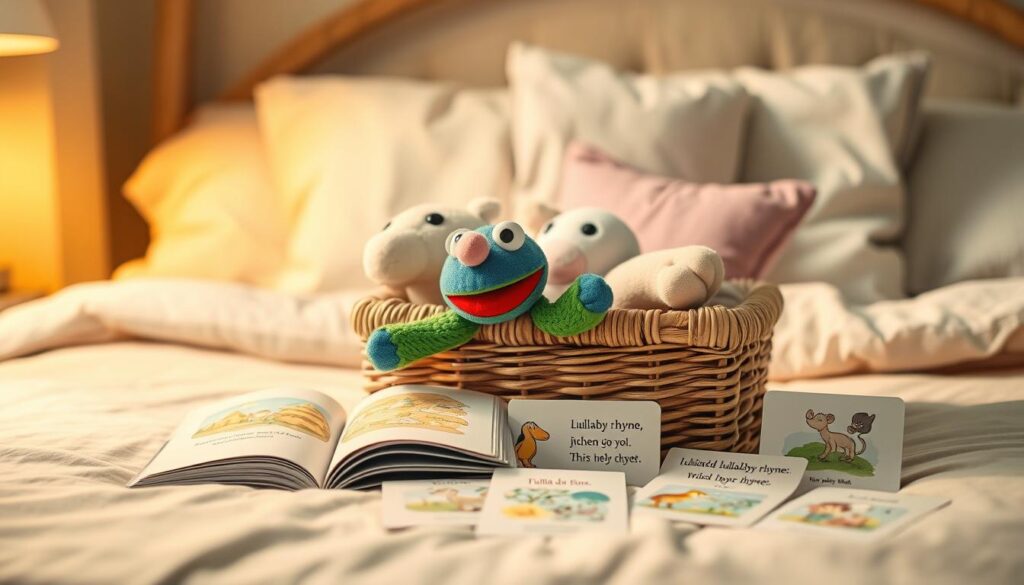
First, add a simple hand puppet. This encourages your child to talk and act out stories. They can be the puppet, asking questions or sharing feelings.
Next, include an object from your day. It could be a pinecone, a stone, or a favorite toy. This object helps your child tell stories about their day and the story.
Lastly, make a rhyme card with a familiar lullaby. This card helps with hearing sounds in words. Using it every night helps your child learn to sleep better.
| Basket Item | Primary Purpose | Language Skill Enhanced |
|---|---|---|
| Simple Puppet | Character dialogue and role-play | Expressive language, emotional vocabulary |
| Daily Object | Personal narrative connection | Descriptive language, past-tense storytelling |
| Rhyme Card | Phonological awareness and sleep cue | Sound recognition, rhythm of lullaby rhymes |
Put these items in a small basket or box. Keep it by your child’s bed. When they reach for it, it means story time is starting. This makes bedtime easier.
The puppet makes talking about stories fun. Ask your child what the puppet thinks. Let the puppet teach new words in a fun way.
The daily object connects real life to stories. If you find a feather, ask how it fits into the story. This helps your child think creatively.
The rhyme card brings comfort with its familiar rhythm. It helps your child learn about sounds and syllables. These are key for reading.
Change the items in the basket every week. Try new puppets, objects, and rhymes. This keeps bedtime exciting and magical.
Your story basket is a special tradition. It makes learning fun and strengthens your bond. Every night, you create something magical together.
Retell methods: picture walk, three‑event drawings, audio note
The final “one-minute retell” in your bedtime routine is where listening turns into active learning. Let’s explore three simple methods for the retell that feel more like play than practice. These strategies are designed to be low-pressure and to match different energy levels and personalities.
You can choose the method that fits your child’s mood any given night:
- Picture Walk: A visual recap using the book’s own art.
- Three-Event Drawings: A quick sketch showing the story’s flow.
- Audio Note: A recorded summary you make together.
The Picture Walk is perfect for kids who love the illustrations. Simply flip back through the book’s pages. Ask your child to describe what’s happening in a few pictures. Gently prompt them to use sequencing words like “first,” “then,” and “at the end.” This helps them grasp the story’s order in a natural, conversational way.
Three-Event Drawings are great for hands-on learners. Grab some paper and crayons. Ask your child to draw three quick pictures: one for the story’s beginning, one for the middle, and one for the end. The drawings don’t need to be detailed. The act of choosing what to sketch solidifies their recall of the main events.
The Audio Note is a hit with tech-curious kids. Use your phone’s voice memo app. Record a 30-second story summary together. You can start a sentence and let your child finish it. This method is fantastic for capturing their voice and language progress over time. It turns the retell into a fun, shared project.
Remember, the goal is comprehension and recall practice, not perfection. A single sentence about a favorite character or a scribbled drawing is a complete win. Celebrating any attempt builds confidence and reinforces that using language is fun. For more strategies for teaching retelling, explore resources that break down this key skill. The focus is always on making connections and using those important sequencing words to build a strong narrative foundation.
Sibling and travel adaptations for consistency
Life with kids brings challenges like sibling rivalry and schedule changes. But, your bedtime routine can adjust to fit. It’s not about keeping everything the same. It’s about keeping the core pattern of connection and talk alive, no matter where you are or who’s around.
Let’s talk about siblings first. When kids are different ages, a single storytime can be tough. The younger one might get bored, and the older one might feel like they’re being treated like a baby.
The answer is a tiered routine. It meets each child’s needs while keeping the family tradition alive.
- Younger Child First: Start with the younger sibling. Share a short, engaging picture book using your dialogic reading prompts. Then, tuck them in with a goodnight rhyme.
- Older Child’s Turn: Move to the older child’s bed. They might enjoy a chapter from a longer book, a more complex discussion about a character’s motives, or even listening to an audiobook together.
- Helper Role: Empower the older sibling by giving them a special job. They can hold the book, turn the pages for the little one, or ask a simple “CROWD” prompt like, “What do you think the bear will do next?” This builds their own narrative skills and fosters bonding.
Now, let’s talk about travel and summer vacations. These breaks can disrupt your routine. The key is to keep the sequence, not the exact schedule or setting.
If bedtime is later at Grandma’s or on vacation, that’s okay. Just adjust. What’s important is the three-part wind-down: quiet talk, shared story, and quick retell or rhyme.
This consistent sequence is your family’s routine language. It tells your child’s brain it’s time to calm down and connect, no matter where you are.
Practical travel tips help make this easier. Pack a special “travel story basket” with a favorite puppet and two beloved books. Use phone flashlights for drama if you lack a bedside lamp. For bright summer nights, blackout curtains or shades are key for a sleep-friendly environment anywhere.
| Situation | Challenge | Adaptation Strategy | Preserved Core Element |
|---|---|---|---|
| Siblings (Different Ages) | Different attention spans and comprehension levels. | Implement a tiered routine: short story for younger, then chapter for older. Involve older child as a “helper.” | The shared reading ritual and dialogic conversation. |
| Summer/Vacation Disruption | Later sunsets, unfamiliar rooms, broken schedules. | Allow a 30-45 minute time shift. Use blackout curtains. Keep the 3-part sequence (talk, story, retell) with minimal props. | The predictable “routine language” and calming sequence. |
| Travel (Hotels, Relatives) | Missing familiar books and bedtime environment. | Pack a mini “story basket.” Use digital books. Focus on oral storytelling or rhymes if books are forgotten. | The connection and vocabulary-building talk before sleep. |
Remember, it’s the pattern that matters, not the exact details. A five-minute version of your routine in a hotel room, where you recap the day’s adventure and sing a familiar song, does more for your child’s language development than skipping it entirely because it’s not perfect.
Your adaptable approach teaches a powerful lesson: communication and connection are portable, lifelong skills. By adjusting your routine to fit real life, you show your children that their words and stories matter—anytime, anywhere.
Troubleshooting Common Hurdles
Even the best plans can face challenges like wiggles, late nights, or short attention. See these as signs to adjust your approach.
For the energetic child, add movement to story time. Let them act out a character or hold a puppet. A small protein snack before bedtime can also help. Try moving dinner earlier or cutting down on screen time.
On busy nights, shorten the routine but keep it consistent. A five-minute picture walk through a favorite book can work. For late nights, aim for a consistent bedtime. Start at their natural sleep time and move it 15 minutes earlier every few nights.
Anxiety or protests are common. A “Worry Box” where children draw or voice concerns before bed can ease their minds. If they get upset, stay calm and brief. Reassure them it’s bedtime. Consistency teaches them what to expect.
Stick with your plan. The first few nights are often the toughest. This nightly practice builds vocabulary, narrative skills, and resilience to overcome challenges.