Forget about the latest productivity hacks or brain-training apps. The most powerful cognitive upgrade is right in front of us. It’s been around for centuries.
We’re not just talking about learning Spanish or Mandarin. It’s about a fundamental mental rewiring. Think of it as upgrading your child’s mind to a more advanced operating system.
A child’s brain is incredibly flexible. Those early years are perfect for learning languages. They’re also a time when the brain’s architecture gets a makeover.
This is more than just cultural enrichment. In our fast-changing world, the benefits of bilingualism in children are essential. They build cognitive strength for future challenges.
So, what’s happening in the brain? Let’s explore the science behind this powerful cognitive toolkit.
Cognitive Benefits
Most parents worry about screen time, but the real change comes when a child switches between ‘hola’ and ‘hello’. It’s not just about learning words. It’s about building a new brain structure.
Think of the bilingual brain as a personal trainer for the prefrontal cortex. Every language choice is like a workout. This constant challenge is where the magic is.
The executive function gets a big boost. This is your brain’s CEO, handling focus, impulse control, and switching tasks. Bilingual kids practice these skills every day without knowing it.
Here’s what that looks like in practical terms:
- Enhanced Mental Flexibility: Switching languages is like a chess player thinking ahead. The brain learns to switch quickly between rules.
- Superior Working Memory: Using two languages strengthens the brain’s memory. It’s like upgrading your brain’s RAM.
- Advanced Problem-Solving: Bilingual brains find creative solutions to communication challenges. They think like systems thinkers.
- Improved Attention Control: Choosing the right language trains the brain to ignore distractions.
Research shows these cognitive benefits in surprising ways. Bilingual preschoolers do better on tasks needing control. They’re better at ignoring distractions in our busy world.
The working memory advantage is fascinating. Imagine your brain as a busy kitchen. Monolingual brains have one chef. Bilingual brains have two, working together.
This coordination creates “cognitive reserve.” Bilingual brains have backup systems and alternative paths. When one path is blocked, they easily find another.
Mental flexibility is the most valuable cognitive benefit today. Bilingual kids learn that reality can be organized in many ways. This flexibility is cognitive gold.
Impulse control is another big advantage. Every time a bilingual child chooses the right word, they practice self-control. This strengthens their brain’s ability to focus.
The cognitive benefits last beyond childhood. Bilingual adults stay sharp longer. Their brains stay focused longer, like a cognitive annuity.
These advantages aren’t about being smarter. They’re about being more efficient. The bilingual brain learns to process information better.
In essence, bilingualism makes the brain more efficient. It turns the brain into a highway system, ready for any challenge. The journey to communicate becomes more capable.
This cognitive edge doesn’t need special lessons. It comes from daily practice in switching languages. The brain adapts and gets stronger.
Academic Benefits
Standardized tests are a big deal in America, and bilingual kids are ahead of the game. The numbers show it clearly. Bilingual students do better than those who speak only one language on these tests.
This isn’t just about knowing more words. It’s about being better at solving problems and understanding things. Being bilingual gives kids an unfair advantage in school subjects.
Bilingual kids are like detectives in school. They find patterns in math and understand stories in books. They see connections that others don’t.
Grades show bilingual kids do better in school. They take harder classes and get into better colleges. They do well in college too.
The key is knowing how language works. Bilingual kids learn not just Spanish or Mandarin. They learn how to learn. This helps them understand math, history, and science better.
Think of it like this. A monolingual student has a library. But a bilingual student has a librarian who knows how everything connects. This librarian helps them find and understand information.
These early skills help bilingual kids do well in school. They get better at reading, writing, and math. It’s a cycle of learning that keeps getting better.
Classrooms become places where kids can explore and solve problems. Hard topics become puzzles to figure out. This way of thinking is very valuable.
Standardized tests are now recognizing what bilingual brains have known for years. They see the skills that bilingual kids have, like thinking critically and solving problems.
So, when we talk about school success, we’re not just talking about small gains. We’re talking about a whole new way of learning. Bilingual kids aren’t just learning subjects. They’re learning how to learn itself.
Social & Emotional Advantages
In today’s world, where algorithms and echo chambers divide us, the bilingual brain is a rare social antidote. Your child is learning to understand and communicate in many ways. This is more than just ordering food in another language.
It’s about decoding the unspoken rules of different cultures. Bilingual children pick up on subtle cues and cultural references that others miss. They understand the hidden meanings behind words.
This skill builds built-in empathy. When you understand another culture’s language, you see their world differently. You learn why they value certain things and solve problems in unique ways. It’s a way to break free from the “main character syndrome” that affects our social landscape.
Bilingual kids know the world is full of stories, not just one. This understanding helps them develop enhanced interpersonal skills. They become natural mediators, connecting people across language and cultural barriers. Their social confidence grows as they belong to multiple “tribes.”
While others learn to communicate, bilingual children learn to connect. They build rapport across cultural divides. This skill is invaluable in our globalized yet fragmented society.
Research on the benefits of a bilingual brain shows that this cultural fluency helps with identity formation. Kids don’t just learn about another culture; they participate in it through language. This dual belonging makes them resilient and adaptable.
The result is a child who moves through the world with diplomatic grace. They’re comfortable with ambiguity and curious about differences. In an age of digital isolation, this social fluency is a valuable gift for the next generation.
Bilingualism & Future Success
AI can translate words, but it can’t understand the hidden meanings behind a Parisian shrug or a Tokyo boardroom agreement. This is where bilingualism shines. It’s not just about preparing for jobs; it’s about raising innovators and leaders who see the world as a bridge, not a border.
The Global Career Calculus
In today’s job market, where AI can do many tasks, what sets humans apart? It’s our ability to communicate in a way that’s rich in culture and complexity. Being bilingual sends a strong message to employers. It shows you’re more than just a language speaker.
It means you have deep thinking skills and can adapt quickly. This isn’t just about ordering coffee in two languages. It’s about closing deals, diagnosing patients, or writing policies with a sensitivity that AI can’t match.

Being bilingual gives you a clear edge. Imagine a project manager in Berlin and Boston. The monolingual manager might face more challenges. But the bilingual manager understands the cultural nuances behind feedback, preventing conflicts. That’s true leadership.
Where Bilingual Skills Pay Dividends
| Industry | Monolingual Pathway | Bilingual Advantage | Future-Proof Rating |
|---|---|---|---|
| Technology & Business | Competes in a dense local talent pool. | Leads global teams, localizes products authentically, unlocks emerging markets. | High |
| Healthcare & Medicine | Provides standard care, may use interpreter services. | Builds immediate patient trust, understands nuanced symptoms, conducts frontier research with international colleagues. | Very High |
| Diplomacy & International Relations | Limited to analyst or support roles. | Engages in direct negotiation, grasps geopolitical subtleties, becomes a cultural liaison. | Exceptional |
| Academia & Research | Accesses mainly English-language journals and conferences. | Collaborates on groundbreaking international studies, taps into untapped primary sources, attracts diverse funding. | High |
The Cognitive Endowment: Your Child’s Mental Trust Fund
The benefits of bilingualism aren’t just for work; they’re for your brain. That flexibility your bilingual toddler shows? It stays with them, growing into mental resilience.
Research shows bilingual adults may delay cognitive decline. It’s like a mental reserve. Switching languages keeps the brain sharp, making it agile and curious for life.
The Academic Fast-Pass
Bilingual students often solve problems better and understand language more deeply. They can learn more languages easily. This is great for getting into top universities.
Universities want students who can think differently and adapt. Bilingualism opens doors to special programs in law, health, and literature. It’s not just for better grades; it’s a key to the best opportunities.
So, when your kids talk in two languages, remember it’s the start of something big. It’s the foundation for a career and a brain that robots can’t match.
Research-Backed Insights
Let’s talk about a common worry. Many think two languages confuse a child’s brain. But, research shows this is not true. In fact, it’s quite the opposite.
One myth is that bilingual kids are delayed in language. But studies prove this is not true. A strong first language helps a child learn a second one easily. It’s like learning music before playing another instrument.
So, what happens in a bilingual brain? Science has the answers. MRI scans show bilingual brains are different. They have more gray matter in areas for language and thinking.
This difference means bilingual kids have better thinking skills. They are better at solving problems, thinking abstractly, and switching between tasks. These are key skills for learning and growing.
- Problem-solving: Switching between languages makes kids more agile.
- Abstract thinking: Seeing things from different angles helps kids think creatively.
- Task-switching: Using one language and then another improves focus.
These skills are essential for learning and growing. The benefits of bilingualism in children are built into their brains.
When kids start learning a second language early, they do better. They learn to speak and understand like a native. This sets up their brains for lifelong learning and thinking.
The science is clear. Bilingualism makes kids’ brains better, not worse. It’s not about confusing them; it’s about making them smarter.
Parental Support Strategies
Learning a second language is exciting, but it needs careful planning. It’s not about forcing vocabulary at every turn. Instead, it’s about making language a part of daily life, like an adventure.
Imagine teaching your child through stealth. The goal is to make learning so natural that it feels accidental. Start by changing your home’s soundtrack. Play songs in the target language instead of your usual tunes.
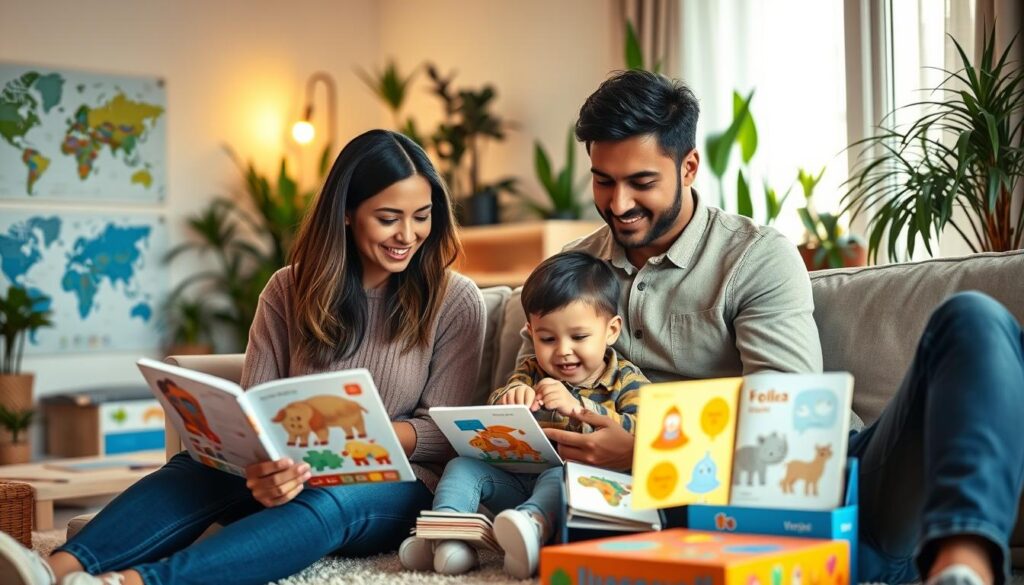
Make storytime a treasure hunt for new words. A growing library of bilingual books can help. Then, host cultural events like taco Tuesdays or movie nights in the target language.
Consistency is key. A little bit of language practice every day is better than a big session once a week. Label items in your home and use the new language for simple tasks.
But, don’t forget about school. The right educational environment is vital. Look for schools that truly embrace bilingualism, not just offer it.
Quality programs like Rayito de Sol create an immersive environment. They use the language for everything, not just lessons. This approach helps your child become fluent.
Look for programs that celebrate different cultures. A good program will make learning fun and meaningful. This way, your child will learn to communicate in a new way.
| Approach Type | Specific Tactics | Academic & Social Impact |
|---|---|---|
| Home-Based Cultural Weaving | Bilingual music playlists, labeled household items, cultural theme nights, target-language TV time, daily reading rituals. | Builds positive emotional association with language; enhances listening comprehension; fosters family social connection through shared activity. |
| Structured Program Enrollment | Full immersion preschool, dual-language elementary programs, after-school language clubs, summer cultural camps. | Provides systematic grammar and vocabulary foundation; offers peer practice; develops formal academic language skills. |
| Community & Technology Integration | Playdates with fluent families, language learning apps designed for kids, attending cultural festivals, virtual exchanges. | Creates authentic communication needs; demonstrates real-world utility; expands child’s social network. |
| Parental Modeling & Mindset | Parents learning alongside child, celebrating mistakes as progress, focusing on communication over perfection. | Reduces performance anxiety; models lifelong learning; strengthens the academic mindset. |
The table above is a guide, not a checklist. The best approach combines different strategies. Home provides love, while the right program offers structure and friends.
Your role is to create engaging experiences and support your child’s efforts. Cheer them on, even when they make mistakes. This supportive environment turns learning into fun.
See learning a language as gaining a superpower. Frame it as a way to make new friends, explore stories, and play games. When your child sees the value in learning, they will naturally pick it up.
Conclusion
Think of bilingualism as the Swiss Army knife for the modern mind. It’s a skill that sharpens thinking and opens doors. It rewires brains for greater flexibility.
The research shows bilingualism’s benefits go beyond simple tasks. It’s not just about ordering coffee in Paris or watching a telenovela. It’s about sharpening your mind.
We’ve moved past the outdated fear that two languages confuse a child. Studies show they actually improve focus, problem-solving, and even fight off mental decline. It’s not a burden but a booster rocket for academics.
Socially and emotionally, bilingualism builds empathy and cultural dexterity. Professionally, it’s a key skill in global companies like Google or Netflix. It’s not just a nice line on a resume.
So, choosing bilingual education is upgrading childhood development. It’s a long-term investment in a child’s cognitive portfolio. It pays dividends in attention, academic performance, and career prospects.
In our interconnected, noisy world, bilingualism gives you quiet confidence. The question is no longer “Is it too much?” but “Why would we settle for less?”