
A child can describe what is happening long before they can easily explain what might happen. Understanding when children use if then means looking at that shift: from talking about visible events to linking a possible condition with a consequence that has not happened yet.
“If you put the block there, then the tower might fall” asks more of a child than “The tower fell because the block moved.” The first sentence requires the child to hold one possibility in mind and connect it to another. That makes conditional language an important next step after children begin mastering words that connect ideas.
When children use if then, they are doing more than joining sentences
An “if” sentence has two connected parts. One states a condition, and the other describes what follows if that condition is met.
“If it rains, we will stay inside.”
The rain has not necessarily happened. The speaker is describing a possible situation and its consequence.
That separates conditional language from simple cause-and-effect statements such as “We stayed inside because it rained.” In the causal sentence, the event is treated as real. In the conditional sentence, the child has to think about what could happen.
“Then” can make that relationship especially clear—“If you finish your snack, then we can go outside”—but English does not require “then” in every conditional. Children therefore have to learn the relationship between the ideas, not simply memorize a fixed “if…then” formula.
Conditional language develops substantially during the preschool years
Children may begin producing individual “if” constructions relatively early, but consistent conditional thinking develops gradually.
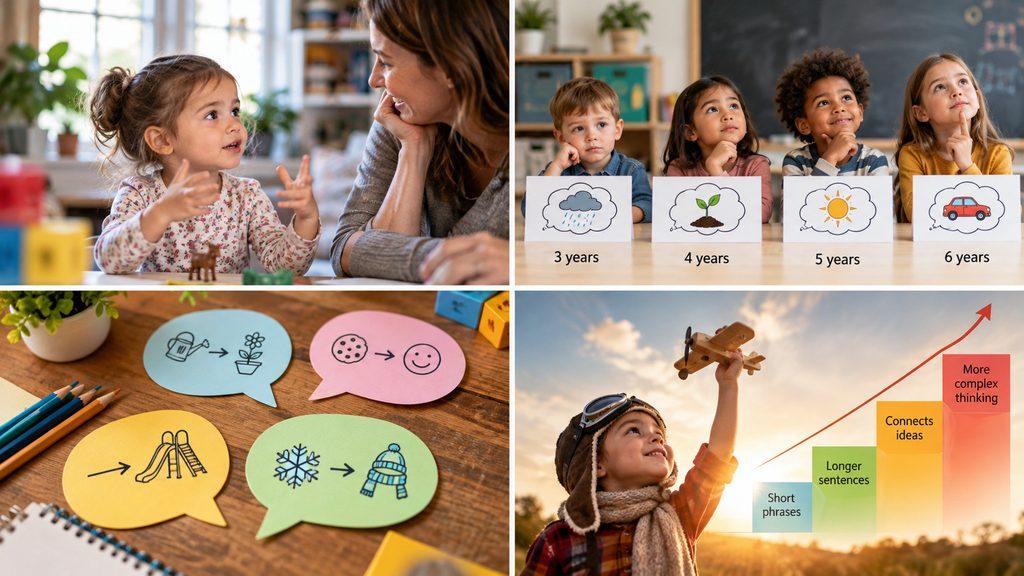
A 2026 study of children ages 3 to 6 found striking differences across the preschool years. Three- and four-year-olds rarely expressed hypothetical conditions in the experimental situations, while five- and six-year-olds were much more similar to adults in how often they communicated conditional meanings.
The new conditional-language study also found that children did not rely exclusively on explicit “if” clauses. They sometimes communicated hypothetical ideas using other sentence patterns.
That matters because a child may understand or express a conditional relationship without producing the textbook construction an adult expects.
Meaning can precede form.
Current preschool communication milestones also show that by ages 4 to 5, children are typically producing longer, more complex sentences and connecting information in stories. Conditional sentences fit into that broader growth in grammatical and conceptual complexity.
Not every cause-and-effect sentence is truly conditional
Parents hear many sentences that sound logically connected before children begin using genuine hypothetical language.
The distinction becomes clearer by comparing what each type of sentence asks the child to represent.
| Sentence type | Example | Main idea the child must connect |
|---|---|---|
| Description | “The dog is wet.” | What is happening now |
| Sequence | “We ate, then we played.” | One event followed another |
| Cause | “I cried because I fell.” | One real event caused another |
| Prediction | “It might rain later.” | Something could happen |
| Conditional | “If it rains, we will stay inside.” | One possibility depends on another |
| Counterfactual | “If it had not rained, we would have played outside.” | An alternative to what actually happened |
The last two rows are particularly demanding because the child must mentally separate reality from another possible version of events.
This is why sentence length alone is misleading. A long sentence can simply list several real events, while a shorter conditional may require more sophisticated reasoning.
Everyday “if” sentences usually begin with meaningful consequences
Conditional language is easiest to understand when the relationship matters to the child.
“If your shoes are on, we can go outside.”
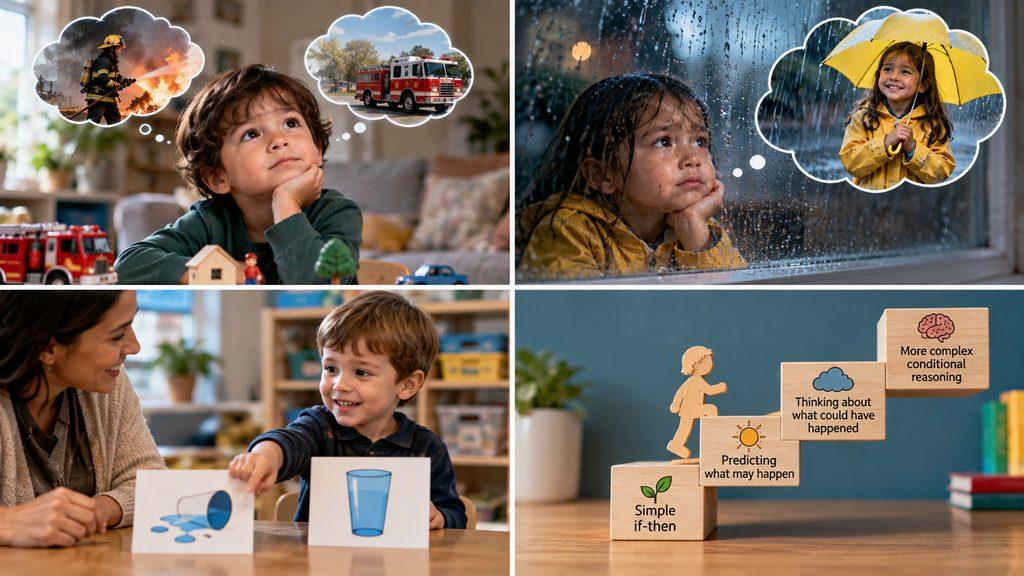
“If the cup tips over, the water will spill.”
“If we add another block, what do you think will happen?”
These statements connect a recognizable condition with a consequence the child can imagine or observe.
Adults do not need to insist that the child repeat the complete sentence. If a child responds “It falls!” after hearing “What happens if we put this block here?”, the important skill is the underlying connection. The adult can model the fuller form naturally: “Yes, if we put it there, the tower might fall.”
Play works especially well because children can test predictions immediately. Ramps, blocks, water, toy vehicles, pretend cooking, and simple board games create repeated opportunities to talk about conditions and outcomes.
The strongest examples involve real choices and possibilities, not drills built around filling in the missing word “if.”
Counterfactual sentences add another layer
Ordinary conditionals consider what may happen. Counterfactuals ask children to think about what could have happened differently.
“If I had brought my umbrella, I would not have gotten wet.”
That sentence requires the speaker to represent what actually happened—getting wet—while simultaneously imagining an alternative event in which the umbrella was present.
Research on conditional reasoning has shown that even young children can succeed on some if-then tasks when the information is presented in an accessible way. That means performance can depend heavily on the wording, context, and demands of the task.
Still, counterfactual language is generally more complex than everyday predictive statements such as “If we hurry, we can catch the bus.”
Parents should therefore expect different levels of conditional thinking rather than treating every “if” sentence as the same milestone.
Look for flexible use rather than one perfect age
Conditional language becomes more revealing when children begin using it spontaneously across different situations.
A child might predict an outcome during play, negotiate a rule with a sibling, make a promise, explain a possibility, or imagine what would happen if part of a story changed.
Parents can listen for whether the child understands the dependency between the two ideas. If the condition changes, does the expected outcome change too? Can the child explain possibilities that are not immediately visible? Can they use conditional ideas outside a memorized family phrase?
Those patterns matter more than whether “if” first appeared at 2½, 3, or 4.
If a child has broader difficulty understanding increasingly complex sentences, explaining relationships between events, following connected language, or expressing ideas across situations, parents can discuss those concerns with a speech-language pathologist.
Understanding when children use if then is ultimately about more than waiting for two small words to appear. Conditional language gives children a way to talk about plans, consequences, rules, predictions, and imagined alternatives. As that skill becomes more flexible, their language begins to represent not only the world as it is, but the different ways it could be.
Frequently asked questions
At what age do children start saying “if”?
Some children begin producing “if” constructions during the toddler or early preschool years, but consistent use varies. More sophisticated conditional meanings typically become easier to express as language and reasoning develop across the preschool period.
Does a child need to say “then” after “if”?
No. English conditionals often work without “then,” as in “If it rains, we’ll stay inside.” The important developmental skill is understanding how the condition and consequence relate, not producing both words every time.
How can parents encourage conditional language?
Use natural predictions during play and routines: “What happens if we add another block?” or “If we leave now, where can we go?” Model complete sentences without requiring the child to repeat them.