For families raising bilingual children, dual language interventions can sound like a technical school term. In practice, the question is simple: does the support help a child use and grow both languages, or does it treat the home language as separate from learning? A 2026 scoping review gives families, clinicians, and educators a clearer way to think about that question without pretending the evidence answers every case.
The review focused on young dual-language learners, ages 3 to 9, who had or were at risk of language impairment. That matters because these children may need language support that is more structured than ordinary exposure. The review analyzed 29 studies, including child-based, caregiver-based, information and communication technology-based studies, and prior reviews; 21 of the studies focused on Spanish-English dual-language learners in the United States, according to the 2026 scoping review.
What The Review Says About Dual Language Interventions
Dual Language Interventions And Transfer
The most useful insight is not that one program format works for every child. It is that language support appears stronger when it intentionally connects the child’s languages. The review found that approaches incorporating the child’s first language, or using shared features across languages such as cognates, showed consistent cross-language transfer in vocabulary, semantics, and narrative skills. That means a well-planned activity in one language may support skills that matter in the other language, especially when the connection is made clear.
By contrast, English-only support showed limited or no spontaneous transfer to the home language in the reviewed work. This does not mean English instruction is harmful by itself. It means families should be careful about assuming that English-only practice will automatically protect or strengthen the child’s other language. For a bilingual child with language needs, the home language may need direct attention too.
Why The First Language Belongs In The Plan
For parents, the review’s message is reassuring: using the home language is not a distraction from English growth. The first language can be part of the support plan, especially when adults help children connect meanings, story structure, and related words across languages. For Spanish-English learners, cognates are one clear example. A child learning words that share meaning and form across both languages may have a bridge into vocabulary growth, although the review’s Spanish-English focus means we should be cautious about applying the same idea to every language pair.
Caregiver involvement also matters in the research base. A caregiver does not need to become a therapist or teacher. A parent can support the plan by using familiar routines, asking the clinician which home-language words connect to the goal, and sharing which phrases the child already uses at home. Families who build bilingual story routines may find related support in bilingual narrative skills support, especially when the goal is story retell, vocabulary, and meaningful conversation.
How Program Evidence Should Be Read Carefully
School Programs Are Not All The Same
Intervention research and school program research answer related but different questions. A classroom dual language program may support literacy through instruction in two languages, while a language intervention may target vocabulary, grammar, semantics, or narrative skills for children with identified needs. Families often hear these terms together, but they should ask what the specific program is designed to do.
The What Works Clearinghouse reviewed 45 studies of dual language programs, and only 2 met its evidence standards. Based on 844 students, the report found moderate evidence that dual language programs had potentially positive effects on English literacy achievement compared with non-dual language programs. Effects on science and math were uncertain in the available high-standard studies, as reported in the WWC intervention report.
Potentially Positive Is Not A Guarantee
That phrase, “potentially positive,” is worth taking seriously. It supports interest in bilingual education, but it does not promise that every program will produce the same result. Program quality, teacher preparation, language allocation, student characteristics, and local implementation can all affect what children experience day to day. The evidence base also leaves open questions about outcomes beyond English literacy.
This is why families should ask specific questions rather than simply asking whether a school “has bilingual support.” Useful questions include whether the program teaches literacy in both languages, how teachers connect concepts across languages, how children with language impairment are supported, and how progress is measured in each language. These questions are not confrontational; they help families understand whether the plan matches the child’s needs.
Turning Evidence Into Daily Language Support
Use Both Languages With Clear Purpose
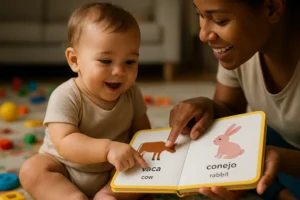
At home, the evidence points toward purposeful use of both languages rather than pressure to choose only one. If a child is practicing story language, a parent might tell a short story in the home language, then talk about the same characters, problem, and solution in English. If the child is learning vocabulary, the adult can name related words in both languages when those words are part of family life.
This does not need to become a long lesson. A five-minute conversation during breakfast, a bedtime book, or a walk to school can support language when the adult repeats useful words, expands the child’s sentence, and connects ideas. Families who use children’s books, stories, and print-rich routines may also appreciate related language and publishing resources at Leap Year Publishing, part of a related network that offers additional support materials.
Ask For Cross-Language Goals
When a child receives speech-language or school-based support, parents can ask whether goals are being considered across both languages. A goal such as “use story grammar” may look different in Spanish and English, but the larger skill can still connect. A vocabulary goal may also have related words, cognates, or category links that help the child build meaning across languages.
Well-planned dual language interventions should make these connections visible. If the professional only tracks English, families can ask how the home language will be monitored. If the professional does not speak the home language, the team may still gather caregiver input, use interpreters when available, and document functional language use at home. The evidence does not require every adult to be bilingual, but it does suggest that ignoring the home language leaves part of the child’s communication profile unseen.
Limits Of The Evidence Families Should Know

Most Evidence Focuses On Spanish-English Learners
The scoping review’s heavy focus on Spanish-English learners in the United States is both useful and limiting. It gives more direction for families in that language pair, but less certainty for children who speak Arabic, Vietnamese, Mandarin, Haitian Creole, or other home languages. Some principles may still apply, such as valuing the home language and teaching for meaning, but the exact transfer patterns can differ by language.
Families should also remember that the review focused on children ages 3 to 9 with or at risk of language impairment. Its findings should not be stretched to every bilingual child, every age, or every classroom model. Evidence can guide decisions, but a child’s hearing, development, schooling, family language patterns, and access to support all need to be considered.
Progress May Look Different Across Languages
Bilingual development is not always balanced at every point. A child may know school words in English and family words in the home language. Another child may tell longer stories in one language but use stronger vocabulary in the other. This uneven profile is not automatically a sign of disorder. For children with suspected language impairment, assessment and support should consider both languages whenever possible.
The review supports a practical stance: do not judge progress only by English gains, and do not assume the home language will maintain itself without support. For children receiving dual language interventions, progress checks should look for functional gains, such as clearer storytelling, better word learning, stronger comprehension, and more successful participation with family and peers.
Dual Language Interventions For Everyday Choices
A Practical Family Checklist
Families do not need to read every research paper to make better language decisions. They can use the main findings to guide conversations with teachers, speech-language pathologists, and program staff. The goal is not to demand a perfect model. The goal is to make sure the child’s full language life is part of the plan.
- Ask whether goals address both English and the home language, especially for vocabulary, meaning, and narrative skills.
- Share home-language examples with the professional team, including words, phrases, routines, and story topics the child already uses.
- Ask how adults will connect concepts across languages rather than presenting each language as unrelated.
- Check whether progress is measured in ways that reflect real communication, not only test performance in one language.
- Use daily routines, books, and conversation to reinforce the same ideas across languages when it feels natural for the family.
The best reading of the evidence is both hopeful and cautious. Dual language interventions that include the first language, caregiver input, and cross-language connections are better aligned with what the review found. At the same time, the research base is not equally strong for every language group, age, diagnosis, or school setting. Families deserve support that respects both sides of that truth: bilingualism is an asset, and children with language needs may require planned, evidence-informed help in both languages.