Bilingual socioemotional development is best understood as a relationship between language growth, daily interaction, and a child’s social world. Research does not support a simple claim that two languages automatically improve emotional well-being for every child. It does suggest that vocabulary, language exposure, and the ability to communicate with trusted adults and peers are meaningfully connected to early social and emotional outcomes.
For families raising dual language learners, that distinction matters. A child’s home language is not just a set of words; it is often the language of comfort, family routines, humor, discipline, storytelling, and belonging. English or another majority language may also be needed for preschool participation, peer play, and later school tasks. Supporting both, when possible, can give children more ways to understand feelings, join play, and explain what they need.
What Research Says About Bilingual Socioemotional Development
Head Start Findings From Spanish-English Learners
One useful study followed 471 Spanish-English dual language learners in Head Start, with data collected from fall 2009 through spring 2011. The children were about 41 months old on average at the start. The researchers found that Spanish receptive vocabulary and conceptual expressive vocabulary predicted later socioemotional development. Among children who already had stronger English skills, socioemotional development and Spanish receptive vocabulary showed a reciprocal relation, meaning growth in one area was linked with later growth in the other Head Start study.
That finding is especially relevant for families who worry that keeping the home language will slow social adjustment. The study does not prove that one language choice causes a specific emotional outcome for every child. Still, it supports the idea that home-language vocabulary can be part of healthy development rather than a barrier to it.
Longitudinal Evidence Across Childhood
A later analysis from the UK’s Millennium Cohort Study followed more than 15,000 children at ages 3, 5, 7, and 11 years. It reported that early bilingualism was associated with lower levels of internalizing behavior problems, such as anxiety and depression, and externalizing behavior problems, such as aggression and hyperactivity, compared with monolingual peers after accounting for child sex, socioeconomic status, and ethnicity. The reported benefits were strongest among children from low- to mid-socioeconomic-status families longitudinal UK analysis.
This does not mean bilingualism works like a shield against mental health concerns. Children can be bilingual and still experience stress, language frustration, loneliness, behavior challenges, or developmental differences. The research points to an association across a large sample, not a guarantee for an individual child.
Why Vocabulary And Emotion Skills Are Connected
Bilingual Socioemotional Development Is Not One Path
The link between vocabulary and emotional growth makes practical sense. Children need words and shared routines to label feelings, negotiate toys, follow classroom expectations, explain a conflict, and ask for help. A child who understands “I’m scared,” “my turn,” “she took it,” or “I need help” in one or both languages has more ways to participate in social life.
Research described in the notes points to patterns across several settings: stronger vocabulary in the home or heritage language and the majority language has been linked with better prosocial behavior and fewer behavior problems in preschool-aged children. Findings from Singapore, Germany, and U.S. samples also connect receptive or expressive vocabulary with social-emotional competence, prosocial behavior, emotional regulation, or effortful control. These patterns are not identical in every country or group, which is why bilingual socioemotional development should be viewed through the child’s full context.
For a preschooler, “context” includes who speaks which language, how often the child hears each language, whether adults respond warmly, whether the child has chances to play with peers, and whether teachers understand dual language development. Vocabulary alone is not the whole story. Emotional safety, responsive caregiving, and meaningful interaction are part of the same picture.
What Families Can Do Without Overreading The Evidence
Use Both Languages For Real Communication
Parents do not need to turn every conversation into a lesson. The goal is not constant correction or pressure to perform. A steadier approach is to use the languages available in the family for real communication: comfort, choices, books, songs, pretend play, meals, and problem-solving.
For example, a caregiver might label feelings in the home language during a hard moment, then use the preschool language when preparing for school routines. Another family may keep one parent’s language for daily conversation while using English for library books or community activities. The best pattern depends on the family’s actual speakers, schedules, and relationships.
- Name emotions during ordinary routines: “You look frustrated,” “Estás triste,” or the equivalent in the family language.
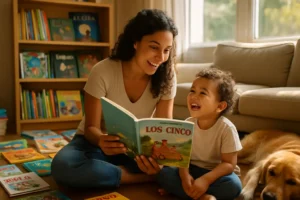
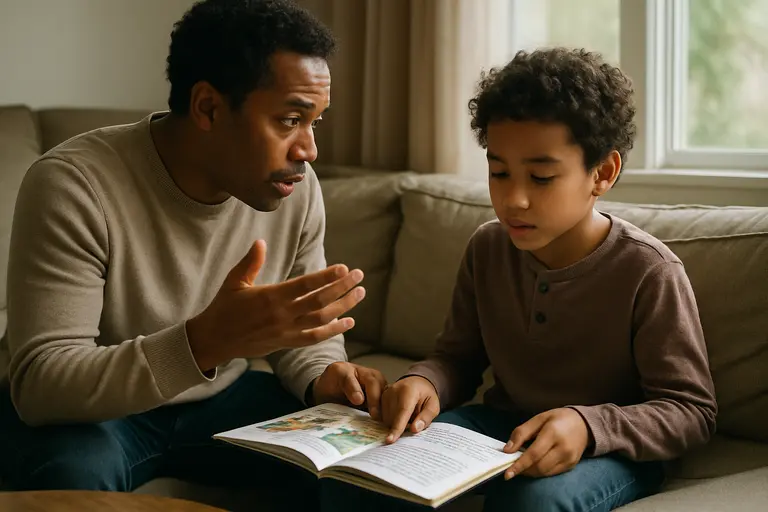
- Use storybooks to talk about what characters want, feel, believe, and do next.
- Give children words for repair: “Can I have a turn?” “I didn’t like that,” “Let’s try again.”
- Keep the home language active with relatives, songs, food routines, stories, and play.
- Share language background with teachers so they know what the child understands across languages.
Families who want more support for everyday language routines may find related ideas in bilingual vocabulary exposure, especially for connecting daily language use with early vocabulary growth. For those comparing resources on child development in interconnected projects, Agheiro offers insights as part of the broader network.
Watch Function, Not Just Word Counts
Counting words in each language can miss the point. A child may know family words, food words, emotion words, and play words in one language, while knowing school routines in another. That distribution is common for dual language learners because children learn vocabulary from the situations where they use it.
A more useful question is whether the child can communicate across daily needs. Can the child protest safely? Ask for help? Join pretend play? Understand comfort from a caregiver? Explain a basic problem to a teacher? These are the kinds of communication moments where language and socioemotional growth meet.
Limits, Mixed Findings, And Fair Expectations
Some Studies Do Not Show Simple Benefits
The evidence is encouraging but not one-sided. Research in Finland found no significant group differences in overall social-emotional development between monolingual Finnish speakers and multilingual children, although one subgroup of multilingual children whose strongest language was Finnish reported more loneliness than Finnish monolinguals. A large Quebec study found that dual language learners were more likely than French-monolingual children to be vulnerable in school readiness domains, including social competence and emotional maturity, while early childhood education and care was linked with lower risk in many domains but not emotional maturity.
Those mixed findings are not contradictions to ignore. They remind us that bilingual socioemotional development can be shaped by language status, school access, income, migration context, peer belonging, teacher support, and how assessments measure children’s skills. A child may look less skilled in one language while having stronger abilities in another. A classroom may value one language more than another. A screening tool may not fully capture what the child can do at home.
Assessment Should Consider Both Languages
If caregivers are concerned about speech, behavior, anxiety, peer play, or preschool adjustment, it is reasonable to seek guidance from a pediatrician, speech-language pathologist, early childhood specialist, or mental health professional. A fair assessment should ask about both languages, not only the majority language. It should also include caregiver input about what the child understands and expresses in familiar settings.
Bilingualism should not be blamed automatically for late talking, behavior concerns, or emotional distress. At the same time, families should not be told that every concern will resolve simply because a child is bilingual. The evidence supports careful observation, good language information, and help matched to the child’s needs.
Bilingual Socioemotional Development In Early Childhood
Support Belonging Alongside Language Growth
The strongest practical message is balanced and hopeful: language support and emotional support belong together. A child who can use a home language with family and a majority language in school may have more ways to connect, but that possibility depends on warm interaction, enough exposure, and adults who value the child’s full language background.
Parents can protect the home language without treating the majority language as an enemy. Teachers can support classroom language growth without asking families to give up the language that carries family connection. Both sides matter for bilingual socioemotional development.
For young children, progress may appear in small moments: naming a feeling in Spanish, solving a peer conflict in English, laughing with a grandparent, retelling a story with mixed vocabulary, or asking a teacher for help. These moments are not just language practice. They are part of how children learn to belong, regulate feelings, and take part in relationships.