AI story tools are quickly moving into family life. They can generate characters, invent adventures, ask questions, and adapt a story around a child’s interests in seconds.
That makes AI story apps for kids tempting for families who want more language practice. The opportunity is real, but so is the risk: a tool that produces more words is not automatically a tool that builds better communication.
AI Story Apps for Kids Are Not Ordinary Storybooks
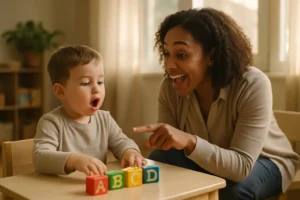
A traditional storybook is fixed. The adult and child create the interaction around it. They pause, point, laugh, predict, retell, and connect the story to real life.
An AI story app can change the story. It may ask the child what should happen next, generate a new ending, or include the child’s favorite animal, place, or superhero.
That interactivity can support motivation. A reluctant storyteller may become more interested when the story includes their own idea. A child may hear new vocabulary inside a playful context. A parent may use the app to create story prompts when they are tired or short on ideas.
Recent early childhood AI research is exploring tools that support storytelling, language learning, and assessment, including systems designed to scaffold child-AI story collaboration through co-creative storytelling.
Still, novelty is not the same as developmental value. A story app must be judged by what it invites the child and adult to do.
The Best Use Is Adult-Guided, Not Child-Alone
Young children benefit most when AI-generated stories become shared material.
The adult can ask, “What do you think will happen?” The child can choose a character. The parent can pause the app and act out the scene. The family can retell the story later without a device.
That turns the app into a prompt rather than a replacement.
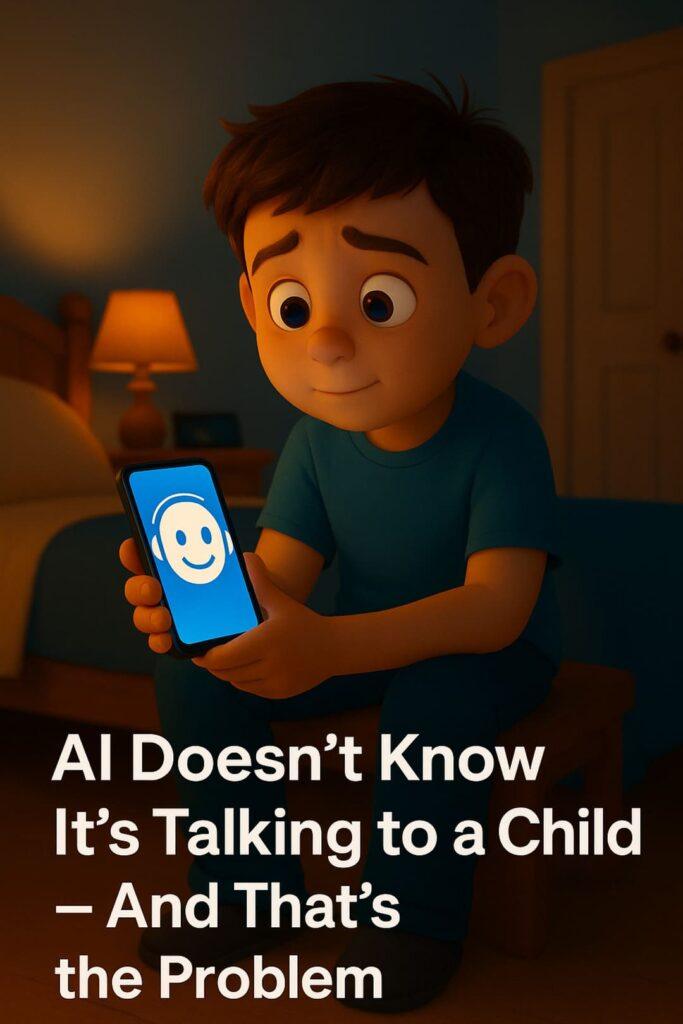
A child alone with an app may hear plenty of language, but the interaction may still be thin. The app does not know the child’s full history, emotional cues, family routines, cultural context, or speech-language needs in the way a caregiver does.
Talk and Play’s guide to speech and language apps makes the same broader distinction: digital tools are most useful when chosen carefully and used with clear purpose.
The screen should support connection, not quietly replace it.
Compare the Promise With the Pressure Points
AI story apps vary widely. Some are simple creative tools. Others include voice chat, avatars, personalization, data collection, rewards, or companion-like interaction.
| App Feature | Possible Language Benefit | Parent Question |
|---|---|---|
| Custom characters | Increases interest and participation | Does the child talk about the story afterward? |
| Story prompts | Encourages prediction and sequencing | Can adults pause and discuss ideas? |
| Voice interaction | Gives speaking practice | Is the feedback accurate and gentle? |
| Adaptive vocabulary | Introduces new words | Are words explained in real context? |
| Always-available chatbot | May invite conversation | Could the child overuse it for companionship? |
| Personalization | Makes stories feel relevant | What child data is collected or stored? |
A good app should make it easier for the child to communicate with people, not pull the child deeper into a closed loop with the device.
Safety and Privacy Are Part of Language Quality
Parents often evaluate story apps by cuteness, educational claims, or price. AI adds other questions.
What information does the app collect? Does it record a child’s voice? Can the child type or say personal details? Does the app generate unpredictable content? Are ads, purchases, or external links present? Can parents review or control interactions?
UNICEF’s updated guidance on AI and children emphasizes that AI systems should protect children’s rights, safety, privacy, fairness, and participation through child-centered AI.
Those principles matter in a language app because speech and storytelling are personal. Children may reveal names, fears, family details, locations, or emotional worries during open-ended interaction.
A language tool that ignores privacy is not a neutral educational product. It is asking children to practice communication inside a system that may not be built around their developmental needs.
AI Feedback Should Not Become a Speech Evaluation
Some apps may attempt to listen to a child’s pronunciation, vocabulary, or answers. That can be useful for practice, but parents should be cautious.
Young children’s speech is variable. Accents, bilingual development, speech sound differences, background noise, and microphone quality can affect what AI hears. A tool may misjudge a child’s word, interrupt a child who needed more time, or reward fast answers over thoughtful communication.
No app should be treated as a diagnosis.
If a child has speech, language, hearing, fluency, or developmental concerns, parents need guidance from qualified professionals. AI may someday help professionals organize practice or track progress, but it should not replace clinical evaluation.
The safest use is narrow: let the app provide story material, then let the adult provide human response.
That means noticing the child’s idea, expanding a phrase, accepting gestures, waiting through silence, and helping the child repair a message.
Signals Parents Should Monitor as AI Tools Spread
AI story apps will likely become more persuasive, more personalized, and more conversational. The pressure point is not whether families can avoid them completely. Many will not.
The better question is whether the tool strengthens or weakens the child’s real communication life.
Watch for positive signals: the child retells stories to people, asks more questions, invents characters away from the screen, uses new words in play, or invites adults into the story.
Watch for warning signs: the child prefers the app to people, becomes upset when the story does not continue, shares private information, stops choosing physical books, or uses the app mostly alone for long periods.
Parents should also monitor whether the app narrows imagination. If every story is instantly generated, children may get fewer chances to sit with uncertainty, negotiate ideas with siblings, or build a story slowly with toys.
The next wave of children’s AI will arrive with strong educational promises. Some tools may become useful supports. Others may simply automate talk without creating connection.
The best standard for AI story apps for kids is not how much the app says. It is whether the child becomes more able to share ideas, listen, imagine, question, and connect with real people after the screen is off.