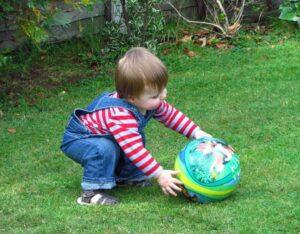
When do babies start babbling? The answer is not one birthday or one perfect “ba-ba-ba,” but a progression from soft coos to increasingly speech-like sound patterns during the first year. Understanding that progression helps caregivers enjoy early vocal play without turning every sound into a test.
Babbling matters because it connects listening, movement, attention, and social interaction. Long before a baby says a recognizable word, the mouth and voice are practicing the timing and sound combinations that spoken language will later require.
Early Sounds Already Carry a Social Purpose
Before babies produce recognizable babble, they are already learning that sounds can bring another person closer. A cry may attract help, while a softer vocalization can hold a caregiver’s attention during feeding, cuddling, or face-to-face play.
These early exchanges teach babies a basic conversational pattern. One person makes a sound, the other responds, and both pause for the next turn. The sounds may not resemble words, but the timing is already becoming social.
Caregivers support this process by responding warmly rather than trying to force a specific sound. Smiling, copying a vocalization, and waiting for another response helps babies connect their voices with attention, interaction, and shared enjoyment.
Babbling Begins Before the First Repeated Syllable
The earliest vocal stage is usually cooing. During the first few months, babies may produce comfortable vowel-like sounds such as “oo,” “ah,” or “eee,” often while looking at a familiar face or relaxing after feeding.
Cooing is different from crying because it is less tied to immediate discomfort. It often becomes part of a social exchange: the baby vocalizes, an adult responds, and the baby looks, smiles, pauses, or makes another sound.
Around the middle of the first year, vocal play becomes more varied. Babies may squeal, growl, blow raspberries, change pitch, and experiment with loudness. These sounds may seem playful rather than word-like, but they show growing control over breathing, voice, lips, and tongue.
Listening Lays the Foundation for Early Vocal Play
Babies begin learning about speech by listening long before they can copy recognizable sounds. They notice familiar voices, changes in pitch, repeated rhythms, and the difference between calm speech and an excited tone.
Face-to-face interaction gives those sounds additional meaning. A baby watches how a caregiver’s lips move, connects a voice with facial expressions, and gradually learns that vocal sounds can be part of a shared exchange.
This early listening prepares babies to experiment with their own voices. As control of the mouth, tongue, and breathing develops, quiet coos gradually expand into squeals, raspberries, consonant-like sounds, and more recognizable babbling.
When Do Babies Start Babbling in Recognizable Patterns?
Babbling often becomes more speech-like between roughly 4 and 6 months, although development varies. The ASHA communication milestones describe babies in this period as using many sounds and beginning to babble in ways that resemble speech.
The clearest shift often arrives when consonants and vowels form compact syllables such as “ba,” “ma,” “da,” or “ga.” This is sometimes called canonical babbling. The sound does not need to refer to a person or object. “Mama” may simply be enjoyable mouth practice before it becomes a meaningful name.
| Approximate Stage | Common Vocal Pattern | What Caregivers May Notice |
|---|---|---|
| Birth to 3 months | Crying, comfort sounds, early coos | Different cries, vowel-like sounds, smiles during interaction |
| 4 to 6 months | Vocal play and early babble | Squeals, raspberries, pitch changes, consonant-like sounds |
| 6 to 9 months | Canonical or repeated babbling | Clear syllables such as “bababa” or “mamama” |
| 9 to 12 months | Varied babbling and jargon-like strings | Mixed syllables, changing rhythm, gestures, attention-seeking sounds |
These age bands are guides rather than deadlines. A baby may move between patterns, repeat an older sound for weeks, or develop one feature earlier than another.
Repeated Babbling Gradually Becomes More Varied
Repeated or reduplicated babbling uses the same syllable several times: “bababa,” “dadada,” or “mamama.” It may sound like a word, but meaning depends on whether the baby uses it consistently for a person, object, or situation.
Later, many babies begin mixing syllables, producing patterns such as “bamada” or “dagabu.” This varied, or variegated, babbling demands more rapid changes in mouth position and begins to resemble the rhythm of connected speech.
Babies may also produce long strings with adult-like rises, falls, pauses, and emphasis. This is sometimes called jargon because the melody sounds conversational even when the syllables are not recognizable words. The rhythm may carry social meaning before the syllables carry vocabulary.
Babbling Is Practice, Not a Performance Score
Parents can become concerned when another baby sounds louder, uses more consonants, or appears to say “dada” earlier. Those comparisons are rarely precise because recordings capture only brief moments, and babies differ in temperament, opportunity, hearing history, and developmental pace.
A more useful question is whether the baby’s sound repertoire is expanding. Look for greater variety over time: new vowels, emerging consonants, longer strings, changing pitch, and vocalizations used to gain attention or continue an interaction.
Babbling should also be considered alongside listening, eye gaze, facial expression, gestures, and social response. The NIDCD developmental milestone guide places early sounds within this broader communication system and explains that hearing concerns can affect speech and language development.
Caregivers Can Turn Vocal Play Into Conversation
The best response to babbling is usually simple: notice it, pause, and answer. Copy one sound, smile, or add a short phrase such as, “Ba-ba! You found the ball.” Then wait long enough for the baby to respond.
This pause matters because conversation begins with turn-taking, not with correct words. Caregivers do not need to repeat every sound or demand imitation. A warm response teaches the baby that vocalizations can attract attention and keep an enjoyable exchange moving.
Face-to-face play, songs, peek-a-boo, bath routines, and shared books create natural opportunities for sound play. Follow the baby’s focus rather than constantly redirecting it. Talk about what the baby is touching, watching, or anticipating.
As babbling moves closer to first words, Talk and Play’s first words toolkit offers practical ways to connect sounds, gestures, signs, and simple spoken models without adding pressure.
Quiet Vocal Patterns Deserve Thoughtful Attention
One quiet day is not a warning sign. Babies may vocalize less when tired, unwell, distracted by a new motor skill, or adjusting to an unfamiliar environment. The pattern across weeks is more informative than one afternoon.
Caregivers should raise concerns with a pediatrician when a baby rarely responds to sound, stops using abilities already acquired, or shows little change in vocal variety over time. Loss of skills deserves prompt attention, and concerns about hearing should not be postponed simply because a baby reacts to some noises.
Babbling is only one part of early development, so evaluation considers the whole child. A pediatrician may recommend hearing screening, developmental assessment, or consultation with a speech-language pathologist when the broader pattern warrants a closer look.
When do babies start babbling? For many, speech-like babble becomes noticeable around the middle of the first year and grows into repeated and varied strings over the months that follow. The strongest signal is not a perfect timetable but steady movement toward more varied, social, and intentional communication.
FAQs
Is cooing the same as babbling?
Not exactly. Cooing usually contains open vowel-like sounds, while babbling develops more speech-like consonant-and-vowel combinations. Both stages help babies experiment with their voices and participate in early social exchanges.
Should babbling sound like real words?
No. Repeated strings such as “mamama” may be sound practice before they carry a stable meaning. A vocalization becomes more word-like when the baby uses it consistently for a particular person, object, or event.
What if my baby babbles less than other babies?
Compare patterns across several weeks rather than isolated moments. Discuss concerns with a pediatrician when vocal variety is not growing, the baby rarely responds to sounds, or previously used communication skills disappear.